Archive

Tag Archives: aviation industry

Electronic Borders SolutionsIt has been announced that the UK Border Force have awarded a contract for the upgrade and installation of electronic borders solution – eGates – to Portugese company, Vision-Box. Vision-Box have previously installed 46 first generation eGates and will now deploy a further possible 180 new, second generation gates at airports across the country.

The second generation eGates are designed to make the most of limited space in today’s airports and in particular, immigration halls. The project will help to further enhance and streamline passenger processing, improving passenger experience and effectively increasing security aspects.

Gatwick airport is the first to announce completion of the installation of 15 new generation eGates.

Haroona Franklin, Director of Border Systems Strategy & Capability said that “this deployment will represent the biggest ePassport Gate project in Europe. The new gates will allow Border Force to improve the passenger experience while maintaining security at the border and enabling the effective deployment of our resources to areas of highest priority”

Electronic border technology is a fast-growing industry that maintains critical border security while enhancing and streamlining the process to provide greater productivity, improved efficiency and passenger experience.


Aircraft Datalink SolutionsVHF coverage is now extended with a combined effort from Satcom Direct, TAG Farnborough Airport and SITA, who have based their new VHF ground station equipment in Hangar 2.

The new equipment and subsequent VHF coverage will enable the airport to provide enhanced services to operators and aircraft owners with the addition of the aircraft datalink services.

CPDLC is a growing requirement in the aviation industry, with mandatory regulations for Europe coming into play at the end of this year and the beginning of next year. Although business and private jets are exempt from the ruling, it is only a matter of time.

CPDLC (Controller Pilot Data Link Communications) give greater flexibility in the cockpit and on the ground and eliminate many previous problems that are encountered during communications. The mandates will open up better opportunities for flight operations as the airwaves become less congested. Streamlining communications with aircraft datalink is not only more efficient, but also globally recognised, without interruption, given provision from a reliable and reputable supplier.

Companies such as SITA and ARINC have global ground stations to aid the facilitation of aircraft datalink messaging.

Flight Support Services to aid Business Jet GrowthThe private jet industry is experiencing a surge as business passengers are increasingly demanding flights to far flung shores and harder-to-reach locations.  This is fuelling a requirement for longer range aircraft to help them achieve their goals.

Flight support services are backing up this new wave of long-haul business jets with satellite communications solutions that provide seamless connectivity – critical for operational productivity for both the airline and the business passenger.

While the total number of business flights decreased 0.7%, the number of long-range business flights rose by almost 19%. This was also reflected in the business jet manufacturing sector as long-range jets grew by 29% and business jet manufacture as a whole fell by 2.1% on last years’ figures.

This has been acknowledged by the president and chief executive of the NBAA, Ed Nolan, who said, “The segment of business aviation that has grown the fastest in the last five years is the ultra-long-range jets that are capable of flying halfway around the world. The Internet has helped shrink the world, and to do business in far-flung places there is still a need for face-to-face communication.”

The oil and mining industries are amongst the most prolific users of the long-range business aviation sector, but an emerging breed of business travellers are spreading their wings in terms of business opportunities in farther corners of the globe.

Many private aviation companies are benefiting from these new trends, such as VistaJet, whose owner; Thomas Flohr began leasing his own aircraft when he was not using it himself.  He believes that the routes are changing considerably, largely due to globalization.

Long-range business jets are still subject to the ETOPS rules and expanding capacity for range and routes gives the industry the boost it needed. Business aviation growth is expected to continue as executives from every corner of every industry strive to find new business from previously inaccessible or economically unreachable locations.

Beautiful New Facility for Google JetsGoogle are set to break more records as they launch their new $82 million business jet facility on a 29 acre site at San Jose airport. The airport will make approximately $3 million per year in lease income.

The facility will house the personal aircraft belonging to the Google executives and principal players, joining Hewlett Packard on the site, who have corporate hangers already in place. Google will move from a NASA-owned site, which have housed their aircraft since 2007.

The new facility will bring San Jose revenue, and will create 36 permanent jobs in addition to 370 generated direct and indirect positions.

Although this will effectively give Google its own, private airport, the facility will also grant private access to “other figures in the Silicon Valley business community as well.”

The new complex will be one of the largest corporate facilities in the world once completed and in operation, but it has not been without problems.

Earlier this year, Atlantic Aviation, who currently lease part of the development, filed legal challenges against San Jose, on the grounds that the airport did not meet Californian environmental issue requirements when granting the Google facility.  Blue City will run the facility, a partner described by San Jose as “a corporation representing the personal aircraft of the principals at Google.”

There has been ‘talk’ that Google and Blue City have received hefty discounts on fuel prices to the cool tune of more than $3 million less than the current market rate for jet fuel. The report says that another Google associate, H211 received the fuel at a considerable saving and may have ‘engendered a sense of unfairness’ amongst the business aviation community.

We know that Google executives fly ‘a lot’ and now can look forward to an exclusive facility, dedicated to their private aircraft.

Exciting Airport Applications Through TechnologyAn industry group has been founded to bring together resources and services for the planned Taoyuan aviation city project with an expected completion date of 2030.

The enormous project will be funded in a collaborative move by the government and the private sector, who expect to invest $16.7 million, making this the largest investment with the highest expectation in recent years, according to Premier Jiang Yi-huah.

The group, The Taiwan Intelligent Aerotropolis Association (TIAA) was founded last week at an official ceremony.  The President, Lee Yen-sung, who is also chairman of Chunghwa Telecom Co. said, “The association is aiming to build a national gateway with smart technologies.”

The TIAA has five groups who will focus upon technology applications, smart airport applications, regulations, information, communications technology infrastructure and promotion and must provide the government with a report next year, then a proposal within two years on the competition, cooperation and ultimately, the development of the aviation city.

Chunghwa Telecom plans build a cloud-computing centre with numerous 4G base stations.

The project is estimated to be capable of generating more than 300,000 jobs upon completion and economic benefits could top almost $67 billion for surrounding areas.

Interest is understandably high in the project, and the TIAA now has over 70 members from 21 members in October.

Logan Teleflex France has been awarded a contract for the deployment of a new baggage handling system in Warsaw Chopin International Airport.

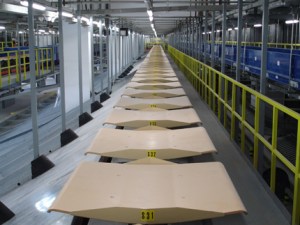
Superior Baggage Handling System ProvidersIncluding the next generation M700RF Tilt Tray Sorter, the 7.5 million Euro baggage handling system is a part of a development programme for the airport that it expected to be operational by 2015. The baggage handling system will work in conjunction with an adjacent sorter in the Terminal A complex at the airport and should be up and running by summer 2014.

Warsaw Chopin International will benefit from streamlined operations within the baggage handling system in addition to SCADA/PLC controls and the use of a Logan Sort Allocation Computer System.

The fully automated system includes an electric tip action, controlled by a radio signalling system, and will feature handling equipment with conveyors, pushers and ploughs using Logan and Daifuku technology.

An additional 29 destinations can be handled from the 48 check-in desks using the new system.

There has been a call to action from the Middle East Business Aviation Association chairman, Mr Ali Al Naqbi for business aviation operators to move their business operations to Al Maktoum Airport (DWC) from Dubai International (DXB). The move will help to ease slot shortages and timing restrictions at the busy DXB. The situation is likely to worsen in May 2014, when a runway improvement is planned and is expected to take three months.

According to Mr Al Naqbi, “When the runways close in May, they will not allow any business aviation flights at DXB.”

He commented that there are four FBO’s running from DWC and claims that the facilities for business aviators are better in terms of being able to ‘fly on demand’.

SriLankan Airlines Upgrade Passenger Processing Systems as Tourism GrowsSriLankan Airlines and Mihin Lanka have announced an upgrade to the AMADEUS Altea Suite for enhanced mission critical messaging capability as a part of the bid to become more ‘customer centric.’

The messaging system will allow the airline to manage more effectively passenger reservations, departure control and inventory processes.

Although the changeover, scheduled for 7th and 8th December will cause slight disruption, it is hoped that this will be minor and should not affect online check-in, other than the duration reduced to 24 hours.

SriLankan Airlines offices will be available by telephone throughout the changeover to deal with the redemption of air miles for FlySmiLes members between 6th and 13th December.

Once completed, the changeover will make a significant difference to passenger processing, streamlining operations and procedures, bringing passengers an enhanced travel experience.

The new system plays a major role in the expansion of SriLankan Airlines and also with the planned induction into the OneWorld Alliance in the first part of 2014.

Leading TypeB Messaging Consultancy ServicesUK-based aviation consultants, DW International have announced a new partnership with Navtech, leading in-flight operations software and services providers. The partnership agreement will provide GPS coverage information for airports and routes for the Navtech Flight Plan (NFP) customers to meet PBN guidelines and mandatory State requirements.

Bill Macey, Product Director of Flight Planning at Navtech said, “The relationship with DWI will strengthen the Navtech Flight Plan product. We are continuously motivated to provide our customers with superior quality offerings, especially when they are supported by a partnership with a reputable aviation firm like DWI. Their reliable 24/7 service, along with their initial help desk support will afford our users peace of mind.”

DW International brings technical support as an independent consultancy for aviation communications, navigations and air traffic management.

Many companies enlist the services of consultancy firms for product planning and advice in many areas of aviation.

Leading industry companies, such as ARINC, operate independent consultancy agencies calling upon combined years of experience and technical knowledge to assist the industry with messaging solutions, communications appraisals and operational activities to streamline facilities, maximising cost effective practices across the board.

Electronic Flight Bag to Reduce Weight & Improve OperationsTurkish MNG Airlines have signed a 5-year contract with Jeppesen, part of Boeing Digital Aviation, for an electronic flight bag service with iPad integration as a part of an initiative to the paper-free cockpit.

Electronic flight bag solutions enhance operational productivity with the reduction of pilot workload and paperwork and the efficiency of having essential in-flight information at the touch of a button, or at the touch of a finger with the iPad applications.

The fuel consumption aspects of flight operations can also be improved through weight reduction.

Jeppesen will deliver the flight data to airline iPads via their web-based distribution manager (JDMPro), which will ensure fast and reliable delivery of navigational and operational data, while maintaining a secure network.

Other electronic flight bag services providers, such as ARINC, bring additional services to the table with in-flight solutions for cabin services, flight planning and flight support services for an end-to-end experience.