Archive

Tag Archives: ARINC

Evolving Self-Service Kiosks

Evolving Self-Service Kiosks

In June Airport Business Magazine featured the evolution of the kiosk. As passengers come to expect technologies to make their check in process simpler companies such as ARINC have reacted to the demand to offer ever increasingly advanced solutions.Common-use self-service (CUSS) kiosks are now extensively used across Europe, but now we are seeing the next generation – kiosks that allow passengers to check-in, select their seat, print boarding passes, and print out their own baggage tags.

ARINC provides cost effective solutions for private and commercial airlines to improve efficiency and security.

In recent years common-use technology that enables multiple airlines to share computer systems at airport check-in desks and boarding gates has become well established. The next decade will see many airports and airlines moving away from PC-based applications to those hosted in cloud computing environments. The advantages of hosted services include not only lower capital outlay and greater efficiency, but also a reduction in power consumption, space requirements and IT airport costs.

ARINC will continue to exploit the benefits of common-use technology by designing new systems to meet the ever-changing demands of the industry. At the same time, the company provides a comprehensive service to enhance customers’ legacy solutions, ensuring they are CUPPS (Common-use Passenger Processing System) compliant and certified.

It is all part of the service at ARINC, which has significant experience in delivering reliable, versatile and innovative solutions to improve all airport operations, from baggage management and passenger reconciliation to terminal optimisation and automated turnaround activity.

This month we heard from ARINC, the world’s leading provider of managed IT services and support for airports and airport facilities, that the Hilton Philadelphia Airport has implemented the ARINC microFIDS(TM) flight information system to enhance customer service and revenue at its location adjacent to the Philadelphia International Airport.

ARINC microFIDS technology enables the hotel to deliver focused information to both types of guests: at-a-glance flight info for airport travelers and promotional and events-focused content for longer-term guests.

Providing on-site flight status information, the hotel makes it easy for guests to spend any delays in the comfort of the hotel rather than the airport. The addition of ARINC’s patented iSMART technology makes it easy for the hotel to add customized content and promotions that drive traffic to hotel services and increase revenue.

ARINC offers solutions to business aviation users, as well as large scale operations. In Europe ARINC Direct offers a whole host of flight planning and flight support services to business jet owners and operators. Including everything from in-flight broadband for passenger communications to mission critical messaging and other flight deck communications to fuel planning and graphical weather ARINC Direct aim to keep pricing affordable through unique pricing structures for this market. More details can be found at www.business-flight-planning.com.

ARINC Flight Information System Selected for Hilton Philadelphia Airport

ARINC Flight Information System Selected for Hilton Philadelphia Airport


Airbus has been making appearances at more aviation events than ever – 11 planned this year.

Currently at EBACE with an ACJ319 ACJ is showing off the impressive cabin to as many potential buyers as possible. The ACJ319 carries 19 passengers and has two private rooms that convert to bedrooms, one with an en-suite bathroom.

Airbus has secured 60 orders for VIP versions of its widebody airliners since the mid-1980s, and 110 narrowbodies since launching the Airbus Corporate Jet family in 1997.

The business jet market continues to perform well in most countries, despite the current economic conditions, but owners and operators are becoming increasingly conscious of economic constraints.

In order to create a more effective operation many owners and operators of business jets are turning to ARINC Direct solutions for flight planning, flight deck communications and flight support.

ARINC Direct offers unsurpassed reliability and 24/7 support to its customers who benefit from simple pricing structures. For more information please visit: www.business-flight-support.com

Airbus Corporate Jets Moves to Push Sales

Airbus Corporate Jets Moves to Push Sales

Yet again this month we heard about the on-going debate between the EU and US on passenger name records.

The agreement allows US authorities access to data collected by airlines including passenger names, addresses, credit card details and seat numbers. There are provisions in the agreement limiting the use of PNR, and individuals will have the right to access their data, to have incorrect data corrected and the right to redress under the agreement.

Passenger name records and Advance Passenger Information (API) is obligatory in the USA and all EU member states. The information must be sent to the destination country’s border security department for effective border management. Failure to supply API can land airlines with fines of up to $5,000.

For the business aviation market cost effective solutions that fully comply are a must. ARINC offers a cost effective and reliable solution, called AviSec Messaging.

AviSec offers airlines Advanced Passenger Information & Passenger Name Records (PNR) systems to allow them to comply with current regulation and implement air transport security measures.

ARINC processes 25 million messages each day – over 50% of the world’s operational Type B traffic. For more information please visit: avisec-messaging.com

AviSec Messaging - Passenger Name Records

AviSec Messaging – Passenger Name Records

.

Focus on Type B Messaging

Focus on Type B Messaging

This week I wanted to look at aviation Type B Messaging. Type B messages are kept short using a series of codes depicting the message type and contain certain application data in specific places within the message. The IATA specified standards are so efficient that the 20 million daily messages would fit on a home use memory stick.

Whilst the standard has not changed for some time, the technology we use to send Type B Messages constantly evolves. We heard this week that the latest Esterline PilotView EFB has launched a new processor and is approved for real-time ACARS messaging over VHF-based and satellite services.

For business aviation users, Type B Messaging can be a complex and expensive area of mission critical messaging. ARINC offer a unique service to calculate your Type B Messaging costs using a simple online calculator.

ARINC says: “Use our message calculator tool to gain an immediate idea of the size of your potential saving and then contact us to confirm the numbers.”

For more information please visit: www.typebcheck.com

Technology Leaps Ahead in Flight Decks

Technology Leaps Ahead in Flight Decks

This week we heard about the release of the Garmin® G5000 Flight Deck for Learjet 70 and Learjet 75. This is one of many examples of how quickly aviation technology and tools for flight planning and flight operations evolves.

The Learjet 70 and Learjet 75 aircraft cockpits feature high-resolution, wide aspect ratio displays with a multi-pane display capability. Primary flight information can be displayed to both the pilot and co-pilot along with four other viewing windows capable of showing moving maps, charts, checklists, aircraft system synoptics pages, TAWS, TCAS, flight planning information, live weather radar and other broadcast weather products.

Flight planning tools and flight deck data communications are areas that required to utmost accuracy and reliability. The current market leader in these areas is ARINC, ARINC Direct serves the business aviation community with the latest advances in technology, with unsurpassed reliability whilst being mindful of commercial constraints faced by business jet owners and operators.

For more information of the range of flight planning services available please visit:  www.business-flight-support.com

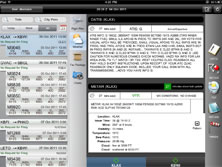
ARINC Direct Flight Planning via iPad

ARINC Direct Flight Planning via iPad

Everyday technology is increasingly seen in aviation now, and this has moved another step further ahead with ARINC’s push towards flight planning and flight operations technology being available through the iPad.

Since October ARINC have been offering parts of their service via iPad, and functionality has been increasing as pilots move away from the traditional pen and paper.

James Hardie, director of ARINC Direct’s Europe, Middle East, Africa and Asia-Pacific operation, says 50% of the roughly 2,500 subscription holders for the service have logged in with iPads in the past month.

The latest software version provides annotation capability to the iPads, allowing pilots to update certain documents during a flight and automatically send PDF versions to the operations centre or other location upon landing.

ARINC Direct offer flight planning technology to business aviation users across the world. For more information on their full range of services please visit: www.business-flight-planning.com

Electronic borders have been regularly in the news over the last few months and years so I wanted to do a focus on what they have to offer both individuals and airlines. The UK Home office wants to implement e-borders to improve border security by screening travel document information (TDI), otherwise known as Advance Passenger Information (API), on people travelling to, and from, the UK. Already routinely submitted by airlines this data can be used both for border security and has the potential to deliver improvements to migration and population statistics.

e-Borders works by taking biographical TDI (API) of passengers and crew members via their air, sea or rail carrier prior to travel either into or out of the UK. TDI is the biographical data on a travel document i.e. name, date of birth, nationality, gender, travel document type, state of issue, number and expiry date. The information is provided electronically to e-Borders by the airlines, who are legally responsible for collecting the data.

Airline Responsibility

The legal responsibilities of airline carriers are found in the migration laws and regulations of the state that grants those rights to land. All carriers must therefore be familiar with, and comply with, a wide range of legislation and regulations relating to national border control procedure and admittance.

Having effective and harmonised guidelines to deal with the communication of advance passenger information, improperly documented travellers, the denial of boarding to potential asylum-seekers, and arrangements in regard to inadmissible passengers who are in transit are important for airlines and airports to meet their obligations and provide the highest levels of customer service, as well as keep control of operational costs of staff and IT systems incurred as a result of new security requirements and mandates.

Border Management Systems

There are a wide variety of border management systems available. The ARINC Border Management System is designed to adapt to operational changes new technology, enabling quick integration with new Border Control agencies demands and requirements.

The ARINC Border Management system is a role-based system and offers a full stay management capability, managing entry and exit processes, and improving traveller flow. The system supports secondary line investigative processes, enabling immigration, customs and other agencies to co-ordinate resources for a holistic view on potential threats.

Affordability?

All airlines, but especially those in business aviation need to consider cost in addition to effectiveness.  The complete ABMS solution features an adaptable platform to protect your investment long term and the flexibility of a local, distributed, or cloud configuration. For more information please visit: www.electronicborders.com

ARINC Electronic Border Management System

ARINC Electronic Border Management System

Aviation Messaging

Aviation messaging will undoubtedly change in the future – but how can we keep current costs low whilst retaining reliable performance?

The DCIS (Data Communications Integrated Services) programme will next month reveal who will play a part in changing aviation messaging. Identified as one of the ‘foundational’ NextGen programmes, it not only improves controller productivity by automating the delivery of routine clearances but also moves the FAA towards its ultimate vision of trajectory-based operation.

The construction of NextGen will enable real-time communication between controllers and flight crews through the use of modern digital data transmissions instead of analogue voice technology, allowing aircraft to fly safer, more efficient routes and ease congestion in major metropolitan areas nationwide.

The DCIS contract will provide ground-to-ground and air-to-ground segments of the data communications system, with special attention paid to the interoperability of the data communications services and avionics.

In the meantime aviation messaging continues to be an area of substantial cost and responsibility for all aviation users, especially within business aviation where costs can be significant. Business aviation users are recommended to seek to use providers who cater especially for this market. ARINC offers business aviation one such service.

The ARINC AviNet Type B Messaging services are built on a technologically advanced platform that provides high availability and throughput; but can help business aviation users you to understand existing the Type B profile and work towards decreasing costs and simplifying infrastructure. For more information please visit: typebmessaging-avinet.com


The next generation of in-flight connectivity systems will increase onboard broadband speeds to 50mbps Inmarsat & Honeywell said this week.

Honeywell will develop the onboard hardware that will connect to Inmarsat’s Global Xpress network, made possible by the use of the Ka-band, which is found between 26.5GHz and 40GHz.

Global Xpress is scheduled for launch in 2013, with global service availability for commercial, business aviation and government customers during 2014.

The deal between Honeywell and Inmarsat is exclusive and is estimated to result in US$2.8 billion for Honeywell in sales of hardware, customer service, and maintenance to airlines, governments and OEMs over the next two decades, according to a statement.

Inmarsat already works with ARINC to provide in-flight internet through their SwiftBroadband product in the “Cabin Connect” services. Thanks to the enhanced bandwidth offered by SwiftBroadband and ARINC’s Cabin Connect, airline passengers can surf the internet, send and receive email, and use universal messaging all through their own portable electronic device, be that laptop, tablet computer eg iPad or Playbook, smart phone or portable gaming devices.

These services are currently available for business aviation users here: cabinconnect.aero.