Archive

Tag Archives: ARINC vMUSE Airport Common Use Systems

Scottish Airports Select AviNet Airport SolutionRockwell Collins have announced new five-year agreements signed with Aberdeen International Airport, Edinburgh Airport and Glasgow Airport for the installation of their ARINC vMUSE Common Use Passenger Processing System (CUPPS) with workstations throughout the airports.

The process was competitive, but Rockwell Collins was delighted to announce the news this week and is the third contract to be won in recent times. Earlier this year, they were awarded a contract in Scotland for their ARINC AviNet Airport service, with installation of common-use self-service kiosks at Aberdeen International. Glasgow Airport also signed up for the AviNet Airport service.

“This new system means that different airlines can use the same desks,” explained Andrew Mutch, Airport Head of IT. “It increases our flexibility and means that in a growing airport we can be much more reactive to demand than the previous system allowed for. As a result this will provide real benefits for our customer service provision, it will help to manage queues and deliver a more integrated product.”

“We’ve been providing airport solutions in Scotland for almost ten years,” said Michael DiGeorge, vice president of international and global airports for Rockwell Collins. “This win is another example of our commitment to invest and grow our business in Europe, the Middle East and Africa.” ”Rockwell Collins’ ARINC solutions are now being used at three of Scotland’s major airports. This contract marks yet another key milestone in our commitment to invest and grow our business in Scotland, and we look forward to a long and productive relationship with Glasgow and other airports throughout the country.”

“The Rockwell Collins solution provides Glasgow Airport with a customized and cost-effective program that meets our current requirements while being flexible enough to easily adapt to our projected growth in passenger traffic,” said Graeme Frater, CUTE Club Chairman at Glasgow Airport.

Passenger Reconciliation Systems ProvidersSao Paulo International Airport (GRU) is undergoing a big change to their passenger reconciliation system as Rockwell Collins implement its leading ARINC VeriPax system. Although the entire installation is in progress, the first phase of the project went live ahead of the 2014 World Cup tournament on June 12.

ARINC VeriPax reads boarding passes using automated security screening with 2D barcode scanners and checks passengers against flight information in real time. The system has streamlined the entire process of check-in and has already proved its worth with the attendance of elevated numbers of passengers for the World Cup tournament, speeding up the passenger screening process at security checkpoints.

“Hosting the 2014 World Cup has brought soccer fans from around the world to Brazil so we needed a solution that would provide our passengers with a better, faster check-in experience,” said chief information officer for GRU, Luiz Eduardo Ritzmann. “By automating the screening process, we believe that VeriPax has enabled us to improve GRU’s passenger flow by 15 to 20%.”

Although the ARINC VeriPax solution is utilised in some of the world’s busiest airports, and has been since 2009, GRU is the first airport in South America to use the bar-coded boarding pass gates and the VeriPax solution. The new security screening system is currently in use in the airport’s new terminal 3, but will soon go live in subsequent phases planned for terminals 1, 2 and 4.

“We’re proud to be playing a critical role in making GRU one of the most modern airports in the world in terms of passenger processing capabilities,” said staff vice president of airport systems, Information Management Services for Rockwell Collins, Michael Picco. ”This program marks yet another key milestone in our commitment to invest and grow in Brazil. We look forward to a long and productive relationship with GRU and other airports throughout the country.”

AviNet Mail Airport Messaging Service InformationIt has been announced today by Rockwell Collins that Tunisian Airline, STARS, has selected their ARINC AviNet Mail Enterprise messaging service to provide a cost-effective solution for their messaging requirements for passenger processing and cargo systems messages.

“AviNet Mail Enterprise Hub represents the next generation messaging hub for the air transport industry,” said general manager for STARS Airlines, Chemam Hichem. “With eHub serving as our messaging platform, we have migrated all of our legacy accounts to Rockwell Collins because of its cost effective solution and superior customer service.”

The ARINC AviNet eHub solution is a cloud-based service, requiring no costly internal server installation or software licensing fees and offers free local traffic routing. There are also reduced costs to the customer for infrastructure, training and individual messaging transactions. The solution brings reliable airline operational messaging with tailored plans and IATA compliance.

“eHub has been designed to meet all the IATA standards and customer interface needs, including Type B, XML SMTP, X400, Fax, SMS or even Type X,” said Alexis Hickox, senior director, Aviation Solutions for Rockwell Collins. “With eHub, we’re continuing the drive to reduce operational costs, and at the same time equipping our customers with the ability to embrace future developments in messaging.”

Other Aircraft Internet ProvidersAs the demands for aircraft internet rise amongst passengers, in-flight WiFi communications providers are beginning to see a rise in revenue with Gogo Inc reporting an increase of 35% for the first quarter of this year, amounting to $95.7 million.

“We have proven our leadership in bringing more bandwidth to any aircraft type no matter where it flies,” said Michael Small, Gogo CEO. “In addition Gogo has uniquely positioned itself as a full-service communications provider to the global aviation industry. There’s a sensational demand for connectivity on every face of the earth,” he said. “It’s not surprising that it’s the same demand in the air too.”

Business passengers have had high expectations of aircraft connectivity for some time, according to business aviation providers, ARINC Direct. Faster broadband speeds and global connections are essential for the ‘office-in-the-sky’ needs and competitiveness in the business sector is rising as more operators strive for better services for their passengers.

ARINC Solutions for Information Management & Passenger Processing Rockwell Collins have been awarded a five-year contract to place ARINC’s vMUSE in four common-use terminals at London Heathrow Airport (LHR). The contract was awarded through Heathrow AOC Ltd on the strength of Rockwell Collins’ recent acquisition of ARINC Inc. LHR will upgrade their current ARINC MUSE platform in terminals 1,2 and 3 to the latest vMUSE implementation and will install a new system in Terminal 4, supporting more than 1,500 common-use workstations.

The upgrades will bring the latest CUPPS standards, offering airlines and LHR greater efficiency and cost management opportunities. The vMUSE platform allows the extension of CUPPS support to off-site locations and is a scalable solution for baggage drop and information management systems.

“As one of the world’s busiest airports, Heathrow must utilize the most effective passenger processing technologies available,” said David P. Wilding, chairman of the AOC Shared Systems Board. “The ARINC system enables us to meet the needs of our member airlines by improving the efficiency and flexibility of passenger processing, which ultimately enables us to provide the best customer service possible.”

“We’ve been working with LHR for many years, and are delighted that the AOC has decided to renew and expand its relationship with us,” said Tony Chapman, executive director, Heathrow for Rockwell Collins’ Information Management Services business. “As passenger traffic continues to grow, we remain committed to providing airlines and airports of all sizes with the most efficient solutions available to meet passenger demands.”

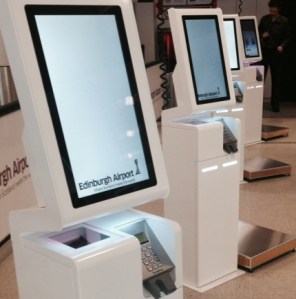
Single Bag Drop Solutions for Multi-Airline UtilisationEdinburgh airport has become the first to bring multi-airline bag drop system operation to the UK in a move that has seen them install ten, new self-service kiosks and web-based software that operates a fully common, shared bag drop facility for its passengers.

Operated by EasyJet and FlyBe, passengers will retain control of their entire check-in experience, from online check-in and self-printed boarding pass to baggage weigh in and luggage tag attachment, when they will be directed to a drop off point to dispatch their luggage.
Although new to Edinburgh and the UK, this system is in operation in CUTE platforms across the world and is designed to streamline airport operations. Using common-use functions for bag drop system operation speeds up the check-in process and allows cost-sharing within the terminal, also freeing up premium space.

This is just the beginning for Edinburgh airport, as they plan to continue a programme of investment for the installation of the latest technological solutions. Later this year, they plan to carry out a trial for a baggage storage facility, where passengers will be able to check-in luggage in advance of the flight.

David Wilson, chief operating officer at Edinburgh Airport, says: “New ownership has allowed us to be creative in the way we look at the check-in process. A huge amount of research, engagement and investment has gone into this new process and we’re delighted to officially launch the first multi-airline common bag drop facility in the UK with our partners at easyJet and Flybe.

Providers of Passenger Self Check-in Solutions & TechnologyIt has been announced that the Australian Immigration Authority will trial the use of the SmartGate passenger self check-in facility for Singaporean travellers this year, allowing them to join US and Swiss electronic passport holders in the trial. The successful SmartGate system is already in use permanently for Australian, New Zealanders and UK citizens, processing over four million passengers during 2012 and 2013.

The SmartGate system is an electronic, self check-in programme that speeds up passenger processing in eight airports across Australia and allows passengers to be expedited through passport control. The benefits have been felt particularly during peak times and busy periods.

The trial will eventually extend to further countries during 2014, with a view to rolling out the system in full force by 2018, when Australian immigration expect more than 80% of travellers to be in possession of the ePassport. The focus can then shift to monitoring for ‘high-risk’ passengers that may pose a threat to the borders.

eBorders technology is designed to bring flexibility to airport operations in order to manage secure integration with border security and government mandates, managing not only the check-in process, but careful screening and delivery of API.

Airport Operations Solutions ProvidersRaytheon, global defence contractors and Passur Aerospace, specialising in predictive analytics and business intelligence have formed an alliance to bring an enhanced perspective to airport safety and efficiency, it has been announced. The partnership will integrate Passur’s predictive analytics decision support software with Raytheon’s air traffic management systems and will work in unison with the FAA’s NextGen Terminal Flight Data Manager programme.

It is hoped that the collaboration will produce and process enhanced flight data and transmit it to air traffic positions and tower control. The information will allow airport operators and airlines to function efficiently within a seamless air traffic system, thus streamlining operations. The system will roll out with a demonstration this month at the Communications for Safety conference.

Jim McCoy, VP of Raytheon ATS said, “We are using analytics to create useful information and get it to the air traffic managers and operators who make crucial decisions regarding air traffic flow at all stages of flight. Rapid access to better information enhances safety, efficiency, and the curb-to-curb travel experience.”

“Passengers and operators are rightfully demanding a more predictable air travel experience,” said Jim Barry, PASSUR president and CEO. “Through the Raytheon/PASSUR collaboration, we achieve this objective and bring enhanced reliability to everyone involved.”

Industry Pioneering Self-Service Bag Drop Solutions OnlineMontreal Trudeau Airport has converted eight of their 17 previously manned baggage desks into self-service bag drop points in a bid to enhance passenger check-in and speed up operations within the terminal.

More passengers will now be able to make use of the common use, self-service bag drop points for multiple airlines baggage on any flight bound for the US. The airport has observed that the new system has already been adopted by almost half the passengers.

Common-use self-service bag drop points have and will continue to revolutionise airline travel worldwide, streamlining the check-in system and helping to create fluidity within the terminal space that has previously lacked the world over.

Maintaining airport security still remains a priority and the common use desks use up-to-the-minute technology to ensure all the bases are touched in this area. While many of us still check-in online and an increasing number check-in at off-site locations, the self-service bag drop desks offer airlines and airports greater use of terminal space and staff to ensure that the passenger service and experience is better than ever.

Providers of Automated Baggage Handling SolutionsSince 9/11, there is little doubt that increases in airport security and border control have swept the globe. As governments and border control agencies take technological advancements and solutions to border security into the 21st Century airports, not only have these biometric solutions improved security, but have indeed contributed to an enhanced experience for the passenger.

It is small wonder that market intelligence providers, Acuity, report that the automated border control eGate and kiosk market will generate over $1.2 billion annually by 2020. The analysts also predict that during the same year, automated border control systems will number more than 6,000 with 33,000 self-service kiosks and eGates deployed for baggage drop and check-in across all ports, including airports, land and sea.

Maxine Most, principal of Acuity Market Intelligence says, “Automated border control eGates and kiosks represent the customer-facing touch points to what promises to be a far more complex and highly interoperable 21st Century border management IT infrastructure.”

Automated border control providers can integrate the system of passenger processing and baggage handling both within the terminal and off-site, creating improved through-flow for the airport and greater efficiency, which in turn offers the passenger far greater flexibility. Common-use terminal equipment brings multiple airlines baggage and self-service check-in solutions to streamline operations, leading to cost-effective management and infrastructure.