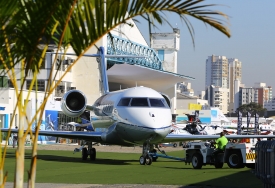
business aviation growth 13-08According to recent data, the region encompassing Latin America and the Caribbean is home to 2457 jet aircraft and 2588 turboprops, which represents almost 15% of the world’s fixed wing business turbine fleet. Mexico, with 851 and Brazil, with 824 business jets have the second and third-largest business jet fleets after the U.S. who carry a fleet of almost 12,000 altogether.

“The LAC business jet fleet growth and LAC GDP growth have been essentially expanding in tandem over the last 10 years, averaging about a 3.9-percent compound annual growth rate (CAGR)–faster than North America,” said Rolland Vincent Associates president Rolland Vincent. “The 50/50 balance between business jets and turboprops in the LAC fleet is in contrast to the worldwide jet/turboprop mix outside the region, which favors business jets by 1.5:1.”

According to Vincent, the LAC region has the highest concentration of business jets – 4.52 per 1000 High Net Worth Individuals (HNWIs), amounting to more than three times the world average of 1.44 and ahead of the U.S. at 2.87, making the LAC region ripe for business growth and an ‘attractive’ step-up market for the larger corporate jet manufacturer.

This is because, he said, that the average business jet fleet age is approximately 19 years old and 54% of the fleet is in the light jet aircraft segment. The growing number of HNWI’s in the region shows positivity in terms of the potential sales over the next 5 years as the world average age of corporate aircraft is around 16 years old.

Brazil’s business aircraft fleet expansion has been helped by the rising prominence of ‘homegrown’ Embraer, Vincent said. “The fastest-growing OEM, Embraer has established a particularly strong base and loyal following amongst LAC aircraft owners and operators, growing its fleet by 16.5-percent CAGR worldwide since 2008, and capturing more than 7-percent share of the LAC business jet fleet as of mid‐2014.”

Other SwiftBroadband SATCOM Solutions ProvidersKing Air will soon be installing its SwiftBroadband SATCOM solution with installers Cobham SATCOM receiving Supplemental Type Certificate (STC) approval from Brazilian Administración Nacional de Avianción Civil (ANAC).

King Air models B200, B200C and B300 (Super King Air 350) will receive access to an extensive range of communications abilities with built-in WiFi options.

The aircraft will receive Cobham’s AVIATOR 200, a compact, lightweight system with the reliability of SwiftBroadband, Inmarsat’s 200 service. With speeds of up to 200 kbps and a single ABME 2 channel for voice calls, the King Air aircraft will be fully connected.

Kevin Harriman, Pro Star Aviation General Manager, said, “The AVIATOR 200 is the perfect choice for King Air operators as it offers the ideal broadband and voice solution and is small and lighter than other solutions. It is practical and affordable, and, with reduced hardware and installation costs, the AVIATOR 200 is everything you need to stay connected.”

Kim Gram, Vice President Aeronautical Business Unit, Cobham SATCOM, said, “The AVIATOR 200 offers in-flight broadband communication to aircraft of virtually any size as it utilizes a low gain antenna. We are particularly pleased to add the Brazilian approval to the FAA and EASA STCs already developed with Pro Star for King Air. This is a world-wide solution which can now benefit many more people. It represents another key step forward in enabling more users to take advantage of modern in-flight communications in the South America region.”

Other Inmarsat SwiftBroadband SATCOM providers, such as ARINC, can offer business jet operators seamless global connectivity with its unique partnership with the Iridium satellite networks.

Brazil Business Aviation ConferenceThe LABACE show opened today in Brazil with a feeling of optimism despite signs of a difficult year. However cautious, Eduardo Marson, president of industry group ABAG announced that ‘the market grew by 5-6%, as it has for the last decade’.

Operators were placed under pressure during the World Cup earlier this year and restrictions were tight, particularly regarding parking throughout the tournament.

Many issues facing the industry will be topics of discussion at the LABACE show, held at Sao Paulo’s Congonhas Airport. It appears that a continued lack of airports investments will be a key issue, according to a statement given to press by director general of ABAG, Ricardo Nogueira. Manufacturers, operators, customers and support providers will come together at the show to air recent difficulties and discuss possible improvements in addition to the state of the industry.

“We’ve seen little effort to handle more aircraft, only to handle more passengers,” Mr Nogueira said. “There’s been a focus on terminals, and not on airports. There has been nothing relevant to improve capacity for air traffic, only localized, uncoordinated and temporary actions.”

The show exhibitor numbers are up 2% and as a result, the exhibition area has been increased by 10%, with a greater number of larger aircraft on show. Visitor numbers are estimated to contain 32% upper management attendance and at least to match last years’ figures.

APIS Transmission ProvidersManila’s Bureau of Immigration (BI) is set to introduce APIS in a bid to exclude unwanted foreign visitors. The Advance Passenger Information System, mandatory for U.S. travellers, will be operational following government approval.

The BI commissioner, Mr Siegfred Mison said on Friday that ‘immigration authorities from countries where passengers originated will be required to submit names and personal circumstances of passengers boarding airlines and ships bound for the Philippines, allowing those with derogatory records to be segregated pending further security checks’.

The planned introduction of APIS is a part of preparations for two big events in Manila’s calendar, namely the visit of Pope Francis in January 2015 and the Asia-Pacific Economic Cooperation Conference (APEC) in November.

“As soon as the measure is approved we will bid it to interested parties the APIS scan data base which will receive and accept the information sent by the BI foreign counterparts,” said Mison.

Arizona Airport FBO, Scottsdale AirCenter’s aFlight Support & Business Aviation Services Providersssets have been acquired by Signature Flight Support, it was announced today. The 16th largest business aviation airport in the U.S. and a dedicated general aviation airport serving the Greater Phoenix Metro Area, Scottsdale AirCenter is one of only two FBOs on the field. Signature Flight Support is the world’s largest fixed-base operation and distribution network for business aviation services and is a division of BBA Aviation PLC.

Services include fuelling, hangar and office rentals, ground handling, maintenance and an extensive range of passenger and crew facilities.

Business aviation services and flight support services providers across the world ensure the smooth running of operations within airports. Many providers also offer flight planning and communications solutions for the flight deck and for airport operational productivity, largely running ‘behind the scenes’ of operators.

Scottsdale AirCenter is housed in a modern facility with 145,000 square feet of hangar space for large cabin business aircraft and 12,000 square feet of terminal space. Additionally, the centre has concierge services, passenger lounge, pilot and crew lounge and gift shop with an extra 32,000 square feet of shop and office space.

Maria Sastre, President and Chief Operating Officer for Signature Flight Support commented on the acquisition, “Scottsdale AirCenter represents an important addition to our world-class FBO locations in our global network. Their reputation for exceptional customer service was one of many attributes Signature considered in making this acquisition. Scottsdale AirCenter is a fantastic facility in a key market for Signature. We welcome the staff and customers of Scottsdale AirCenter to the Signature family.”


Other Bag Drop Solutions ProvidersRumours are circulating that the aviation arm of John Menzies, the newspaper and magazine distributor, could take over from baggage handlers Swissport at Gatwick Airport if a repeat of last months’ baggage fiasco occurs.

The airport was forced to apologise to hundreds of passengers who were told to go home empty-handed because of what was later described as a ‘failure to meet service levels’ by Swissport.

Following the debacle, Monarch Airlines cancelled two Swissport contracts at Gatwick and Manchester, while International Consolidated Airlines said it will ‘look at other opportunities’ should the delays continue.

John Menzies provides cargo and passenger ground-handling services, including ticketing, check-in, baggage reclamation and passenger lounge facilities, which makes up two-thirds of its current aviation business revenue. There is no doubt that share prices would make a dramatic increase should they take over from Swissport as Gatwick and Manchester airports baggage handlers.

Electronic Borders Technology for Effective Passenger Screening

A Credential Authentication system is to be installed at major U.S. airports for screening passenger information in place of visual inspection. The seven-year, $85 million contract has been awarded by the Transport Security Administration (TSA) and will read multiple security features contained within passenger identification documents to ensure that it is genuine.

MorphoTrust is a provider of identity solutions and will undertake the contract for the TSA. “MorphoTrust E-CAT is the culmination of many years of work to address airport security requirements following the 9/11 tragedy, while simplifying travel for American citizens,” MorphoTrust CEO Bob Eckel said. “It is also just the beginning of our vision for what’s possible in air travel, creating a future in which passengers can move easily and securely from the curb to the gate without boarding passes or security lines.”

The electronic security industry is helping to secure borders across the world with the latest technology. EBorders solutions are helping to take security to another level with solutions for passenger processing and screening, the secure and reliable transfer of Advance Passenger Information, biometric security and bioterrorism detection systems.

Business Aircraft Broadband ProvidersEchoing an industry-wide sentiment, Mike Minchow, Completions and Modifications Manager for Duncan Aviation said, “There is strong market demand for products that increase the productivity of business aircraft. Wireless internet certainly filled a need for business aviation, and Aircell has been a leader in that market. On-board Wi-Fi has completely transformed the travel experience, allowing operators to be much more efficient in the air and allowing for a true office-in-the-sky experience. Combining the benefits of our Organization Designation Authorization (ODA) and multiple locations, we’re able to offer owners a great deal of flexibility as well as the confidence that their aircraft is in the care of the most experienced technicians in the industry and a company known for its service and support”.

He spoke after Duncan Aviation reached a milestone 500 installations of in-flight broadband solutions, such as SwiftBroadband and Aircell GoGo Biz.

Business aviation passengers rate amongst the highest in terms of demand for in-flight broadband solutions, requiring seamless connections over long-range flights. The office-in-the-sky advantages for travellers needs include email, video conferencing, phone calls and fax operation, to name but a few. Inmarsat SwiftBroadband and Iridium solutions, such as those provided by ARINC Direct, can mean that there is no loss of signal, even when flying over vast oceanic expanses or Polar Regions.

Airport Operations Integrated with Management SolutionsExelis, aerospace and defence information company headquartered outside Washington, VA, have announced their acquisition of Orthogon; German airport operations management business, providing applications for air traffic flow management and decision-making to airport operators and ANSPs across the world.

The Orthogon business designs and develops traffic optimisation applications and predict traffic demand on runways, giving airport operators flexibility to optimise their resources both on the ground and in the air.

“The acquisition of Orthogon expands our aviation solutions portfolio and international market position,” said Pam Drew, Exelis president of the Exelis Information Systems division. “With our global airport presence and Orthogon’s queue management applications we see opportunities to deliver solutions to our customers that will lower costs and increase capacity and efficiency of their operations.”

Airport management systems integration is a necessary part of the process of information management. Additional applications available from other providers of airport management systems can include ‘back-office’ applications that assist with the smooth and efficient operation of baggage handling systems and passenger processing. As airports grow busier, with estimated passenger flow on the increase to the tune of more than 5% each year, operational productivity can suffer without key integrated systems in place.

Self Service Bag Drop Solutions ProvidersSelf Service bag drop solutions offer improvements to passenger processing and minimise ground delays. Halifax Stanfield International Airport is the first in North America to offer self-service baggage drop for all their passengers, working closely with their airline partners.

“This new, fully automated, self-serve baggage drop system uses the latest technology to simplify the check-in process for airline passengers,” says Joyce Carter, Halifax International Airport Authority (HIAA), President & CEO. “With airline customer service agents available to assist passengers if necessary, this improved level of service speeds up the check-in process and makes it possible for passengers to avoid line ups at counters.”

The airport followed the lead of airports across the world, when looking for ways to streamline these vital processes and ensure that ground delays were kept to a minimum during peak flow seasons.

“We welcome any airport improvements that enrich the travel experience for our guests,” says Jon Quinton, Station Manager for WestJet in Halifax. “This new system helps travellers move through the check-in process more quickly, and frees up our team members to get out from behind the counters and assist those guests who need a little extra attention.”

The new baggage handling system formed a part of a larger project to modernise the terminal space within the International airport. The domestic and international check-in halls in addition to U.S. preclearance have been renovated to create additional space, with future growth in mind. A stylish new exterior has changed the face of the airport and are a part of a 10-year plan to meet the needs of current and future passengers.

There is little doubt, if we look at the affect that self-service bag drop has upon the world’s busiest airports, that the new system will streamline passenger processing and increase operational productivity for Halifax Stanfield.