Archive

Business Aviation News

Technology Leaps Ahead in Flight Decks

Technology Leaps Ahead in Flight Decks

This week we heard about the release of the Garmin® G5000 Flight Deck for Learjet 70 and Learjet 75. This is one of many examples of how quickly aviation technology and tools for flight planning and flight operations evolves.

The Learjet 70 and Learjet 75 aircraft cockpits feature high-resolution, wide aspect ratio displays with a multi-pane display capability. Primary flight information can be displayed to both the pilot and co-pilot along with four other viewing windows capable of showing moving maps, charts, checklists, aircraft system synoptics pages, TAWS, TCAS, flight planning information, live weather radar and other broadcast weather products.

Flight planning tools and flight deck data communications are areas that required to utmost accuracy and reliability. The current market leader in these areas is ARINC, ARINC Direct serves the business aviation community with the latest advances in technology, with unsurpassed reliability whilst being mindful of commercial constraints faced by business jet owners and operators.

For more information of the range of flight planning services available please visit:  www.business-flight-support.com

ARINC Direct Flight Planning via iPad

ARINC Direct Flight Planning via iPad

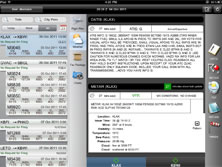
Everyday technology is increasingly seen in aviation now, and this has moved another step further ahead with ARINC’s push towards flight planning and flight operations technology being available through the iPad.

Since October ARINC have been offering parts of their service via iPad, and functionality has been increasing as pilots move away from the traditional pen and paper.

James Hardie, director of ARINC Direct’s Europe, Middle East, Africa and Asia-Pacific operation, says 50% of the roughly 2,500 subscription holders for the service have logged in with iPads in the past month.

The latest software version provides annotation capability to the iPads, allowing pilots to update certain documents during a flight and automatically send PDF versions to the operations centre or other location upon landing.

ARINC Direct offer flight planning technology to business aviation users across the world. For more information on their full range of services please visit: www.business-flight-planning.com

Electronic borders have been regularly in the news over the last few months and years so I wanted to do a focus on what they have to offer both individuals and airlines. The UK Home office wants to implement e-borders to improve border security by screening travel document information (TDI), otherwise known as Advance Passenger Information (API), on people travelling to, and from, the UK. Already routinely submitted by airlines this data can be used both for border security and has the potential to deliver improvements to migration and population statistics.

e-Borders works by taking biographical TDI (API) of passengers and crew members via their air, sea or rail carrier prior to travel either into or out of the UK. TDI is the biographical data on a travel document i.e. name, date of birth, nationality, gender, travel document type, state of issue, number and expiry date. The information is provided electronically to e-Borders by the airlines, who are legally responsible for collecting the data.

Airline Responsibility

The legal responsibilities of airline carriers are found in the migration laws and regulations of the state that grants those rights to land. All carriers must therefore be familiar with, and comply with, a wide range of legislation and regulations relating to national border control procedure and admittance.

Having effective and harmonised guidelines to deal with the communication of advance passenger information, improperly documented travellers, the denial of boarding to potential asylum-seekers, and arrangements in regard to inadmissible passengers who are in transit are important for airlines and airports to meet their obligations and provide the highest levels of customer service, as well as keep control of operational costs of staff and IT systems incurred as a result of new security requirements and mandates.

Border Management Systems

There are a wide variety of border management systems available. The ARINC Border Management System is designed to adapt to operational changes new technology, enabling quick integration with new Border Control agencies demands and requirements.

The ARINC Border Management system is a role-based system and offers a full stay management capability, managing entry and exit processes, and improving traveller flow. The system supports secondary line investigative processes, enabling immigration, customs and other agencies to co-ordinate resources for a holistic view on potential threats.

Affordability?

All airlines, but especially those in business aviation need to consider cost in addition to effectiveness.  The complete ABMS solution features an adaptable platform to protect your investment long term and the flexibility of a local, distributed, or cloud configuration. For more information please visit: www.electronicborders.com

ARINC Electronic Border Management System

ARINC Electronic Border Management System

Aviation Messaging

Aviation messaging will undoubtedly change in the future – but how can we keep current costs low whilst retaining reliable performance?

The DCIS (Data Communications Integrated Services) programme will next month reveal who will play a part in changing aviation messaging. Identified as one of the ‘foundational’ NextGen programmes, it not only improves controller productivity by automating the delivery of routine clearances but also moves the FAA towards its ultimate vision of trajectory-based operation.

The construction of NextGen will enable real-time communication between controllers and flight crews through the use of modern digital data transmissions instead of analogue voice technology, allowing aircraft to fly safer, more efficient routes and ease congestion in major metropolitan areas nationwide.

The DCIS contract will provide ground-to-ground and air-to-ground segments of the data communications system, with special attention paid to the interoperability of the data communications services and avionics.

In the meantime aviation messaging continues to be an area of substantial cost and responsibility for all aviation users, especially within business aviation where costs can be significant. Business aviation users are recommended to seek to use providers who cater especially for this market. ARINC offers business aviation one such service.

The ARINC AviNet Type B Messaging services are built on a technologically advanced platform that provides high availability and throughput; but can help business aviation users you to understand existing the Type B profile and work towards decreasing costs and simplifying infrastructure. For more information please visit: typebmessaging-avinet.com


I wanted to make the first post of May a story about business aviation doing well. In these times of economic uncertainty it is certainly uplifting to hear of new ventures.The story which has appeared on many of the aviation news sites, including FlightGlobal concerns a new start up in the industry, Thai firm Advance Aviation. Previously operating only four VIP helicopters, that were purchased brand new from Eurocopter, the company hold 80% of the helicopter market share, being the only operator to cover all of Thailand.

Now expanding into the business jet market its jet operations commenced this February with just one G200.  Advance Aviation is already planning to increase its fleet with the second hand purchase of one further G200 and a management agreement for two more.

Advance Aviation vice-chairman Chai Nasylvanta commented that the regulatory environment for helicopter operations improves every year in Thailand, but that the industry would enjoy faster growth if Thailand releases more authority to pilots and operators, creating an environment similar to that in the USA and Australia.

Business Aviation Success Story

©Advance Aviation 

The next generation of in-flight connectivity systems will increase onboard broadband speeds to 50mbps Inmarsat & Honeywell said this week.

Honeywell will develop the onboard hardware that will connect to Inmarsat’s Global Xpress network, made possible by the use of the Ka-band, which is found between 26.5GHz and 40GHz.

Global Xpress is scheduled for launch in 2013, with global service availability for commercial, business aviation and government customers during 2014.

The deal between Honeywell and Inmarsat is exclusive and is estimated to result in US$2.8 billion for Honeywell in sales of hardware, customer service, and maintenance to airlines, governments and OEMs over the next two decades, according to a statement.

Inmarsat already works with ARINC to provide in-flight internet through their SwiftBroadband product in the “Cabin Connect” services. Thanks to the enhanced bandwidth offered by SwiftBroadband and ARINC’s Cabin Connect, airline passengers can surf the internet, send and receive email, and use universal messaging all through their own portable electronic device, be that laptop, tablet computer eg iPad or Playbook, smart phone or portable gaming devices.

These services are currently available for business aviation users here: cabinconnect.aero.

Tens of thousands of football fans will be arriving this arriving in Poland this summer to attend the EURO 2012TM tournament matches. The Gdansk Lech Walesa Airport has recently more than doubled its passenger capacity by increasing airside infrastructure and adding a second passenger terminal

The sharp increase in passenger numbers expected has led the airport to chose vMUSE Enterprise hosted technology from ARINC Incorporated as its common-use passenger check-in and departure solution.

ARINC say “Unlike common-use systems that require costly IT hardware on site, ARINC’s vMUSE Enterprise solution delivers passenger processing as an Internet service. The check-in and departure functions use inexpensive “thin client” terminals in conjunction with an Internet connection.”

Because the data processing for vMUSE Enterprise occurs at an off-site data centre managed by ARINC, there is no need for the costly servers, core rooms, and computer workstations typical with other common-use systems. The need for on-site server maintenance, back-ups, and health checks is also eliminated. Airports can lower their IT capital and support costs while enjoying advanced common-use passenger services with improved overall system reliability and security.

As an added benefit, vMUSE Enterprise greatly reduces power consumption compared with conventional server-based core systems, enabling airports to lower their carbon footprint.

Along with Warsaw, Poznan, and Wroclaw, Gdansk is one of Poland’s four Host Cities with venues for the UEFA (Union of European Football Associations) EURO 2012 matches. With the opening of Terminal 2, Gdansk Lech Walesa Airport will serve 5.0 million passengers a year. In addition to facility improvements for EURO 2012, the airport will enact a special management plan to ensure efficient and friendly service for the volume of fan traffic expected from all over Europe.

Cost-saving strategies are the current hot topic for all business aviation users. As airline operational costs continue to rise with airport taxes, fuel prices, maintenance, staffing and the multitude of ‘back end’ costs we look at one of the ways that business jets can improve their bottom line.

Type B messaging services are one of the airlines essentials. Operational messaging can be expensive – but is not something that can be compromised on. There are of course many providers of these services but I want to focus on a supplier that actually offers a calculator tool to find out if you could make savings before you need to get in touch,.

Not all Type B business messaging services are the same. There are major differences between network providers in pricing, support, and efficiency of their applications.

ARINC Direct’s ‘Type B Check’ allows you to calculate your potential savings in this area. As a leading network provider, ARINC has pioneered many advanced features and widely publicise that their Type B messaging applications the most user-friendly available today.

Because ARINC offers several flexible pricing plans, including a flat rate option, new customers could benefit from savings as much as 60% of their messaging costs.

ARINC’s Type B access products are built on ARINC’s technologically advanced AviNet platform and deliver unsurpassed reliability and user-friendly operation.

For more information please visit typebcheck.com

Last week we heard that ARINC Incorporateds Air/Ground Domestic Radio VHF voice service in North America announced that it has restructured its regional network design. The Air/Ground Domestic Radio VHF voice service has been restructured from 12 separate networks into 6 regionally divided networks operating on 6 frequencies across the continental United States. This change improves the ease-of-use for the air crews while maintaining the high quality of service and availability customers expect from ARINC. The network restructuring is the final phase of a system-wide technology refresh, including digital connectivity and replacing analogue radios with state-of-the-art digital transceivers. The digital connectivity and radios have demonstrated greater voice clarity, improved reliability, and real-time network monitoring. The digital technology also allowed ARINC to make the overnight transition with minimal service interruption.

As the critical communications medium for thousands of today’s commercial and business aircraft, it is vital for ARINCs VHF voice radio service to respond to the requests of our users, said John Metzger, Program Director, ARINC Aviation Voice Services. The new regional network structure offers a single frequency for each region to minimize frequency changes across our customers’ major route structures. This will greatly improve the air crews ability to select the correct frequency relative to aircraft position and reach the ground for priority company communications.

Even with the increased use of data link communications, VHF voice radio remains the industry standard used by commercial air carriers and business and general aviation. VHF voice radio enables airlines to communicate emergency or other non-routine situations to company dispatch, maintenance and medical advisory services, limiting unnecessary diversions and providing the critical communications link from the aircraft to the ground.

ARINC Direct offers a full suite of flight planning, flight support and flight deck communications solutions for business aviation. For the full range please see: www.business-flight-support.com.

The largest gathering of avionics manufacturers, distributors and government-certified repair stations in the world is taking place now in Washington DC! An opportunity for manufacturers, distributors, technicians and business leaders to network and look at new solutions for avionics.

The official event site boasts:

  • More than 75 hours of FAA-accepted regulatory, technical and business management training.
  • More than 100 exhibitors in the AEA Exhibit Hall.
  • Meet the regulators and learn the latest issues impacting the avionics industry and your business.
  • The introduction of new avionics products for 2012.
  • AEA’s Show Specials – deep OEM to dealer discounts that could offset the cost of attending the entire show.
  • AEA’s social events, including the First-Nighter Party with a Crab and Beer Fest, the annual Awards
  • Luncheon and the Last Call Reception.

One exhibitor will be ARINC Direct offering flight support, flight planning, flight tracking, data services and flight deck communications for the business aviation community. For more information on these solutions please visit: business-flight-planning.com