Archive

Tag Archives: InFlight Broadband

Other Cabin Services ProvidersTo help reduce operational costs, Finland airline, Finnair has announced its decision to outsource cabin services for 20 long and short-haul flights over the next two years. It is not yet clear about the related impact this will have upon current personnel.

This is not breaking news, as Finnair have been finalising cost-saving measures since March, particularly in the area of cabin services. Finnair has had a cost reduction program in place since 2011, aiming to reduce operational expenses by 18 million EUR. The options include personnel reductions including redundancy, temporary lay-off, hours reductions or a combination of all these options. The cabin services outsourcing plan will go ahead and will be trialled in order to determine the best course of action moving forward for the airline. Finnair will also examine the cost implications of setting up a subsidiary to take over the cabin services functions.

Ville Iho, Chief Operating Officer for Finnair made the following statement, “Finnair has once more met with representatives of the Finnish Cabin Crew Union (SLSY) in an effort to find a common cost reduction solution that would make it possible to avoid outsourcing. SLSY offered 2.9 million EUR in permanent, instant savings, as well as 4.8 million EUR savings that would be achieved within a 20-year time period. This is mainly the same as SLSY’s previous offer. In addition, as a new element, SLSY proposed approximately 4 million EUR temporary savings for a period of one year. In exchange, SLSY required two year protection against lay-offs. Unfortunately, this is too far from the savings that Finnair requires. We cannot continue with our current cost structure, which is why we need to make instant, permanent changes to it. We proposed a solution that would see 12 million EUR of the cost reductions implemented immediately and the remaining 6 million EUR over a longer period of time. Even this compromise did not lead to an agreement.

He added that partnership negotiations for outsourcing are proceeding well, with potential partners in Finland, Europe and Asia. No rushed decisions will be made and careful negotiation and planning will be ensured.

In-flight Connectivity Solutions ProvidersBritish satellite communications company, Inmarsat has announced its intention to deliver high-speed, EU-wide in-flight connectivity with a unique integrated telecommunications network including an order for a new s-band satellite, Europasat.

“We believe that the same in-flight connectivity opportunity exists in Europe and that, with the support of EU telecoms regulators, Inmarsat can rapidly bring to market unique, high speed aviation passenger connectivity services to meet this market demand on an EU-wide basis,” said Inmarsat CEO Rupert Pearce.

Inmarsat capabilities already include seamless coverage via Global Xpress and will place them ahead of the competition for in-flight connectivity for passengers.

Widespread interest is being shown by major airlines and passengers could soon be looking forward to the same connectivity that is currently only enjoyed by the business aviation community, with the deployment of Europe’s first 4G broadband network.

Currently, the company are working on shared system to reduce initial costs in partnership with Hellas-Sat, a non-competing European satellite operator and Thales Alenia Space for the construction of a satellite on a shared basis. Europasat will also support the next-gen emergency network services for public protection and disaster relief.

The aviation network deployment, planned for the end of 2016, will be enabled by Inmarsat’s current existing authorisation to operate integrated satellite and terrestrial communications in 30MHz of S-band frequencies spanning the 28 Member States of the European Union. The licensing process has already begun with EU member states and Inmarsat has received strong support for its application from a high number of EU telecommunications regulators. It is hoped that a consistent regulatory foundation can be accomplished quickly in order to facilitate the swift implementation of the services for the benefit of businesses and passengers across the EU.

Broadband for Business Aviation ConnectivityBusiness aviation connectivity is set for an upgrade next year with faster in-flight broadband speeds promised by Honeywell and AT&T. Honeywell have announced that they will be providing the hardware for a new 4G network service from AT&T that could potentially, based upon current capabilities, offer download speeds ranging from 16.65 to 66.11 Mbps and upload speeds of 7.43 Mbps.

These speeds could enable business aviation passengers to watch video, text and Internet surf in addition to the data messaging benefits for flight deck communications and cabin services.

Using the new Ka-band GX aviation service, these speeds promise to be the fastest to date.

Honeywell will provide the hardware, including antennas, for access to the network and will be developed to work with the Inmarsat L-band and new Global Xpress Ka-band satellite networks, giving connectivity the chance to stretch its legs beyond the continental U.S.

Business aviation currently enjoys global connectivity with other providers, such as ViaSat’s Yonder service and ARINC Direct’s range of passenger and cabin communications solutions.

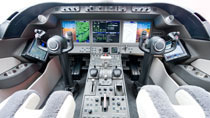
Business Jet Connectivity ProvidersBombardier’s latest addition to the family is the Learjet 85, a beautiful single-aisle business jet with a capacity for up to 8 passengers. The aircraft will include Rockwell Collins’ award-winning Pro-Line Fusion avionics and the horizontal stabiliser trim system (HSTS) for superior flight deck connectivity.

The HSTS helps to control the pitch of the horizontal stabilizer, which can reduce drag and trim the aircraft to improve efficiency for the entire flight. With two placement point in the aircraft frame, safety is optimised, as the Learjet features thinner cabin walls to maximise space inside, improving passenger experience and comfort.

Pro Line Fusion is the latest award-winning offering from Rockwell Collins, featuring the largest LCD displays in the industry at 15.1 inch and a suite of capabilities including, but not limited to:

• Dual Flight Management System
• Localised Performance with Vertical Guidance
• Integrated Flight Information System,
• Synthetic vision
• Intuitive electronic checklists
• Electronic Circuit Breaker display and control

Bombardier’s Learjet 85 took its first flight this week in Wichita, Kansas and will be ready for the first deliveries in early 2015.

In-Flight Entertainment via Inmarsat SwiftBroadbandGogo company, Aircell are pleased to announce EASA certification for the installation of their in-flight entertainment and connectivity systems for Bombardier Challenger 300 business aircraft.

EASA has awarded Supplemental Type Certificates (STC’s) for their Aviator 300 and UCS 5000 systems. Aviator 400 brings Internet, email and voice applications for both passengers and crew using Inmarsat SwiftBroadband.

UCS 5000, introduced in October last year, gives the industry the first all-in-one router and media server and offers passengers seamless access to in-flight entertainment plus brings router functionality in one box. Passengers will have access to Gogo Vision; an IFE service with a comprehensive library of on-demand movies and TV, in addition to news, weather updates and flight information.

Cabin Management TechnologyRockwell Collins, recent acquirers of ARINC Inc, today unveiled the latest innovation in personal tablet use. Their new side-ledge arm personal tablet mount is designed to work with the Venue Cabin Management System.

The new mount means that passengers with iPads and Galaxy tabs will be able to easily mount, charge and operate their personal tablets onboard, integrating with the latest in-flight entertainment system. This is great news for the ever-increasing numbers of passengers carrying personal tablets.

“With Venue, we’re creating a cabin experience that’s tailored to best suit its passengers,” said vice president and general manager, Flight Controls and Information Systems for Rockwell Collins, Greg Irmen. “Our new mount enables passengers to seamlessly integrate their personal tablets into the cabin setting and more comfortably enjoy their own content.”

Rockwell Collins offer apps that integrate with the cabin management system, such as Airshow, which displays an interactive moving map and real-time flight information. Also, they can offer Cabin Remote, which allows control of the cabin environment.

The new personal tablet mounts are available now for use in cabins equipped with the Venue system and allows Skybox passengers access to current onboard digital content.

Leading Cabin Services Solutions ProvidersThe partnership of Honeywell and Inmarsat has announced that they have completed the critical design review (CDR) for the GX Aviation avionics, and hope to gain certification later this year. Once certification is achieved, the product is expected to be introduced in spring 2015.

The GX Aviation system will bring ‘home equivalent’ wireless internet to both passenger aircraft and business jets elevating the experience for passengers in terms of connectivity and cabin services.

This follows the successful launch of Inmarsat’s latest Ka-band satellites, Inmarsat-5 F1, the first of three that will be launched this year. The new network will enhance global coverage and offer the high-speed connections that are in increasing demand in the industry.

The review will enable continued progress and is a milestone for the joint-managed project.

Other Providers of Business Aviation ServicesConsiderable growth in the business aviation services sector has been highlighted by the announcement that Gogo plans to relocate its business aviation division, Aircell, to a larger facility in Broomfield, CO, later this year.

Aircell provides business aviation services, including in-flight entertainment and connectivity to private jet aircraft. With almost 200 employees, and plans to create more jobs, the company expect further growth over the next few years and hope that the new facility, housing more than double the space that they currently occupy, will suit their future expansion needs.

The business aviation services sector has experienced a surge in recent times, largely due to the competitive demands of the modern executive traveller. It is expected to offer seamless connectivity during the entire flight and with aircraft covering greater distances, it has been necessary for business operators to step up to the challenges of continuous connectivity.

Business aviation services providers, such as ARINC Direct, bring seamless connectivity to their customers with a unique partnership of Inmarsat and Iridium satellite communications networks. This partnership offers truly global coverage, even when traversing oceanic expanses and Polar Regions.

As demands continue to grow, the business aviation services sector is expected to become more and more competitive and will give rise to further expansion as the year passes. There are no visible signs of business slowing, and as regulatory conditions continue to add to the pressure, it is set to be an interesting year for business aviation services.

In-Flight Connectivity Solutions ProvidersOnly weeks after the U.S. lifted the ban on in-flight connectivity, Global Eagle Entertainment showcased their new satellite Internet system at the Consumer Electronics Show.

The company claims that their satellite connection provides a more reliable system than air-to-ground providers.

“The satellite is already there and it’s possible to have more bandwidth when needed,” said Simon McLellan, chief engineer for Row44, the technology division of California-based Global Eagle, continuing his explanation that a satellite connection, “allows you to expand the capacity when the demand grows.”

With the demand for passenger in-flight connectivity with mobiles and tablets, and with the limitations lifted, the sky is no longer the limit for aviation communications providers.

Global Eagle have already signed a deal with Southwest Airlines and are set to rival Gogo, who have announced modifications to their ground-based connections in order to provide a hybrid system that will utilise both land and satellite transmissions.

Installation and set up of the system will cost carriers in the region of $300,000 to $500,000 – a cost that will be recouped via passenger fees for the use of the in-flight connectivity services. Some carriers may offer a free connection to premium or first class passengers, but demand is so great for in-flight connectivity, that it will become a matter of competitive interest over the coming year.

Business aviation passengers travelling on private aircraft have enjoyed in-flight connectivity for some time, as expectations are high for these premium services when high-end executive travellers need to operated effectively in their airborne offices.

It is expected that many providers will follow the trend for in-flight connectivity, in spite of the mixed bag of opinions from some big airlines – we shall see!


Aircraft Internet & Wi-Fi Services for Business AviationIn-flight Wi-Fi is not breaking news; its popularity continues to grow as passengers begin to expect more from flight operators in terms of connectivity.

In light of this, GoGo has introduced its latest in in-flight technology, giving Smartphone users the opportunity to make phone calls and text as though they were on the ground.

The GoGo air-to-ground connection will operate through the aircraft’s wireless network instead of the picocells, traditionally used for telephone connections.

New rules, sanctioned by the FAA, now give passengers permission to use their electronic devices; Smartphones and tablet technology during the entire flight, even during take-off and landing, of course, still subject to the requirements of the individual airlines.

Data transfers must still be restricted to ‘airplane mode’ and transmissions across cellular networks are still a ‘no-no’, but with a GoGo app, Smartphone users will be able to roam on the aircrafts in-flight service as though they were on the ground.

Other providers of such in-flight Wi-Fi solutions, such as ARINC Direct, offer seamless connectivity to business aviation passengers.  The business passenger places a generally higher demand upon the airline operators in terms of connectivity and welcome the ‘office-in-the-sky’ scenario.