Archive

Tag Archives: flight deck communications

SunExpress, a joint venture between Lufthansa and Turkish Airlines plan to completely revamp its entire fleet of Boeing 737 with the Rockwell Collins Link 2000+ starting later this year.

The retrofitting will allow for compliance with Eurocontrol’s new CPDLC mandate that states that by 2015, all flights operating above 28,000 feet in European airspace must have CPDLC capability.  The mandate is currently under review for private aircraft, but will move forward in improving air traffic management and capacity throughout Europe under the supervision of Eurocontrol.

Controller-Pilot Data Link Communications (CPDLC) is clearly the future of cockpit efficiency, reducing the workload for pilots and allowing for greater air traffic management as the skies grow busier and traditional voice radio communications in congested airwaves makes controller-pilot communication more difficult.

CPDLC providers are preparing for the ultimate changeover and many, such as ARINC, offer an advisory service to airlines concerned with refitting or retrofitting aircraft with a range of solutions, enabling them to be CPDLC ready when the time comes.

Aero Icarus / Foter / CC BY-SA

Flight Planning iPad App

Flight Planning iPad App

This week JetBlue announced that they are training their pilot to switch to Apple’s iPad apps for essential flight planning access.

The iPad app is fast becoming popular in the aviation industry as airlines make the move to a paperless cockpit, offering flight decks greater flexibility with flight planning tasks, replacing laptops and bulky flight bags full of paper manuals, charts and associated flight planning paperwork.

American Airlines announced just days before that it has completed its plan for the introduction of more than 8,000 iPads fleet-wide. This all adds up to less weight, less fuel burned and huge improvements in the efficiency of the flight planning process all round.

ARINC Flight Planning services, which now includes the iPad app, fully realised the potential implications of improving flight planning and flight deck operations and began implementing the app after FAA approval in 2011.

JetBlue hope that, in addition to the electronic flight bag, the FAA will further approve apps for instrument approach and taxiway charts in the near future.  There is little doubt that, certainly for flight planning, the iPad is the way forward for the aviation industry.

Today, Motorola Solutions announced its intention to release its groundbreaking Terrestrial Trunked Radio, commonly known as TETRA in the form of the next generation handheld device which will revolutionize the delivery of mission-critical communications, combining TETRA and LTE.

The TETRA service was introduced for emergency services, military and government agencies, public safety networks staff and other public sector staff for mission-critical communications, enabling secure network switching.

The new Motorola MTS4L base station enables, with the combined TETRA/TEDS and LTE, the choice of the user for when and where, (and even at which frequency), LTE can be added to their core operations networks.

Motorola hope that their new system will overtake the use of Smartphones, as their station will provide a secure environment for voice, data and video communications that can operate on public or private 3G/LTE and Wi-Fi networks.

The MTP6750 TETRA handheld, also has an impressive 5 megapixel camera, featuring Photograph and Intelligence Communications System (PICS), which will enable authenticated management of photographic evidence through a shared connection – incredibly useful for Police wishing to secure evidence or for a Doctor attending an emergency situation, for example, as is being used by Danish Health.

The uses for the Motorola technology are almost limitless; Police Vehicles (CPV) features integrated applications for key recognition functions, activating the TETRA radio with sirens or lights, technology for reading and recognition of license plates and video surveillance – all data-linked to share the information with the relevant network and for the delivery of mission-critical communications.

The combination of integrated applications with off-the-shelf hardware will make the Motorola TETRA Radio the must-have accessory for all personnel, agencies and departments in modern public sector services, rail and aviation operations for all mission critical communications.

mission critical communications

Mission Critical Communications

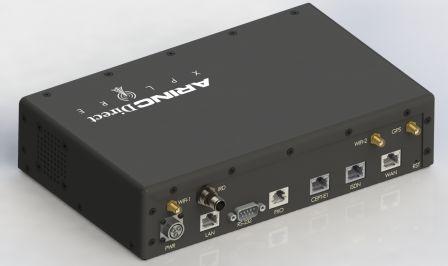
Last week in Geneva at EBACE, business aviation specialists, ARINC Direct took a step closer to a paperless cockpit with their latest innovation, Xplore, a new communications service, offering a four-in-one portable device – ACARS messaging, high-quality voice service, Blackberry email and SMS/Instant Messaging capable.

Xplore will use an iPad application for the user interface and will be user-friendly, adding the benefit of sychnronicity between two or more iPads with bluetooth technology.

ARINC Direct existing business jet-operating customers will notice that the ACARS functionality is completely interoperable with their ARINC Direct account.

“The system is so flexible and easy to use we are looking at a wider range of applications than just business jets for its use,” said ARINC director James Hardie.

ARINC Direct Xplore, using the Inmarsat and Iriudium satellite networks will enable global connectivity for the flight deck and passengers in a simple, single application.

Mr Hardie continued, “If pilots are equipped with SwiftBroadband and they use the iPad App, then they are benefitting from a dynamic aviation information platform which surpasses traditional methods of getting in flight data.”

ARINC Direct encouraged pre-ordering of their business jet innovation at EBACE and hope to complete certification to launch the live product later this year.

Xplore ACARS

ARINC Direct Xplore – ACARS

Dassault Falcon, part of Dassault Aviation and responsible for the sale and support of Falcon Jets throughout the world, recently announced that they had received approval from the FAA & EASA for the new flight deck system EASyII to be installed on all EASy-series Falcons.

The move comes after development of the new flight deck communications system with enhanced data-link capabilities for the communication of CPDLC and other expanding Air Traffic Management technologies.

The new system will help to streamline flight deck comms and aid the reduction of miscommunication of air-ground voice messaging.

“The EASy flight deck has received an enthusiastic reception from Falcon operators due to its ability to streamline the workflow in the cockpit and enhance situational awareness,” John Rosanvallon, President and CEO of Dassault Falcon Jet, said, “EASy II offers new functionalities and improved capabilities based upon extensive customer feedback, new regulations and operational changes that accompany a new set of air traffic management tools.”

CPDLC messaging via data-link is faster, more efficient and can significantly reduce the flight deck workload, offering pilots and coordinators greater flexibility.

EASYII for CPDLC

EASyII CPDLC

The alarming issue of aircraft hacking with the Smartphone app designed by Hugo Teso continues this week as he claims he could create false ACARS messages that could distract pilots with false weather or air traffic information.

Since the current ACARS system uses no authentication, Teso, an engineer and pilot, who works for a German security company, declared it was possible to cause these disruptions from a Smartphone, while seated on the plane.  He uses technology called ‘software defined radio’ to mimic the ACARS VHF frequency.

Teso, speaking at the ‘Hack in the Box’ conference in Amsterdam last week, says he bought second-hand Honeywell and Rockwell Collins Flight Management System equipment from eBay and extensively tested his app.  His findings have led him to believe that he could produce malformed ACARS messages to trigger vulnerabilities in the flight management systems on certain aircraft, potentially giving a hacker a degree of control over the aircraft.

acars

ACARS


The U.S. FAA and the European Aviation Safety Agency (EASA) have dismissed his claims, highlighting the fact that he has only tested his app on flight training simulation software and not on the protected technology that exists on a real flight deck.

A spokesman for EASA said that no, “Potential vulnerabilities on actual flying systems,” have been shown, and that, “The simulation does not have the same overwriting protection and redundancies included in certified flight software.”

Although both agencies strongly deny the possibilities of interference through ACARS messages, Teso states that he is “working with EASA to improve the situation.”


This month we have heard another story of airline struggling to deal with costs. Chanchangi airline has said that high cost of aviation fuel in Nigeria is a huge setback for domestic airline operations.

Airlines now have to look at every aspect of their business in order to balance the books. There are lots of areas that you can make cut backs but using route optimisation as a part of flight planning is one, and getting a good deal on aviation messaging is another.

But even with these basics in place fuel remains crippling. Using a contract fuel supplier will help – but this year at the Avalon air show Australia showcased aviation biofuels as the roadmap for the future. More on that story later…

Australian aviation biofuels showcased at Avalon

Australian aviation biofuels showcased at Avalon – picture courtesy of ABC

Critical Aviation Communications (CPDLC)

Critical Aviation Communications (CPDLC)

The European Commission (EC) has published a framework for the adoption of VDLM2 for CPDLC communications in the form of a Data Link Services Implementing Rule (DLS IR). By this time next year airline operators will be required to retrofit their aircraft with VDLM2/ATN capable avionics, in order to comply with the DLS IR.

The DLS IR legislature is already coming into play – as of 1 January 2011, all new aircraft operating above Flight Level (FL) 285 to be delivered with a compliant system and as of 7 February 2013 the ten core European Air Navigation Service Providers (ANSPs) will need to have implemented a compliant CPDLC ground infrastructure.

Assistance with compliance is essential and ARINC is ne of the suppliers that have publicised details of how they can help your airline become compliant with the new legislation.

ARINC has taken an active role in supporting industry bodies, airframe and avionics manufacturers, ANSPs, and operators, in ensuring that the benefits of the new technology are maximised for the Air Transport Industry. In this context the role of ARINC will evolve from a traditional DataLink Service Provider to an industry partner with years of experience and a history of quality customer support. To see dedicated information regarding this service please see the ARINC CPDLC site.

Type B Messaging Services

Type B Messaging Services

Kazakhstan’s national airline, Air Astana, have renewed and extended its contract for ARINC’s Type B Messaging and AviNet Airport service. ARINC will now provide a complete connectivity and messaging platform for the airline’s airport applications. The first carrier from Russia, Eastern Europe  Kazakhstan’s national airline, Air Astana was recently awarded the prestigious 4-star rating, Skytrax World Airline Awards and named ‘Best Airline in South and Central Asia’.

“As Central Asia’s leading carrier, Air Astana recognises the critical role that connectivity plays in maintaining the very highest standards of operational efficiency and service. ARINC has proved to be an outstandingly reliable and responsive partner in the provision of advanced airline IT solutions over many years and I’m delighted to be renewing and extending the scope of our agreement,” said Chamindra Lenawa, vice president IT and E-business, Air Astana JSC.

ARINC’s market-leading AviNet Messaging is an intuitive solution that uses the internet to provide low cost access to IATA Type B Messaging from anywhere in the world from any computer. Together with ARINC’s extremely resilient network, this meets the air transport industry’s need for high-performance messaging and networking, with the core network operating at 99.999% availability. Integrated with ARINC’s MUSE platform, AviNet Airport provide a fully managed reliable service for Air Astana, the service usually be in operational within 10 working days from the date of order, has an attractive Service Level Agreements (SLAs), pricing, and support.

For more information on ARINCs Type B Messaging Service please visit the ARINC AviNet site.

The Al Maktoum International Airport is hosting the much acclaimed MEBA event, where ARINC Direct will be exhibiting this month.

ARINC Direct will be showcasing its ConnectOnboard Communications System at MEBA. This latest product in a host of flight support services for business aviation delivers complete ACARS messaging, utilizing an iPad application as the user interface, high quality voice using an iPhone or Android device, and managed email.

“This is fertile ground for ARINC and we are delighted to be expanding our portfolio of services and resources in readiness for the growth,” said James Hardie. ”Our ability to support the widest cross-section of customers with continually evolving products and innovations is an advantage that is the envy of our competitors.”

For more details on the passenger communications, flight support or flight deck communications services offered by ARINC Direct please visit the ARINC Direct Business Flight Planning site.