Archive

Tag Archives: Business Jet

Korean Air set up a dedicated charter team in 2007, now, having 3 VIP aircraft in its fleet, it is planning to boost demand for its business jet service by focusing on the Hong Kong and Chinese markets.

The VIP aircraft consists of a Boeing Business Jet, a Bombardier Global Express XRS that it flies internationally, and a Sikorsky S-76C+ helicopter that it operates within South Korea. It is planned that passengers on Korean Air‘s private jet charter service will earn First Class mileage points and will have access to the airline’s VIP lounges.

The airline also has a Flexjet Connect Service, which allows passengers to connect from a regular Korean Air flight to a private jet service for non-stop travel throughout the USA. A spokeswoman from the airline said “With many opportunities from Hong Kong and China, Korean Air is keen to capture a share of the business jet market with a focus in Hong Kong,” “We look forward to flying people to different cities from Hong Kong to China as well as various destinations around the world. With state-of-the-art aircraft, unparalleled services and competitive offerings, Korean Air is confident of capturing a share of the market in Hong Kong and in other countries in the region.”

Please see this link for a full range of business jet support and communications services.

ARINC Cabin ConnectIn the news again and again are the developments for inflight broadband. Some passenger groups hail it as an essential, other just see it as a rip off. One news report this week suggested that supply outweighed demand – but no commercial airline or private jet wants to be left behind the times.

This week we heard that the U.S. Federal Communications Commission (FCC) issued an order implementing Ku-band rules for the operation of satellite earth stations on aircraft enhancing competition and promote the widespread availability of Internet access to aircraft passengers – potentially starting the rise of low cost wifi on airplanes.

Providers to the aviation industry often differentiate their products by aircraft wifi for business aviation, and in flight wifi for commercial airlines.

Up until now, L-band licenses (1-2GHz) could be obtained from the FCC to offer connectivity to airborne aircraft over Mobile Satellite Services (MSS). The new rules will allow the FCC to process ESAA applications up to 50% faster and will speed the deployment of ubiquitous airborne broadband services, including Internet access.

This month we have heard another story of airline struggling to deal with costs. Chanchangi airline has said that high cost of aviation fuel in Nigeria is a huge setback for domestic airline operations.

Airlines now have to look at every aspect of their business in order to balance the books. There are lots of areas that you can make cut backs but using route optimisation as a part of flight planning is one, and getting a good deal on aviation messaging is another.

But even with these basics in place fuel remains crippling. Using a contract fuel supplier will help – but this year at the Avalon air show Australia showcased aviation biofuels as the roadmap for the future. More on that story later…

Australian aviation biofuels showcased at Avalon

Australian aviation biofuels showcased at Avalon – picture courtesy of ABC

Gulfstream

Gulfstream

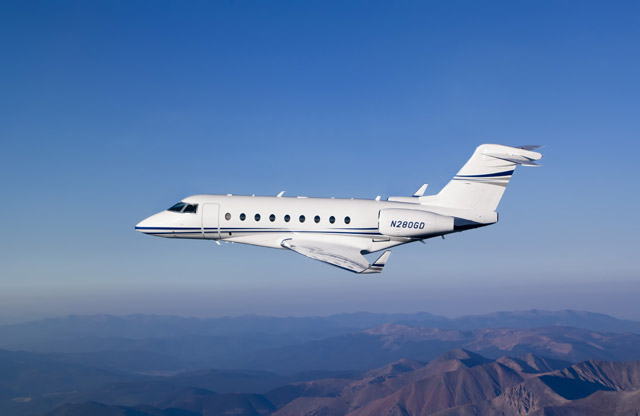
European validation for the Gulfstream G280 business jet after Israel and the USA certificated the super-midsize aircraft. The G280 was introduced in 2008 as a replacement for the G200 is a 10-seat aircraft manufactured by Israel Aerospace Industries in Tel Aviv and completed at Gulfstream’s headquarters in Savannah, USA. Gulfstream delivered 17 midsize-category jets – including the G280’s smaller stablemate the G150 – during 2012. This tally is expected to climb to 26 in 2013.

Mark Burns, Gulfstream president for product support said “The 250h internal testing programme – among the most extensive voluntary reliability programmes ever implemented by Gulfstream – incorporates pilot check rides, maintenance on auxiliary power units, engine run qualifications, technical operations, publications validations and basic servicing and handling at typical fixed-base operators.”

Gulfstream’s G280 business jet has recently set 15 new city-pair speed records as part of a company-driven programme to demonstrate the reliability of the super-midsize aircraft, the most significant from Aspen, Colorado, to Fort Lauderdale, Florida, and another from Honolulu to Savannah.

The G280 flew the 3,034km (1,640nm) from Aspen-Pitkin County airport to Fort Lauderdale-Hollywood International airport in 3h 21min, at an average speed of Mach 0.84. The G280 also achieved a flight of 7,630km from Honolulu to Savannah in 8h 19 min, at an average speed of Mach 0.80. Certificated by the US National Aeronautic Association and forwarded to the Switzerland-based Fédération Aéronautique Internationale for ratification as world records.

Critical Aviation Communications (CPDLC)

Critical Aviation Communications (CPDLC)

The European Commission (EC) has published a framework for the adoption of VDLM2 for CPDLC communications in the form of a Data Link Services Implementing Rule (DLS IR). By this time next year airline operators will be required to retrofit their aircraft with VDLM2/ATN capable avionics, in order to comply with the DLS IR.

The DLS IR legislature is already coming into play – as of 1 January 2011, all new aircraft operating above Flight Level (FL) 285 to be delivered with a compliant system and as of 7 February 2013 the ten core European Air Navigation Service Providers (ANSPs) will need to have implemented a compliant CPDLC ground infrastructure.

Assistance with compliance is essential and ARINC is ne of the suppliers that have publicised details of how they can help your airline become compliant with the new legislation.

ARINC has taken an active role in supporting industry bodies, airframe and avionics manufacturers, ANSPs, and operators, in ensuring that the benefits of the new technology are maximised for the Air Transport Industry. In this context the role of ARINC will evolve from a traditional DataLink Service Provider to an industry partner with years of experience and a history of quality customer support. To see dedicated information regarding this service please see the ARINC CPDLC site.

Thought to be the first cooperation between business operators, 8 Europe major business air charter companies have joined together to form a strategic alliance under the name of AirClub.

Christian Hatje, svp business aviation of PrivatAir and chairman of AirClub, says: “History has been made. AirClub is the first ever alliance of business jet operators and will operate more than 100 business jets. We will combine the strength, purchasing power and expertise of some of Europe’s leading players within the industry to provide clients with premium service, top aircraft availability and flexibility as well as the highest possible standard of safety and comfort.

Founding members ACM Air Charter, Air Alsie, Air Hamburg, Corporatejets, FlyingGroup, GlobeAir, Masterjet and PrivatAir aim to offer their customers flexibility and increase customer service. Based in seven different countries, AirClub will gather resources and knowledge, providing a wider range of solutions and tailored approaches to customers’ needs.

“We will strive to launch our own AirClub online booking system, allowing customers to choose from a vast, diversified fleet located all over Europe, as well as a special member’s programme to complement the latter early next year. Booking a private jet through our online system will be as easy as renting a car.” Continued Hatie.

“GlobeAir is very proud to be a part of the first, and so far only, corporate jet alliance. We are always looking for ways to upgrade our customer service and partnering with other operators offers our customers the benefit of an extended fleet. Said Mauro de Rosa, chief marketing officer Europe at GlobeAir AG and deputy chairman of AirClub, “AirClub is an absolute milestone in today’s business aviation and we are convinced it will further enhance our standing as an industry.”

The Federal Aviation Administration (FAA) intends to establish an Air Transportation Center of Excellence (COE) for Alternative Jet Fuels and Environment (AJF&E). Joining with leading university members and award matching grants to establish, operate and conduct research on alternative jet fuels and environmental matters. The FAA plan to create a cost sharing partnership between academic, industry, and government focusing on the aviation environmental and issues relating to alternative jet fuels.

After a public meeting held on November 15th and 16th 2012 with the FAA COE Program Office and the Office of Environment and Energy discussed the technical requirements, the COE legislative mandates and the competitive selection process. This Final Solicitation follows incorporating the public comments received.

Type B Messaging Services

Type B Messaging Services

Kazakhstan’s national airline, Air Astana, have renewed and extended its contract for ARINC’s Type B Messaging and AviNet Airport service. ARINC will now provide a complete connectivity and messaging platform for the airline’s airport applications. The first carrier from Russia, Eastern Europe  Kazakhstan’s national airline, Air Astana was recently awarded the prestigious 4-star rating, Skytrax World Airline Awards and named ‘Best Airline in South and Central Asia’.

“As Central Asia’s leading carrier, Air Astana recognises the critical role that connectivity plays in maintaining the very highest standards of operational efficiency and service. ARINC has proved to be an outstandingly reliable and responsive partner in the provision of advanced airline IT solutions over many years and I’m delighted to be renewing and extending the scope of our agreement,” said Chamindra Lenawa, vice president IT and E-business, Air Astana JSC.

ARINC’s market-leading AviNet Messaging is an intuitive solution that uses the internet to provide low cost access to IATA Type B Messaging from anywhere in the world from any computer. Together with ARINC’s extremely resilient network, this meets the air transport industry’s need for high-performance messaging and networking, with the core network operating at 99.999% availability. Integrated with ARINC’s MUSE platform, AviNet Airport provide a fully managed reliable service for Air Astana, the service usually be in operational within 10 working days from the date of order, has an attractive Service Level Agreements (SLAs), pricing, and support.

For more information on ARINCs Type B Messaging Service please visit the ARINC AviNet site.

A330 passenger aircraft ordered

A330 passenger aircraft ordered

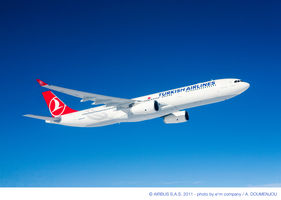
Turkish Airlines has signed a firm order for two additional A330-300 passenger aircraft to be deployed on medium and long haul routes from the Turkish Airlines hub in Istanbul. An additional three options as part of the carrier’s continued growth plans, takes their total orders to 38. With the initial order in 1984, Turkish Airlines now operate in total 104 Airbus

Dr Temel Kotil, CEO of Turkish Airlines said “As one of the fastest growing airlines, our strategy of growth needs to be fully supported by efficient, reliable and profitable aircraft” he continued “This new order for A330s reinforces our commitment to a family of aircraft which already helps us to achieve our ambitious expansion plans, in a profitable and sustainable manner”

The A330 is one of the world’s most efficient aircraft with best in class operating economics. With numerous ongoing product improvements, it still remains the most cost-efficient and capable aircraft, averaging dispatch reliability well above 99 percentThe A330 having 250 to 300 seats, includes Freighter, VIP, and Military Transport/Tanker variants, has now attracted more than 1,200 orders, with over 900 aircraft flying with close to 100 operators worldwide.

Airbus Chief Operating Officer, Customers. John Leahy said “We are very proud to win a repeat order from Turkish Airlines as it shows without doubt a strong endorsement for the A330 unique combination of unbeatable economics, versatility and fuel efficiency,”  “In response to the continuing strong demand, we’re making the A330 better and better, with new higher weight variants to offer more payload-range capability while keeping reliability at top level.”

Airbus aircraft share a unique cockpit and operational commonality, allowing airlines to use the same pool of pilots, cabin crews and maintenance engineers, bringing operational flexibility and resulting in significant cost savings.

Airports know the importance of delivering the best possible for customers travelling through the terminals. The effort to improve customer’s time waiting for their flight has improved during the last few years with gourmet eateries, cell phone charging stations, higher-end facilities, a wide variety of in-airport activities and other plans to upgrades.

When flying, many negative customer experiences are created because of unforeseen delays, mechanical issues, weather problems, etc. These annoyances can create delays of minutes or even hours, and in the worst case scenario cancelled. It is however, possible for these delays to decrease even further, with airlines and airports having the right technology. An iPad-based technology allows cabin crew to manage all reporting and manuals digitally, seeing and addressing unforeseen problems much earlier.

There are polls and articles dedicated to comparing the best and worst airports assisting customers and these new technologies will be a huge benefit in improving customer satisfaction and pre-flight experience, as well as improving a given airport’s reputation.

As well as improving reporting processes, iPad-based technology offers a more effective way to handle customer service issues. Aviation CRM systems are becoming more user-friendly and will be accessible via iPad systems. These CRM systems make it easier for both in-flight crew and airport staff to access customer information, process sales and address customer service issues. Currently airline crews can access corporate memos, manage internal communications, access flight data, up-to-date weather info, etc. while in-flight, from a single device. In the future, airline crews in the airport will be able to handle customer check-in, checking baggage, selling tickets, anywhere, anytime from a single, handheld device.