Archive

Tag Archives: Business Jet

Superbowl ToursAs the New York Super Bowl fast approaches, the area’s Fixed Base Operators are offering a variety of incentives to potential customers, with many of the best deals being publicised at the NBAA’s Schedulers and Dispatchers Conference in New Orleans.

Sheltair, which has FBOs at five of the airports in the local area had representatives on hand to provide operational information, together with details of events planned for the big day from its bases at John F. Kennedy International, La Guardia, MacArthur, Republic and Francis S. Gabreski Airports. Waiving the usual special-event fees and doubling its AVTRIP rewards points, Sheltair warned potential customers that, due to the increased pressure on the already limited hangar space at MacArthur and Republic airports, allocations could only be made on a first-come, first-served basis.

An FBO at Long Island MacArthur Airport (ISP) in Islip, Hawthorne Global Aviation, was also at the show; taking advantage of its location slightly away from what will be the busiest airspace to offer what promises to be an exciting customer experience. A twin-engine helicopter can be hired for a 20 minute flight to either New York City prior to the Super Bowl games or Teterboro Airport for the games themselves, at a round-trip cost of $5,000.

Passenger Communications Services for Business JetsExecutive jet travel is set to increase with between 6,500 – 10,000 private jets predicted to be purchased in the next 8 years. The reasons for its popularity are clear; speed and comfort will always appeal, but on-board communication systems on modern jets can offer a further inducement to business travellers – the ability to offer all the communications capabilities of the office.

Satcom1, an aeronautical satellite communication solutions provider has stated its commitment to extending these capabilities to helicopters in 2014. Not such an easy task, as CEO and Co-founder Karina Larsen explained. “The challenge has always been to manage the rotor wing, so we had to redesign the network in a way that it compensates for the fast interruptions.” The resulting improvements will impact helicopter travel in many ways, from providing the communications data necessary for a TV, to fulfilling the complex requirements of service craft.

As the private aviation industry grows, particularly in emerging markets, Larsen has stated Satcom1’s intention to further develop. With its current business in the Middle East steadily increasing the company is now looking to the potential offered by Asia and Brazil, the latter already being home to Embraer. Of the other BRIC nations, Larsen says that only Russia has the required infrastructure. However, there is certainly a demand for satellite communication technology in aviation and Larsen expects that Satcom1s’s ability to provide complete solutions will leave it well-placed to capitalise on every opportunity as new markets emerge.

Inflight Aviation Communications Solutions for Business AviationRockwell Collins Inc. has opened a new technology division to further extend its reputation as a manufacturer of aircraft electronics after its $1.4 billion acquisition of ARINC Inc., its largest to date.

It is expected that ARINC’s long-standing, industry-leading aircraft communications experience will bring a strong foundation to the table.

Heading the division will be Jeff Standerski, bringing his 25-years of experience with Rockwell to bear on the development of an Information Management Services unit that, according to Chief Executive Officer Kelly Ortberg, will offer “a network in the sky.”

The emergence of smart aircraft, such as Boeing Co. (BA)’s 787 Dreamliner and Airbus SAS’s A380 and A350 jets, has led to an increasing reliance on powerful on-board computers. Ortberg anticipates that Arinc Inc., founded in 1929 and with a long history of providing air-to-ground communications is ripe for further development.

ARINC’s current subscription services, covering everything from in-flight e-mail services to the provision of real-time weather and flight data to pilots via its Aircraft Communications Addressing and Reporting System are reported to assist in over 100,000 flights each day. In combination with Rockwell’s computer architecture Ortberg envisions the creation of new air-to-ground links and other applications that will, ultimately, transform the aviation industry.

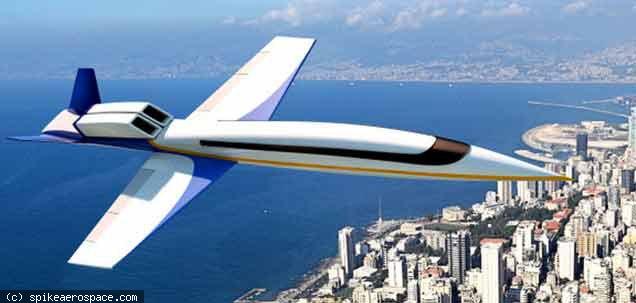
Spike Aerospace's Supersonic JetIt’s a fast moving world, and it’s set to get even faster with the planned introduction of Spike Aerospace’s S-512 supersonic jet aircraft. Two years in design, its Boston based engineers aim for it to halve international travel times, flying at up to 1,100mph with the ability to reach Mach 1.6.   In practical terms that means a trip from Los Angeles to Tokyo should take just five hours.

If that sounds hopeful, its worth remembering that the Spike Aerospace team already have an impressive track record, with experience gained from working with some of the most renowned aircraft companies. Even the occasional traveller cannot fail to recognise such names as Airbus, Bombardier and Gulfstream.

Supersonic travel certainly won’t come cheap, though. The luxury jet will cater for just 12-18 travellers, and with a price tag of between $60- $80million (£36.3-£48.4million), it is expected to appeal initially to multinational companies and busy executives; for whom time really is money.

For now, it’s not cash but patience that will have to be the watchword for the hopeful supersonic traveller. The dream of “crossing the pond” in little more time than it currently takes to ferry across the English Channel to France will have to remain so for just a little while longer. Spike Aerospace has announced that the inaugural flight is planned for December 2018 – with a headlining London to New York time of just three hours.

However, the Federal Aviation Authority’s current ban on supersonic flight over America means that onward travel may not be quite so fast, although NASA and Boeing are both aiming to develop supersonic craft that reduce sonic boom.

Commercial Air Travel Centenary YearAir passengers taking advantage of the recent holidays to travel to far-flung climes, or those regularly nipping a few thousand miles to be united with friends and family have good cause to celebrate this centenary year of commercial air travel.

It’s hard to imagine that this globally vital industry, averaging over 8 million passengers and 140,000 tons of cargo per day began 100 years ago with a single passenger, Abram Pheil, Mayor of St. Petersburg; travelling with a ticket won at auction for $400.  It was an inauspicious start for an industry that today carries around 50 million tons of cargo worth in the region of $6.4 trillion per year, a figure representing some 35% of the value of all traded goods.

With funding organised by Percival Fansler, Pheil as passenger, and Tony Jannus as pilot, the 23 minute flight of Thomas Benoist’s airboat across Florida’s Tampa Bay on New Year’s Day 1914 went down in history not just as the inaugural journey of the St. Petersburg-Tampa Airboat Line, but that of commercial flight.

As the International Air Transport Association (IATA) announced a year-long celebration of the centenary it’s certainly worth considering how far commercial flight has come in that time. Last year annual passenger numbers reached 3.1 billion, exceeding all previous records, and this year it’s anticipated records will be broken again with 3.3 billion journeys. The figures are staggering enough but even more so when one considers they are equivalent to 44% of the global population.

The contribution of commercial flight to all aspects of modern life is well-recognised by IATA director-general and CEO Tony Tyler who said, “The first flight provided a short-cut across Tampa Bay. Today, the aviation industry re-unites loved ones, connects cultures, expands minds, opens markets, and fosters development.”  But the centenary year is not just about looking to aviation’s past, nor even to its present success. As Tyler says, “A hundred years is something worth celebrating. And we look forward to creating an equally remarkable legacy for commercial aviation’s second century.”

The Cessna Aircraft Company, owned by Textron Inc is celebrating today after the first deliveries and FAA type certification of the Citation M2 jet is achieved. Announced in September 2011 and the prototype first flown in March 2012, the development and certification process has involved over 150,000 hours in addition to almost 1,000 test flight hours over 360,00 nautical miles.

Cessna’s senior vice-president of business jets, Mr Brad Thress said, “Cessna is once more redefining the light jet segment with the Citation M2. We’re proud to get the M2 into the marketplace and see the aircraft begin to set the standard for the next generation of business aviation.”

Cessna M2 Business JetThe beautiful jet is certified for single-pilot operation and has a flight capacity of 1,300 nautical miles at a cruise speed of 460 miles per hour. With an operational ability to work on short runways and able to climb to 41,000 ft in 24 minutes, the Citation M2 is flexible and efficient, featuring two Williams FJ44 engines.

“The Citation M2 is a versatile aircraft that fits many markets and missions, attracting owner-operators looking for an advanced, innovative aircraft of this size, capability, and value. Our launch customer, Stuart Woods, represents this type of customer: owners moving up from their Citation Mustang. Further, many new M2 owners are upgrading from a turboprop, while still others are moving laterally to a newer, same-size business jet. With its single-pilot certification, the Citation M2 has room for six passengers and is faster than many comparable aircraft, making it a strong performer in this segment,” continued Mr Thress.

The Citation M2 certainly has style and this continues into the cockpit and the roomy cabin, with Garmin 3000 avionics, high-resolution displays and touch-screen interactivity.

The six-passenger capacity cabin has eight large windows and adjustable seats and provides an aisle height of 57 inches.

Cabin Services Solutions ProvidersAtlanta-based Delta Airlines have announced that they will not allow in-flight voice calls on their flights ahead of the impending final ‘vote’ by the FAA to lift the ban on cell phone usage.

In an internal memo, Richard Anderson, CEO of Delta said, ‘Last week the U.S. Federal Communications Commission voted to seek public comment in consideration of lifting its ban on in-flight cell phone use. Delta will not allow cellular calls or internet-based voice communications onboard Delta or Delta Connection flights.

Our customer research and direct feedback tell us that our frequent flyers believe voice calls in the cabin would be a disruption to the travel experience. In fact, a clear majority of customers who responded to a 2012 survey said they felt the ability to make voice calls onboard would detract from – not enhance – their experience. Delta employees, particularly our in-flight crews, have told us definitively that they are not in favour of voice calls onboard.

Delta has moved quickly when technological and regulatory breakthroughs provide opportunities to make flying better for our customers. That is why we were the first to file our plan with the U.S. Federal Aviation Administration to allow customers to use portable electronic devices below 10,000 feet. Similarly, if the FCC lifts its ban on cellular use in flight, Delta will move quickly to enable customers to use text, email and other silent data transmission services gate to gate.’

Since no decision has yet been reached on the proposed lift, it is still unclear whether passengers may yet be chatting about their journeys using in-flight voice calls – certainly, Mr Anderson has made Delta’s position clear on the subject.

Today, however, there is an ever-growing demand for cell phone use in-flight. Business aviation in particular experience high levels of expectation from their executive passengers as they operate the office-in-the-sky.

Industry-leaders, such as ARINC, offer high-speed passenger connectivity for emails and broadband, as an understanding within the industry realises the need to enhance cabin services, therefore increasing competition and allowing airlines to stay ahead of the game.

Many critics say that there is no real need for in-flight voice calls, with the level of connectivity now available in the cabin. It remains to be seen whether the ban will be lifted and it seems that opinion is divided. Maybe we will see ‘voice-call-seats’ or areas of the plane that will be designated ‘non-voice-call’ to be booked in advance like the years-old ‘non-smoking’ seats – the jury is still out on this moot point.

Aircraft Datalink SolutionsVHF coverage is now extended with a combined effort from Satcom Direct, TAG Farnborough Airport and SITA, who have based their new VHF ground station equipment in Hangar 2.

The new equipment and subsequent VHF coverage will enable the airport to provide enhanced services to operators and aircraft owners with the addition of the aircraft datalink services.

CPDLC is a growing requirement in the aviation industry, with mandatory regulations for Europe coming into play at the end of this year and the beginning of next year. Although business and private jets are exempt from the ruling, it is only a matter of time.

CPDLC (Controller Pilot Data Link Communications) give greater flexibility in the cockpit and on the ground and eliminate many previous problems that are encountered during communications. The mandates will open up better opportunities for flight operations as the airwaves become less congested. Streamlining communications with aircraft datalink is not only more efficient, but also globally recognised, without interruption, given provision from a reliable and reputable supplier.

Companies such as SITA and ARINC have global ground stations to aid the facilitation of aircraft datalink messaging.

Flight Support Services to aid Business Jet GrowthThe private jet industry is experiencing a surge as business passengers are increasingly demanding flights to far flung shores and harder-to-reach locations.  This is fuelling a requirement for longer range aircraft to help them achieve their goals.

Flight support services are backing up this new wave of long-haul business jets with satellite communications solutions that provide seamless connectivity – critical for operational productivity for both the airline and the business passenger.

While the total number of business flights decreased 0.7%, the number of long-range business flights rose by almost 19%. This was also reflected in the business jet manufacturing sector as long-range jets grew by 29% and business jet manufacture as a whole fell by 2.1% on last years’ figures.

This has been acknowledged by the president and chief executive of the NBAA, Ed Nolan, who said, “The segment of business aviation that has grown the fastest in the last five years is the ultra-long-range jets that are capable of flying halfway around the world. The Internet has helped shrink the world, and to do business in far-flung places there is still a need for face-to-face communication.”

The oil and mining industries are amongst the most prolific users of the long-range business aviation sector, but an emerging breed of business travellers are spreading their wings in terms of business opportunities in farther corners of the globe.

Many private aviation companies are benefiting from these new trends, such as VistaJet, whose owner; Thomas Flohr began leasing his own aircraft when he was not using it himself.  He believes that the routes are changing considerably, largely due to globalization.

Long-range business jets are still subject to the ETOPS rules and expanding capacity for range and routes gives the industry the boost it needed. Business aviation growth is expected to continue as executives from every corner of every industry strive to find new business from previously inaccessible or economically unreachable locations.

SATCOM Data Link for Business AviationSatcom Direct, aviation providers of communications solutions has announced that its International office will now bring VHF coverage for aircraft satcom data link communications.

Using the new SITA VHF ground station, the company can offer enhanced flight deck communications with the joint effort from Satcom Direct and SITA.

“Installation of the VHF antenna and ground station is another way for us to continue to support our international customers, especially aircraft that are based at TAG Farnborough Airport,” said founder and owner of Satcom Direct, Jim Jensen. “Having both a VHF and a satellite component allows Satcom Direct to offer our customers a truly global network supporting all aircraft types equipped with a wide variety of avionics.”

Satcom data link allows pilots the flexibility and enhanced efficiency of sending and receiving data messages, allowing greater operational productivity whilst lightening the cockpit load for the flight crew. The improved reliability of satcom data link messaging is a big plus for aviation operators, with global connectivity becoming increasingly necessary in today’s skies.

Business aviation benefits reach into the cabin as the office in the sky is a prerequisite on most flights, either short or long-haul.

Providers of Satcom data link for business aviation, such as ARINC Direct, bring a seamless global connection with their unique partnership of Iridium and Inmarsat satellite networks and offer coverage in previously hard-to-reach areas, such as vast oceanic expanses and Polar Regions.

Voice and internet connections are crisp and reliable with satcom data link and over the VHF network have far-reaching capability, increased efficiency and ultimately help with cost effective operations, supporting a wide variety of avionics systems and web-based operational activity.