Archive

Tag Archives: business aviation

iPad Electronic Flight Bag ProvidersTAG aviation have brought the iPad-based Electronic Flight Bag (EFB) on board following recent authorization from the Swiss Federal Office of Civil Aviation (FOCA).

The move towards a paperless cockpit is being embraced by operators due to its flexibility for flight planning and in-flight operational tools. TAG have selected Jeppesen’s Mobile Flitedeck with mobile device management to allow users to access data remotely.

Damien Chollet, deputy postholder for TAG Aviation flight operations hails the iPad as a ‘great tool that everybody likes to work with.’

The iPad Electronic Flight Bag, with its up-to-the-minute information is already firmly ensconced in the future of the flight deck. Providers are continually updating their apps to ensure their competitive stake in the industry as a whole.

Global Flight Tracking Services for Business AviationHoneywell GDC Aircraft Datalink clients of WSI Corporation can now look forward to global flight tracking as part of the WSI Fusion Package. The announcement is a part of the WSI and Honeywell agreement to enhance business aviation operations.

Global flight tracking enables operators to stay ahead and facilitates operational decision making that will keep flights on time, reducing the impact of disruptive events, such as adverse weather conditions in the planned flight path.

WSI Corporation, based in Massachusetts with offices in Birmingham, U.K. bring weather data to aviation and rely upon aircraft datalink communications to deliver up-to-date, reliable information. Business aviation operators are flying increasingly greater distances and global flight tracking is a valuable tool for the industry sector.

ARINC Direct is another provider of business aviation services to the sector and offer global flight tracking as part of their Flight Support Services package. Global flight tracking is made possible using the network partnership of Inmarsat and Iridium satellites, which can bring seamless connectivity for aircraft datalink  communications.

Flight Deck WeatherWeather Services International (WSI) has announced a new platform in its aim to further improve aircraft efficiency and safety. The new WSI Business Aviation Solution platform combines tools such as weather and flight information, operational data and airspace constraints, offering those tasked with making operational decisions a comprehensive view of this vital data.

WSI’s information systems are currently in use by over 130 commercial airlines on over 55,000 daily flights and have three main platforms; each targeted to fulfil distinct data requirements.

For pilots WSI Pilotbrief offers global weather information to assist in the optimisation of flight paths.  For schedulers and dispatchers WSI Fusion enables global flight tracking with real-time weather alerts, and WSI Hubcast enables ground crew to track flights and prepare for disruptive weather events.

Up-to-the-minute weather data is critical to flight safety, to facilitate swift decision-making on the flight deck and flight support teams on the ground. Other providers, such as ARINC Direct, bring radar data information outside the U.S. to business aviation operators; the only providers to do so.

Working as the professional solutions arm of The Weather Company, WSI is able to alert aviation to multiple hazards en-route, providing information on anything from turbulence, icing and convection right through to the less frequently encountered presence of volcanic ash.

Dassault Falcon 5X Business JetGrowing demand for business flights both from and within Africa has led Dassault Aviation to announce the appointment of Olivier Zuber as its new International Sales Manager.

Working for Dassault since 2005, Zuber has filled a number of key roles at the company, most recently as the Dassault Falcon Jet Corp. Marketing and Business Development Manager for India.

Falcon, a wholly owned U.S. subsidiary of France’s Dassault Aviation, is responsible for marketing the entire line of Falcon jets throughout North America, South America and the Asian Pacific Rim, including China. Over 2,500 Falcon jets have been manufactured since production of the initial Falcon 20 in 1963, with the latest addition to the range being the Falcon 5X.

In that time Dassault Aviation has grown to employ some 11,000 workers both in France and the U.S. Demand for Falcons has doubled in Africa alone in the past five years and the company has also introduced a fighter jet, the Rafale, to its stable of aircraft.

With a Master’s Degree in Engineering, and experience in both Falcon’s flight centre and customer service sections, Zuber will now move from Dassault’s Indian liaison office, based in New Delhi, where he has spent the last three years.

Following his move to the French headquarters in Saint-Cloud, Zuber will report to Dassault’s Sales Directors for the African market, Alain Lemee and Gilles Apollis. Vice President of Falcon Sales, Gilles Gautier, welcomed  Zuber to his new role saying, “Olivier’s extensive experience with the nuances of the business aviation industry in various regions make him the ideal choice to develop leads and spearhead new sales opportunities in the emerging economies of Africa.”

Superbowl ToursAs the New York Super Bowl fast approaches, the area’s Fixed Base Operators are offering a variety of incentives to potential customers, with many of the best deals being publicised at the NBAA’s Schedulers and Dispatchers Conference in New Orleans.

Sheltair, which has FBOs at five of the airports in the local area had representatives on hand to provide operational information, together with details of events planned for the big day from its bases at John F. Kennedy International, La Guardia, MacArthur, Republic and Francis S. Gabreski Airports. Waiving the usual special-event fees and doubling its AVTRIP rewards points, Sheltair warned potential customers that, due to the increased pressure on the already limited hangar space at MacArthur and Republic airports, allocations could only be made on a first-come, first-served basis.

An FBO at Long Island MacArthur Airport (ISP) in Islip, Hawthorne Global Aviation, was also at the show; taking advantage of its location slightly away from what will be the busiest airspace to offer what promises to be an exciting customer experience. A twin-engine helicopter can be hired for a 20 minute flight to either New York City prior to the Super Bowl games or Teterboro Airport for the games themselves, at a round-trip cost of $5,000.

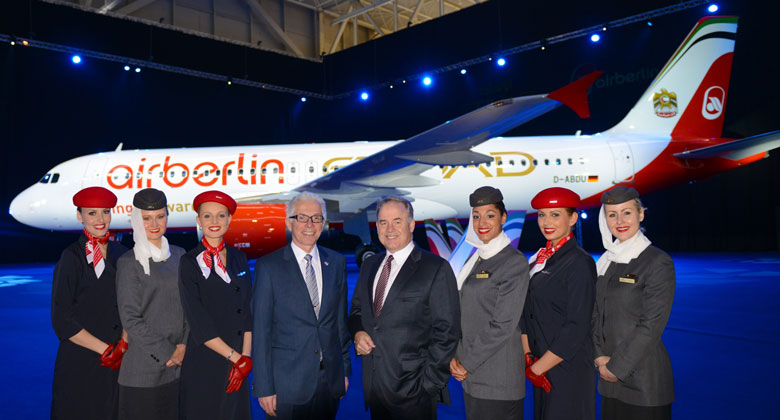
Air-Berlin-Etihad-livery-780The Gulf carrier Etihad has continued its foray into the European aviation market with the unveiling of an Airbus A320 in joint livery with Air Berlin at an event hosted by both Wolfgang Prock-Schauer, CEO of Air Berlin and it’s Vice Chairman, James Hogan, also President of Etihad.

Last year Etihad notably purchased a 49% stake in Air Serbia, formerly known as Jat airlines, and has announced plans to further strengthen its European presence with the purchase of a one third stake in Darwin, which will become Etihad Regional. However, Hogan was circumspect regarding recent reports that Etihad would also soon be announcing an investment in the ailing Alitalia, stating the importance of due diligence and the formation of,  “a clear plan to move to profitability.”

Clearing recent speculation regarding European carriers LOT Polish Airlines and the Latvian Air Baltic, Hogan stated there were no plans to invest in either.

Passenger Communications Services for Business JetsExecutive jet travel is set to increase with between 6,500 – 10,000 private jets predicted to be purchased in the next 8 years. The reasons for its popularity are clear; speed and comfort will always appeal, but on-board communication systems on modern jets can offer a further inducement to business travellers – the ability to offer all the communications capabilities of the office.

Satcom1, an aeronautical satellite communication solutions provider has stated its commitment to extending these capabilities to helicopters in 2014. Not such an easy task, as CEO and Co-founder Karina Larsen explained. “The challenge has always been to manage the rotor wing, so we had to redesign the network in a way that it compensates for the fast interruptions.” The resulting improvements will impact helicopter travel in many ways, from providing the communications data necessary for a TV, to fulfilling the complex requirements of service craft.

As the private aviation industry grows, particularly in emerging markets, Larsen has stated Satcom1’s intention to further develop. With its current business in the Middle East steadily increasing the company is now looking to the potential offered by Asia and Brazil, the latter already being home to Embraer. Of the other BRIC nations, Larsen says that only Russia has the required infrastructure. However, there is certainly a demand for satellite communication technology in aviation and Larsen expects that Satcom1s’s ability to provide complete solutions will leave it well-placed to capitalise on every opportunity as new markets emerge.

Inflight Aviation Communications Solutions for Business AviationRockwell Collins Inc. has opened a new technology division to further extend its reputation as a manufacturer of aircraft electronics after its $1.4 billion acquisition of ARINC Inc., its largest to date.

It is expected that ARINC’s long-standing, industry-leading aircraft communications experience will bring a strong foundation to the table.

Heading the division will be Jeff Standerski, bringing his 25-years of experience with Rockwell to bear on the development of an Information Management Services unit that, according to Chief Executive Officer Kelly Ortberg, will offer “a network in the sky.”

The emergence of smart aircraft, such as Boeing Co. (BA)’s 787 Dreamliner and Airbus SAS’s A380 and A350 jets, has led to an increasing reliance on powerful on-board computers. Ortberg anticipates that Arinc Inc., founded in 1929 and with a long history of providing air-to-ground communications is ripe for further development.

ARINC’s current subscription services, covering everything from in-flight e-mail services to the provision of real-time weather and flight data to pilots via its Aircraft Communications Addressing and Reporting System are reported to assist in over 100,000 flights each day. In combination with Rockwell’s computer architecture Ortberg envisions the creation of new air-to-ground links and other applications that will, ultimately, transform the aviation industry.

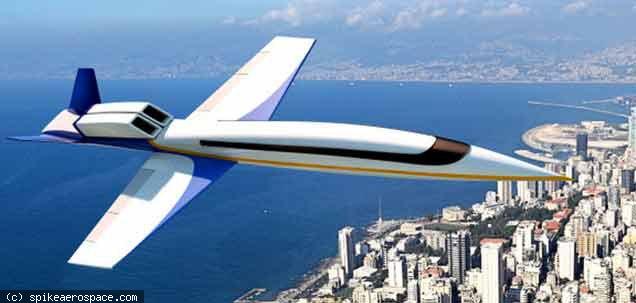
Spike Aerospace's Supersonic JetIt’s a fast moving world, and it’s set to get even faster with the planned introduction of Spike Aerospace’s S-512 supersonic jet aircraft. Two years in design, its Boston based engineers aim for it to halve international travel times, flying at up to 1,100mph with the ability to reach Mach 1.6.   In practical terms that means a trip from Los Angeles to Tokyo should take just five hours.

If that sounds hopeful, its worth remembering that the Spike Aerospace team already have an impressive track record, with experience gained from working with some of the most renowned aircraft companies. Even the occasional traveller cannot fail to recognise such names as Airbus, Bombardier and Gulfstream.

Supersonic travel certainly won’t come cheap, though. The luxury jet will cater for just 12-18 travellers, and with a price tag of between $60- $80million (£36.3-£48.4million), it is expected to appeal initially to multinational companies and busy executives; for whom time really is money.

For now, it’s not cash but patience that will have to be the watchword for the hopeful supersonic traveller. The dream of “crossing the pond” in little more time than it currently takes to ferry across the English Channel to France will have to remain so for just a little while longer. Spike Aerospace has announced that the inaugural flight is planned for December 2018 – with a headlining London to New York time of just three hours.

However, the Federal Aviation Authority’s current ban on supersonic flight over America means that onward travel may not be quite so fast, although NASA and Boeing are both aiming to develop supersonic craft that reduce sonic boom.

Commercial Air Travel Centenary YearAir passengers taking advantage of the recent holidays to travel to far-flung climes, or those regularly nipping a few thousand miles to be united with friends and family have good cause to celebrate this centenary year of commercial air travel.

It’s hard to imagine that this globally vital industry, averaging over 8 million passengers and 140,000 tons of cargo per day began 100 years ago with a single passenger, Abram Pheil, Mayor of St. Petersburg; travelling with a ticket won at auction for $400.  It was an inauspicious start for an industry that today carries around 50 million tons of cargo worth in the region of $6.4 trillion per year, a figure representing some 35% of the value of all traded goods.

With funding organised by Percival Fansler, Pheil as passenger, and Tony Jannus as pilot, the 23 minute flight of Thomas Benoist’s airboat across Florida’s Tampa Bay on New Year’s Day 1914 went down in history not just as the inaugural journey of the St. Petersburg-Tampa Airboat Line, but that of commercial flight.

As the International Air Transport Association (IATA) announced a year-long celebration of the centenary it’s certainly worth considering how far commercial flight has come in that time. Last year annual passenger numbers reached 3.1 billion, exceeding all previous records, and this year it’s anticipated records will be broken again with 3.3 billion journeys. The figures are staggering enough but even more so when one considers they are equivalent to 44% of the global population.

The contribution of commercial flight to all aspects of modern life is well-recognised by IATA director-general and CEO Tony Tyler who said, “The first flight provided a short-cut across Tampa Bay. Today, the aviation industry re-unites loved ones, connects cultures, expands minds, opens markets, and fosters development.”  But the centenary year is not just about looking to aviation’s past, nor even to its present success. As Tyler says, “A hundred years is something worth celebrating. And we look forward to creating an equally remarkable legacy for commercial aviation’s second century.”