Archive

Tag Archives: business aviation services

Other Leading Datalink Communications ProvidersAvionics engineering company, L2 Consulting Services, Inc. (L2) recently announced it has received a Federal Aviation Administration Supplemental Type Certificate (STC) for the installation of the International Communications Group, Inc. (ICG) Iridium Communications System on 767 series aircraft.

A dedicated datalink channel will be able to support Aircraft Communications Addressing and Reporting System (ACARS), Future Air Navigation System (FANs) messaging, Automatic Dependent Surveillance Contract (ADS-C) and Controller Pilot Data Link Communication (CPDLC).

Having developed the integration engineering, produced the installation kits and project managed throughout, including the STC process, L2 will now be allowed to install comprehensive communications systems via ICG NxtLink Series ICS-120A and ICS-220A line replaceable units.

Michael Eiras, Senior Director of L2 Technical Services welcomed the Iridium Communications System STC on the 767 aircraft saying it would ‘complement the companies current portfolio of SATCOM installations on the 737, 747, 757 and 777 aircraft.’

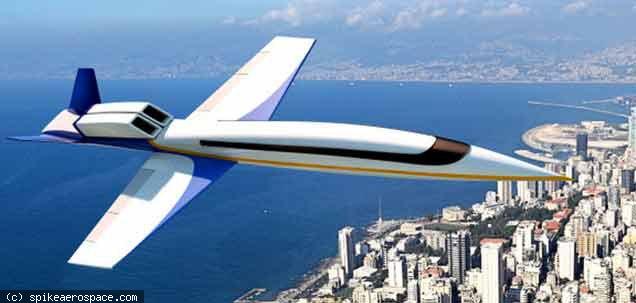
Spike Aerospace's Supersonic JetIt’s a fast moving world, and it’s set to get even faster with the planned introduction of Spike Aerospace’s S-512 supersonic jet aircraft. Two years in design, its Boston based engineers aim for it to halve international travel times, flying at up to 1,100mph with the ability to reach Mach 1.6.   In practical terms that means a trip from Los Angeles to Tokyo should take just five hours.

If that sounds hopeful, its worth remembering that the Spike Aerospace team already have an impressive track record, with experience gained from working with some of the most renowned aircraft companies. Even the occasional traveller cannot fail to recognise such names as Airbus, Bombardier and Gulfstream.

Supersonic travel certainly won’t come cheap, though. The luxury jet will cater for just 12-18 travellers, and with a price tag of between $60- $80million (£36.3-£48.4million), it is expected to appeal initially to multinational companies and busy executives; for whom time really is money.

For now, it’s not cash but patience that will have to be the watchword for the hopeful supersonic traveller. The dream of “crossing the pond” in little more time than it currently takes to ferry across the English Channel to France will have to remain so for just a little while longer. Spike Aerospace has announced that the inaugural flight is planned for December 2018 – with a headlining London to New York time of just three hours.

However, the Federal Aviation Authority’s current ban on supersonic flight over America means that onward travel may not be quite so fast, although NASA and Boeing are both aiming to develop supersonic craft that reduce sonic boom.

Solutions from ARINC AIM

Mohammed Ahli – Director General – Dubai CAA

With the Gulf airports aiming to increase passenger numbers to 450 million per year by 2020, and the development of new terminals at both Doha and Abu Dhabi, the Arabian Gulf States are investing heavily in airport security, an industry currently estimated to have a global value of $22 billion.

Much of this investment is focussed on innovative technologies designed not only to improve security and efficiencies for the airport but also to improve the passenger experience, as

Mohammed Ahli, director general of the, Dubai Civil Aviation Authority (DCAA) explained,  “It’s crucial to adopt innovative technology, improve security and streamline efficiencies to offer a seamless passenger travel experience.”

Airport Show, the Middle East’s largest airport industry event, provides a welcome opportunity for companies to showcase the technologies vital in achieving this aim. Both Intertech Vision Group, which already has 140 installations in the region, and ARINC, a security and systems integration company offering an Advanced Information Management system (AIM) will be attending,

Stephen Horner, International Business Development Director, Integrated Security Solutions, ARINC, said: “There are many security and systems integration opportunities throughout the GCC region. ARINC has provided integration and security solutions for more than 30 years to a security industry of equal age. We are able to provide ‘best fit’ technology and solution to airports. We wish to showcase our wider capability in delivering integrated security solutions, command and control facility as well as airport solutions.”

Cabin Services Solutions ProvidersAtlanta-based Delta Airlines have announced that they will not allow in-flight voice calls on their flights ahead of the impending final ‘vote’ by the FAA to lift the ban on cell phone usage.

In an internal memo, Richard Anderson, CEO of Delta said, ‘Last week the U.S. Federal Communications Commission voted to seek public comment in consideration of lifting its ban on in-flight cell phone use. Delta will not allow cellular calls or internet-based voice communications onboard Delta or Delta Connection flights.

Our customer research and direct feedback tell us that our frequent flyers believe voice calls in the cabin would be a disruption to the travel experience. In fact, a clear majority of customers who responded to a 2012 survey said they felt the ability to make voice calls onboard would detract from – not enhance – their experience. Delta employees, particularly our in-flight crews, have told us definitively that they are not in favour of voice calls onboard.

Delta has moved quickly when technological and regulatory breakthroughs provide opportunities to make flying better for our customers. That is why we were the first to file our plan with the U.S. Federal Aviation Administration to allow customers to use portable electronic devices below 10,000 feet. Similarly, if the FCC lifts its ban on cellular use in flight, Delta will move quickly to enable customers to use text, email and other silent data transmission services gate to gate.’

Since no decision has yet been reached on the proposed lift, it is still unclear whether passengers may yet be chatting about their journeys using in-flight voice calls – certainly, Mr Anderson has made Delta’s position clear on the subject.

Today, however, there is an ever-growing demand for cell phone use in-flight. Business aviation in particular experience high levels of expectation from their executive passengers as they operate the office-in-the-sky.

Industry-leaders, such as ARINC, offer high-speed passenger connectivity for emails and broadband, as an understanding within the industry realises the need to enhance cabin services, therefore increasing competition and allowing airlines to stay ahead of the game.

Many critics say that there is no real need for in-flight voice calls, with the level of connectivity now available in the cabin. It remains to be seen whether the ban will be lifted and it seems that opinion is divided. Maybe we will see ‘voice-call-seats’ or areas of the plane that will be designated ‘non-voice-call’ to be booked in advance like the years-old ‘non-smoking’ seats – the jury is still out on this moot point.

Aircraft Datalink SolutionsVHF coverage is now extended with a combined effort from Satcom Direct, TAG Farnborough Airport and SITA, who have based their new VHF ground station equipment in Hangar 2.

The new equipment and subsequent VHF coverage will enable the airport to provide enhanced services to operators and aircraft owners with the addition of the aircraft datalink services.

CPDLC is a growing requirement in the aviation industry, with mandatory regulations for Europe coming into play at the end of this year and the beginning of next year. Although business and private jets are exempt from the ruling, it is only a matter of time.

CPDLC (Controller Pilot Data Link Communications) give greater flexibility in the cockpit and on the ground and eliminate many previous problems that are encountered during communications. The mandates will open up better opportunities for flight operations as the airwaves become less congested. Streamlining communications with aircraft datalink is not only more efficient, but also globally recognised, without interruption, given provision from a reliable and reputable supplier.

Companies such as SITA and ARINC have global ground stations to aid the facilitation of aircraft datalink messaging.

Flight Support Services to aid Business Jet GrowthThe private jet industry is experiencing a surge as business passengers are increasingly demanding flights to far flung shores and harder-to-reach locations.  This is fuelling a requirement for longer range aircraft to help them achieve their goals.

Flight support services are backing up this new wave of long-haul business jets with satellite communications solutions that provide seamless connectivity – critical for operational productivity for both the airline and the business passenger.

While the total number of business flights decreased 0.7%, the number of long-range business flights rose by almost 19%. This was also reflected in the business jet manufacturing sector as long-range jets grew by 29% and business jet manufacture as a whole fell by 2.1% on last years’ figures.

This has been acknowledged by the president and chief executive of the NBAA, Ed Nolan, who said, “The segment of business aviation that has grown the fastest in the last five years is the ultra-long-range jets that are capable of flying halfway around the world. The Internet has helped shrink the world, and to do business in far-flung places there is still a need for face-to-face communication.”

The oil and mining industries are amongst the most prolific users of the long-range business aviation sector, but an emerging breed of business travellers are spreading their wings in terms of business opportunities in farther corners of the globe.

Many private aviation companies are benefiting from these new trends, such as VistaJet, whose owner; Thomas Flohr began leasing his own aircraft when he was not using it himself.  He believes that the routes are changing considerably, largely due to globalization.

Long-range business jets are still subject to the ETOPS rules and expanding capacity for range and routes gives the industry the boost it needed. Business aviation growth is expected to continue as executives from every corner of every industry strive to find new business from previously inaccessible or economically unreachable locations.

SATCOM Data Link for Business AviationSatcom Direct, aviation providers of communications solutions has announced that its International office will now bring VHF coverage for aircraft satcom data link communications.

Using the new SITA VHF ground station, the company can offer enhanced flight deck communications with the joint effort from Satcom Direct and SITA.

“Installation of the VHF antenna and ground station is another way for us to continue to support our international customers, especially aircraft that are based at TAG Farnborough Airport,” said founder and owner of Satcom Direct, Jim Jensen. “Having both a VHF and a satellite component allows Satcom Direct to offer our customers a truly global network supporting all aircraft types equipped with a wide variety of avionics.”

Satcom data link allows pilots the flexibility and enhanced efficiency of sending and receiving data messages, allowing greater operational productivity whilst lightening the cockpit load for the flight crew. The improved reliability of satcom data link messaging is a big plus for aviation operators, with global connectivity becoming increasingly necessary in today’s skies.

Business aviation benefits reach into the cabin as the office in the sky is a prerequisite on most flights, either short or long-haul.

Providers of Satcom data link for business aviation, such as ARINC Direct, bring a seamless global connection with their unique partnership of Iridium and Inmarsat satellite networks and offer coverage in previously hard-to-reach areas, such as vast oceanic expanses and Polar Regions.

Voice and internet connections are crisp and reliable with satcom data link and over the VHF network have far-reaching capability, increased efficiency and ultimately help with cost effective operations, supporting a wide variety of avionics systems and web-based operational activity.

Beautiful New Facility for Google JetsGoogle are set to break more records as they launch their new $82 million business jet facility on a 29 acre site at San Jose airport. The airport will make approximately $3 million per year in lease income.

The facility will house the personal aircraft belonging to the Google executives and principal players, joining Hewlett Packard on the site, who have corporate hangers already in place. Google will move from a NASA-owned site, which have housed their aircraft since 2007.

The new facility will bring San Jose revenue, and will create 36 permanent jobs in addition to 370 generated direct and indirect positions.

Although this will effectively give Google its own, private airport, the facility will also grant private access to “other figures in the Silicon Valley business community as well.”

The new complex will be one of the largest corporate facilities in the world once completed and in operation, but it has not been without problems.

Earlier this year, Atlantic Aviation, who currently lease part of the development, filed legal challenges against San Jose, on the grounds that the airport did not meet Californian environmental issue requirements when granting the Google facility.  Blue City will run the facility, a partner described by San Jose as “a corporation representing the personal aircraft of the principals at Google.”

There has been ‘talk’ that Google and Blue City have received hefty discounts on fuel prices to the cool tune of more than $3 million less than the current market rate for jet fuel. The report says that another Google associate, H211 received the fuel at a considerable saving and may have ‘engendered a sense of unfairness’ amongst the business aviation community.

We know that Google executives fly ‘a lot’ and now can look forward to an exclusive facility, dedicated to their private aircraft.

Jersey Plans for Aviation RegistryAfter negotiations broke down over the effort to create a joint aircraft registry between Jersey and Guernsey, Senator Alan Maclean approved plans for a dedicated Jersey registry this week.  Both states decided that one registry for both would fail to meet their separate commercial and operational interests and objectives.

It is hoped that the planned launch of a Jersey aircraft registry next summer will open up new opportunities for business on the island.  Guernsey will launch theirs on Monday.

With a formal aircraft registry in place, the Senator hopes that business jet owners will find the island attractive and in turn, figures that this will bring greater opportunities for business, particularly in the legal and financial services sector.

Senator Maclean said, “This is an exciting opportunity for Jersey which will form an incredibly strong additional element to our inward investment strategy.”

Former Director of Civil Aviation for the Isle of Man, Brian Johnson, who is also Director of Operations for Appleby Aviation Ltd, will act in an advisory capacity for the set up and establishment of the registry, which is hoped will be formally launched in August 2014.

There has been a call to action from the Middle East Business Aviation Association chairman, Mr Ali Al Naqbi for business aviation operators to move their business operations to Al Maktoum Airport (DWC) from Dubai International (DXB). The move will help to ease slot shortages and timing restrictions at the busy DXB. The situation is likely to worsen in May 2014, when a runway improvement is planned and is expected to take three months.

According to Mr Al Naqbi, “When the runways close in May, they will not allow any business aviation flights at DXB.”

He commented that there are four FBO’s running from DWC and claims that the facilities for business aviators are better in terms of being able to ‘fly on demand’.