Archive

Tag Archives: business aviation services

????????????????????????????????????Tony Tyler, current Director General of the International Air Transport Association (IATA) marked the 70th annual general meeting with details of the first commercial flight anniversary this year of 100 years. On Jan 1st, 1914, said Tyler, the first paid flight took place between Tampa Bay and St. Petersburg and lasted 23 minutes.

Modern aviation sees the industry handling 3.3 billion passengers a day, and carrying more than 52 tons of cargo across 50,000 routes within 100,000 flights.

“Today, aviation is the life blood of the global economy. The industry supports over 58 million jobs and $2.4 trillion in annual economic activity,” said Mr Tyler. “Flying brings people together—families, friends and business colleagues. It gives people the freedom to be almost anywhere in just 24 hours. It has turned our wonderfully big planet into a wonderfully small world of enormous and wonderful opportunities.”

He went on to address the challenges that the industry also faces, mentioning the unprecedented loss of the Malaysia Airlines flight MH370 and reiterating the urgent need to improve global tracking capability to ensure that such an incident never happens again.

Mr Tyler also talked about aviation security as a challenge within the industry and across all sectors.

“Airlines help fund global aviation security with taxes and fees costing $8.55 billion a year. Not all of this is even spent on aviation security. And passengers still say that security remains their biggest travel hassle,” he said. “Inconsistencies across jurisdictions defy understanding. The focus on prohibited objects sees law-abiding passengers treated with criminal suspicion. There is waste and inefficiency. We must do a better job.”

IATA are working with the Airports Council International (ACI) to help implement change and to improve effectiveness and efficiency with Smart Security and the use of the latest technology to streamline operations in order to improve passenger experience without compromising security.

As we look at the aviation industry a century after the first commercial flight, we see incredible advancements on a global scale. Mr Tyler said, “Aviation’s greatest contribution is the freedom it gives people to follow their dreams and change their lives. In 100 years we have turned our enormous planet into a small world. In doing so, we have created a very big future for us all.”
Ali_Al_Naqbi-MEBAA_03-06The Middle East and North Africa Business Association (MEBAA) has announced that the location of the next MEBAA Conference will be Tunisia, aimed at uniting the region’s business aviation industry around its common trends and challenges, including regulatory framework and FBO issues.

The two-day event, scheduled for 10th and 11th September 2014, will focus upon the North African market, following the recent success of MEBAC in Saudi Arabia last month and Morocco last year, where MEBAA partnered with WINGX and published an infographic based upon a study of the business aviation industry in North Africa and its findings that the industry is playing a positive role in the development of the region.

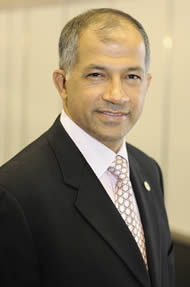
Mr Ali Al Naqbi (pictured), MEBAA’s Founding Chairman, is delighted with the announcement, “It is an exciting time for MEBAA as we continue to grow in membership numbers, products for our members, the launch of our fly and feed initiative, the Middle East Business Aviation show is set to take place at the end of the year at its new home – DWC. And finally, MEBAC, which has gained incredible traction now, spreading from the far west of the region to the east of the region and everything in between, in order to work together on issues critical to aviation’s ability to serve as a catalyst for economic growth. Our association will continue to meet and bring inspired and motivated people together through conferences in different cities around the Middle East and North Africa every year, to ensure the business aviation community remains at the forefront of this ever-changing industry.”

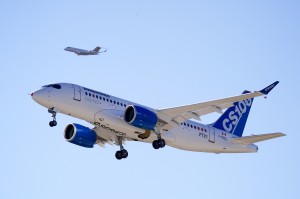
Bombardier 01-06-14According to the Wall St Journal, an incident during ground maintenance testing of the Bombardier C Series jet resulted in an uncontained engine failure and has grounded the jet until an investigation is completed. Although the engine and body of the aircraft were damaged, no personnel suffered any injury.

The geared Turbofan engine (PW1500G) from Pratt & Whitney features a new fuel-saving concept that sees different parts of the engine running at different speeds. The incident is likely to cause further delays to the program that is already behind schedule.

Pratt & Whitney now face a major setback commercially, with the engine currently holding more than 5,500 orders from Bombardier, Embraer and for the Airbus A320neo series.

The company were not available for comment.

Business Aviation Services ProvidersCurrent customers of BaseOps International will be able to look forward to utilising a new flight planning portal from June 2014. The company announced the forthcoming launch at the Geneva EBACE this week.

The web-based system will enable customers to plan routes and file the flight plans in addition to access NOTAMs and weather information, pre-order fuel and arrange aircraft handling, catering, hotels and even rental cars.

Web-based flight planning tools and services can assist military and business aircraft operators, providing secure and flexible solutions that are easily accessible from portable devices.

Other flight support services and flight planning tools providers, such as ARINC Direct for business aviation, bring packages that can be tailored to each individual customer, whether for a fleet of executive jets or for a single private aircraft.

Business Aviation ServicesA couple of former Embraer executives have formed a new leasing business in Dubai to provide simple and straightforward executive jet aircraft leasing to business aviation. The company was launched at EBACE last week.

The new company, Veling Tayara is a part of the airline leasing company, Veling, based in Mauritius and headed by Nirvan Veerasamy, former chief of Air Mauritius.

Ernie Edwards and Colin Steven, both former executives of Embraer Executive Jets are setting out to bring new types of leasing structures with simplified financing that will offer far more flexibility, allowing clients to upgrade or change the agreement as their businesses change.

Mr Edwards said, “Our structured finance model provides more than just an operating lease package for a client’s business jet. Instead of tying up an owner’s cash, an operating lease will permit the owner to invest in appreciating assets instead of depreciating capital equipment.”

“Together, my board and I believe there is a service we can provide the business jet financing world that places the client in the enviable position of not having to worry about aircraft disposal at the end of the lease. At that time, the operator can have the simple choice of either extending the lease or returning the aircraft. It’s as simple as that.”

“Veling Tayara will remove the burden of owning the asset and provide inherent options throughout the lease period. It will provide flexible operating leases designed to clients’ individual needs, permitting upgrades to larger, newer aircraft as the business grows,” said Mr Steven.

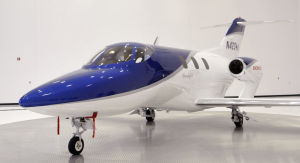
Honda Business JetHondaJet, a production model designed to carry up to seven passengers and crew in style has been unveiled at EBACE in Geneva this week. This much-anticipated debut from Honda was well-received, with the company proudly announcing several milestone achievements.

Honda, who have nine aircraft on the final assembly lines, said that the jet is ready for ground testing, having recently taken delivery of the first GE Honda HF120 engines. The first flights are expected to take place this summer.

“Honda Aircraft Co.’s most important goals are achieving Federal Aviation Administration Type Certification and delivering the first customer aircraft,” said Michimasa Fujino, president and chief executive. The final certification stages began in December 2013.

“The HondaJet production line is maturing with efficient and robust processes in place to build high quality aircraft,” Fujino said. “From handheld tablets that deliver worker instructions to an automatic guided cart to pick up and deliver parts, we continue to integrate the latest technology into our production process to create an efficient workflow.”

Business Jet Just before the opening of Geneva EBACE this year, two major aviation companies announced the launch of new, longer-range business jets, both set to be ready for the markets in early 2015.

The Gulfstream G650ER, an upgraded version of the popular G650, is undergoing FAA certification and will share the same cabin, systems and avionics, but will have a capacity of 7,500 nautical miles, the longest range of its class, according to Gulfstream.

“The G650ER provides our customers with greater mission flexibility and the longest range of any business jet,” Scott Neal, Gulfstream senior vice president of worldwide sales and marketing, said in a statement. “It’s the only aircraft in the world capable of travelling 7,500 n.m.”

Dassault have announced the development of the Falcon 8X, the sixth in the family, including the Falcon 5X that is still in development. The Falcon 8X will have a capacity to carry eight passengers and three crew, with the longest cabin of any other Falcon. With a range of 6,450 nautical miles, the aircraft will also have the longest range of the Falcon family.

Certification is expected at the beginning of 2016 for the Falcon 8X with deliveries to follow before the end of that year.

Leading Cabin Services ProvidersFlight crews and maintenance personnel will now be able to receive cabin communications training from Satcom Direct in a partnership with FlightSafety at the Teterboro Learning Centre in an expansion of their current training program in Georgia.

The aim is to provide cabin communications equipment training in a demonstration of how the satellite and equipment functions and operates in order for cabin crews to better assist passengers with the operation of the IFE systems and for maintenance crews to learn to troubleshoot.

“Students will have a hands-on experience just like they would in the aircraft,” said Scott Hamilton, Satcom Direct chief strategy officer. “They’ll learn how to optimize computers and mobile devices for satellite internet and voice communications.”

Using the very latest equipment from Inmarsat and Iridium, in addition to the Satcom Direct systems, students will learn how to deal with inoperative equipment whilst in-flight, enabling minor issues to be ironed out with minimal disruption to the service.

Cabin communications providers offer seamless connectivity for passengers and crew with Internet access for in-flight entertainment.

arrows-navigation-05-14In today’s modern cockpit, it is difficult to imagine what navigation must’ve been like back in the days before GPS and datalink air traffic control, on-board computers and high-technology.

Evidence of how 1920’s, 30’s and 40’s pilots navigated around the country is still visible today in parts of Kansas in the form of giant concrete arrows on the ground. The U.S. government built a series of light beacons at 10-mile intervals along certain flight paths, including the most famous which stretched from New York City to San Francisco. Underneath many of these beacons were placed the huge arrows.

Today, four of these arrows and one tower are left in Kansas at the Kansas City – Amarillo Airway. Although three are located on what is now private property, one is public; located at the southern end of the Anthony Municipal Airport and attracts hundreds of enthusiasts each year. While they can be seen from the ground, the most clear view is given by satellite images, as the original intention, of course, was to view them from the air.

It is fascinating to think of these as essential navigation for pilots using the eyes as the greatest instrument, rather than reliance upon the many navigational technological advancements that we see today.

Other Providers of iPad Applications for the CockpitThe iPad Mini with retina display will soon become a feature on the flight deck after being issued with a letter of Operational Suitability by the FAA for use with Jeppesens’ electronic flight bag (EFB).

‘We are pleased with the findings of the FAA evaluation team confirming the use of iPad mini and Jeppesen mobile EFB solutions,’ said Tim Huegel, director of Jeppesen Aviation Portfolio Management, ‘iPad mini and iPad mini with Retina display offer pilots the incredible detail and ease of use they need when leveraging our valuable data-driven apps and flight information in the cockpit’.

U.S. operators and air carriers must gain formal FAA authorisation for the use of electronic flight bag applications on the flight deck and Jeppesen will issue copies of the letter to those customers that express an interest in the use of the iPad Mini for specific use in their authorisation application.

Other providers of EFB solutions include ARINC Direct, recently acquired by avionics giant, Rockwell Collins. EFB solutions, such as iPad pilot apps, can minimise weight in the cockpit and bring a significant reduction of the pilot’s workload, offering sharing capabilities for flight information, changes to the flight plan and real-time weather updates, graphics and maps.

The advent of the iPad and now the iPad Mini on the flight deck moves the industry another step closer to the sought-after paperless cockpit.