Archive

Tag Archives: aviation news

Automated Baggage Handling ProvidersThere is little doubt that airports with automated baggage handling provide a smooth, enhanced experience for passengers, reducing waiting times and streamlining the flow of baggage and passengers through the check-in system.

As many of us use some form of self-service check-in process, the advent of the one-stop kiosk is proving to be a huge benefit to those of us who wish to remain in control of every step of our journey.

Keeping it simple is the key. Easy-to-operate systems must be installed to enable even the virgin traveller to handle their own check-in with no fuss. The latest CUTE systems provide a comprehensive check-in system that has clear, simple instructions on a touch-screen interface that enables the passenger to;

  • Check in                 
  • Receive a boarding card and baggage tag
  • Attach the baggage tag
  • Place baggage in the kiosk, where it can be weighed, scanned and sent into the baggage handling system

Automated baggage handling system providers, such as ARINC, use the latest technology to provide just that. Simple, easy-to-operate systems that ensure that the baggage follows the passenger to their destination, including connecting flights, with the help of RF tagging is becoming essential to operational productivity.

The latest automated baggage handling systems are able to keep track of baggage with RF readers at critical points along the track, such as merging points and separators, which ensures that baggage can be verified and expedited along the correct route, even with business passenger baggage, that tends to arrive much closer to departure time.

As airports are being placed under greater pressure with the increase in passenger flow, particularly at peak times, Common Use Terminal Equipment is the answer to the expedition of the check-in process and automated baggage handling systems are growing in popularity across the globe.

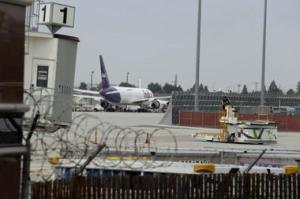
Visit Aviation Security ProvidersIt appears that the Kenyan government are preparing plans for funding to be released at the start of their new financial year to provide upgraded security for major airports around the country. The largest portion of the funding, rumoured to be in the region of 6.4 billion Kenya Shillings, will be invested in upgraded perimeter fencing to improve physical security and the installation of additional CCTV equipment.

Although security measures are in need at Jomo Kenyatta International Airport (JKIA), it is yet to be confirmed whether the much-bemoaned multi-security point access system will be upgraded to provide better, single point access for the new Terminal four. According to the Transport Cabinet secretary, Kamau, the new terminal should be open by the end of the summer and will increase capacity at JKIA by several million passengers, which will hopefully give rise to the full refurbishment and awaited modernisation of Terminals 2 and 3, currently working as international departure terminals.

Physical security in airports across the country is the priority and upgrades to perimeter fencing are in dire need.

arrows-navigation-05-14In today’s modern cockpit, it is difficult to imagine what navigation must’ve been like back in the days before GPS and datalink air traffic control, on-board computers and high-technology.

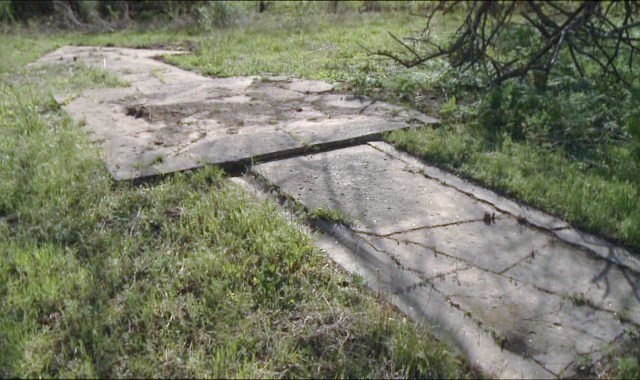
Evidence of how 1920’s, 30’s and 40’s pilots navigated around the country is still visible today in parts of Kansas in the form of giant concrete arrows on the ground. The U.S. government built a series of light beacons at 10-mile intervals along certain flight paths, including the most famous which stretched from New York City to San Francisco. Underneath many of these beacons were placed the huge arrows.

Today, four of these arrows and one tower are left in Kansas at the Kansas City – Amarillo Airway. Although three are located on what is now private property, one is public; located at the southern end of the Anthony Municipal Airport and attracts hundreds of enthusiasts each year. While they can be seen from the ground, the most clear view is given by satellite images, as the original intention, of course, was to view them from the air.

It is fascinating to think of these as essential navigation for pilots using the eyes as the greatest instrument, rather than reliance upon the many navigational technological advancements that we see today.

Solutions for Airport Perimeter Security As the aviation industry reels in shock as a teenage stowaway breaches airport perimeter fencing to board an aircraft bound for Maui, even more serious questions are raised about airport security. Video surveillance footage clearly shows the boy make his way across the tarmac and climb into the wheel well of the plane, yet it was missed.

Since 9/11, airport security has been stepped up, or so we thought. There are increasing numbers of airport breaches being reported, articles claiming that passport checks are not being accurately carried out and monitoring equipment not being monitored.

Holes in security are most certainly there. Although security cameras are installed, they must be manned consistently to be effective. Airport perimeter fencing is more effective at keeping animals from the runway than people, it is said.

Officials are concerned and according to the New York Times, portions of the fencing at the airport are falling down in places.

Measures to Upgrade Airport Communications SystemsAn investigation into the November shooting at Los Angeles International Airport (LAX) that resulted in the death of airport security officer Gerardo Hernandez and the injury of three others, has highlighted airport communications issues and the need for enhancement in this and other physical security areas.

It is important that lessons learned from the tragic incident are used to review and improve security operations and make changes to bolster safety at not only LAX, but at airports across the country. Subcommittee chairman Rep. Richard Hudson, R-N.C. said that ‘communications breakdowns are not unique to LAX.’

The panel was told that co-ordination among ‘all relevant agencies’ and technical issues prevented the agencies from communicating directly with one another, taking more than 45 minutes before a cohesive plan could be put into action.

The incident is likely to put pressure upon authorities to implement technology to enhance airport communications and the interoperability of communications to ensure such an incident does not recur. Across the world, airport security issues are being raised, from passenger processing to physical security and perimeter fencing.

With technological advancements, information sharing and communications systems, there is a realisation that the solutions are available, yet action needs to be taken and investments made to ensure utmost security is held paramount in airports across the globe.

Other Providers of iPad Applications for the CockpitThe iPad Mini with retina display will soon become a feature on the flight deck after being issued with a letter of Operational Suitability by the FAA for use with Jeppesens’ electronic flight bag (EFB).

‘We are pleased with the findings of the FAA evaluation team confirming the use of iPad mini and Jeppesen mobile EFB solutions,’ said Tim Huegel, director of Jeppesen Aviation Portfolio Management, ‘iPad mini and iPad mini with Retina display offer pilots the incredible detail and ease of use they need when leveraging our valuable data-driven apps and flight information in the cockpit’.

U.S. operators and air carriers must gain formal FAA authorisation for the use of electronic flight bag applications on the flight deck and Jeppesen will issue copies of the letter to those customers that express an interest in the use of the iPad Mini for specific use in their authorisation application.

Other providers of EFB solutions include ARINC Direct, recently acquired by avionics giant, Rockwell Collins. EFB solutions, such as iPad pilot apps, can minimise weight in the cockpit and bring a significant reduction of the pilot’s workload, offering sharing capabilities for flight information, changes to the flight plan and real-time weather updates, graphics and maps.

The advent of the iPad and now the iPad Mini on the flight deck moves the industry another step closer to the sought-after paperless cockpit.

Solutions for Advanced Passenger Information SystemFollowing the disappearance of flight MH370, the focus of the Annual General Meeting of IATA this key will be enhancing security and finding ways to prevent the recurrence of such an incident.

Tony Tyler, Director-General and CEO of IATA stressed that speculation on the aircraft cannot be a guide to move forward, he said, ‘We need to base our efforts on evidence and conclusions that will come out of investigation. When an incident or accident occurs, our thoughts go to the families and friends of all those on board, and we rededicate our efforts to make this industry even safer.’

Mr Tyler added that the air transport industry is safe, with a low accident-flight ratio, but the ‘world cannot afford to leave the unprecedented missing of such a large aircraft as an aviation mystery’.

Among the issues to be addressed will be the length of time it is taking to locate the missing aircraft and to ensure that adequate flight tracking can be put into place. The issue of airport security and passenger screening has also been highlighted by the fact that two passengers were able to board with stolen passports.

The AGM, scheduled for early June, will focus upon improvements to passenger safety and will discuss the urgency of countries to provide advanced passenger information.

Providers of CPDLC CommunicationsRockwell Collins, recent acquirers of ARINC Inc, has announced an expansion on its Future Airspace Navigation System (FANS) 1/A capability and is offering an upgrade to Dassault Falcon 50EX, 2000 and 2000EX that are currently equipped with their avionics and flight management systems. The upgrades will be available during 2015.

The FANS a/A upgrade will bring operators savings of both fuel and time, helping to reduce the pilot’s workload with CPDLC capability and Automatic Dependent Surveillance-Contract (ADS-C) and offering enhanced clarity of communications in remote oceanic and Polar Regions of the globe.

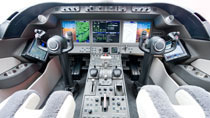
Business Jet Connectivity ProvidersBombardier’s latest addition to the family is the Learjet 85, a beautiful single-aisle business jet with a capacity for up to 8 passengers. The aircraft will include Rockwell Collins’ award-winning Pro-Line Fusion avionics and the horizontal stabiliser trim system (HSTS) for superior flight deck connectivity.

The HSTS helps to control the pitch of the horizontal stabilizer, which can reduce drag and trim the aircraft to improve efficiency for the entire flight. With two placement point in the aircraft frame, safety is optimised, as the Learjet features thinner cabin walls to maximise space inside, improving passenger experience and comfort.

Pro Line Fusion is the latest award-winning offering from Rockwell Collins, featuring the largest LCD displays in the industry at 15.1 inch and a suite of capabilities including, but not limited to:

• Dual Flight Management System
• Localised Performance with Vertical Guidance
• Integrated Flight Information System,
• Synthetic vision
• Intuitive electronic checklists
• Electronic Circuit Breaker display and control

Bombardier’s Learjet 85 took its first flight this week in Wichita, Kansas and will be ready for the first deliveries in early 2015.

Cabin Services Providers for Enhanced Passenger ExperienceCabin services are set to be enhanced for global business awareness as Japanese airline, All Nippon Airways announced a partnership with EF Education First to provide language training via a cloud-based school.

The plans come in the wake of the recently-released corporate strategy for the airline as it plans to increase passenger operations by 45% over the next two years. Global expansion is a key factor and ANA believe that highly-trained and prepared personnel can contribute to their plans.

ANA was last year awarded the Skytrax 5-star Airline ranking for the quality of cabin services, airport operations and enhancements to the service provided for international passengers.

President and CEO of ANA, Osamu Shinobe has high hopes for his airline, ‘As a full service carrier that is aiming to become the world’s leading airline, we want to further enhance the level of service that is provided by our employees. EF has an excellent track record in providing quality language training programs and this partnership will boost our improvement efforts. I have high expectations that this partnership will lead to even better services for our customers.’

President of EF Education First, Mr Peter Burmann said, ‘We are extremely proud to partner with ANA and support them in reaching their English goals. Our industry-specific expertise makes us well-suited to deliver the necessary customised training to ANA and we are looking forward to starting the training and seeing outstanding results.’