Archive

Tag Archives: aviation communications

Other Providers of Operational Messaging SolutionsKazakhstan’s Air Astana is set for further growth with the operational messaging solution for ATS and advanced datalink. Air Astana has expanded in recent times across the CIS and Central Asia regions and has become the travel provider of choice for many passengers, both national and international, with a growth of around 9% annually.

Last year the carrier experienced a 13.5% traffic increase and is preparing for future growth with the latest messaging solutions. Type B messaging underpins every aspect of aviation operations, including commercial and air transport to flight ops and ground support, encompassing passenger services, booking and ticketing to baggage handling and needs to be seamless and reliable to ensure maximum operational productivity.

Providers of Type B Messaging handle many millions of mission-critical transmissions every day and keep the aviation industry smooth running behind the scenes.

Cockpit datalink messaging is critical for management of flight communications, such as ACARS and the provision of datalink technology is a fast-growing requirement across the world for enhanced visibility and transparency of messaging.

Air Astana have selected SITA as their operational messaging provider. Chamindra Lenawa, Vice President IT & eBusiness of Air Astana said, “As Air Astana continues its growth, it is important that we have the right infrastructure in place. We use SITA because it offers excellent service quality and global coverage. Most importantly, because SITA is owned and operated by the air transport industry, the SITA team understands and responds to our needs very well.”
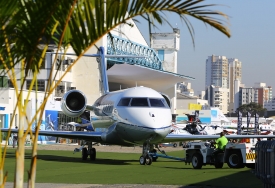
business aviation growth 13-08According to recent data, the region encompassing Latin America and the Caribbean is home to 2457 jet aircraft and 2588 turboprops, which represents almost 15% of the world’s fixed wing business turbine fleet. Mexico, with 851 and Brazil, with 824 business jets have the second and third-largest business jet fleets after the U.S. who carry a fleet of almost 12,000 altogether.

“The LAC business jet fleet growth and LAC GDP growth have been essentially expanding in tandem over the last 10 years, averaging about a 3.9-percent compound annual growth rate (CAGR)–faster than North America,” said Rolland Vincent Associates president Rolland Vincent. “The 50/50 balance between business jets and turboprops in the LAC fleet is in contrast to the worldwide jet/turboprop mix outside the region, which favors business jets by 1.5:1.”

According to Vincent, the LAC region has the highest concentration of business jets – 4.52 per 1000 High Net Worth Individuals (HNWIs), amounting to more than three times the world average of 1.44 and ahead of the U.S. at 2.87, making the LAC region ripe for business growth and an ‘attractive’ step-up market for the larger corporate jet manufacturer.

This is because, he said, that the average business jet fleet age is approximately 19 years old and 54% of the fleet is in the light jet aircraft segment. The growing number of HNWI’s in the region shows positivity in terms of the potential sales over the next 5 years as the world average age of corporate aircraft is around 16 years old.

Brazil’s business aircraft fleet expansion has been helped by the rising prominence of ‘homegrown’ Embraer, Vincent said. “The fastest-growing OEM, Embraer has established a particularly strong base and loyal following amongst LAC aircraft owners and operators, growing its fleet by 16.5-percent CAGR worldwide since 2008, and capturing more than 7-percent share of the LAC business jet fleet as of mid‐2014.”

Other SwiftBroadband SATCOM Solutions ProvidersKing Air will soon be installing its SwiftBroadband SATCOM solution with installers Cobham SATCOM receiving Supplemental Type Certificate (STC) approval from Brazilian Administración Nacional de Avianción Civil (ANAC).

King Air models B200, B200C and B300 (Super King Air 350) will receive access to an extensive range of communications abilities with built-in WiFi options.

The aircraft will receive Cobham’s AVIATOR 200, a compact, lightweight system with the reliability of SwiftBroadband, Inmarsat’s 200 service. With speeds of up to 200 kbps and a single ABME 2 channel for voice calls, the King Air aircraft will be fully connected.

Kevin Harriman, Pro Star Aviation General Manager, said, “The AVIATOR 200 is the perfect choice for King Air operators as it offers the ideal broadband and voice solution and is small and lighter than other solutions. It is practical and affordable, and, with reduced hardware and installation costs, the AVIATOR 200 is everything you need to stay connected.”

Kim Gram, Vice President Aeronautical Business Unit, Cobham SATCOM, said, “The AVIATOR 200 offers in-flight broadband communication to aircraft of virtually any size as it utilizes a low gain antenna. We are particularly pleased to add the Brazilian approval to the FAA and EASA STCs already developed with Pro Star for King Air. This is a world-wide solution which can now benefit many more people. It represents another key step forward in enabling more users to take advantage of modern in-flight communications in the South America region.”

Other Inmarsat SwiftBroadband SATCOM providers, such as ARINC, can offer business jet operators seamless global connectivity with its unique partnership with the Iridium satellite networks.

Arizona Airport FBO, Scottsdale AirCenter’s aFlight Support & Business Aviation Services Providersssets have been acquired by Signature Flight Support, it was announced today. The 16th largest business aviation airport in the U.S. and a dedicated general aviation airport serving the Greater Phoenix Metro Area, Scottsdale AirCenter is one of only two FBOs on the field. Signature Flight Support is the world’s largest fixed-base operation and distribution network for business aviation services and is a division of BBA Aviation PLC.

Services include fuelling, hangar and office rentals, ground handling, maintenance and an extensive range of passenger and crew facilities.

Business aviation services and flight support services providers across the world ensure the smooth running of operations within airports. Many providers also offer flight planning and communications solutions for the flight deck and for airport operational productivity, largely running ‘behind the scenes’ of operators.

Scottsdale AirCenter is housed in a modern facility with 145,000 square feet of hangar space for large cabin business aircraft and 12,000 square feet of terminal space. Additionally, the centre has concierge services, passenger lounge, pilot and crew lounge and gift shop with an extra 32,000 square feet of shop and office space.

Maria Sastre, President and Chief Operating Officer for Signature Flight Support commented on the acquisition, “Scottsdale AirCenter represents an important addition to our world-class FBO locations in our global network. Their reputation for exceptional customer service was one of many attributes Signature considered in making this acquisition. Scottsdale AirCenter is a fantastic facility in a key market for Signature. We welcome the staff and customers of Scottsdale AirCenter to the Signature family.”


Electronic Borders Technology for Effective Passenger Screening

A Credential Authentication system is to be installed at major U.S. airports for screening passenger information in place of visual inspection. The seven-year, $85 million contract has been awarded by the Transport Security Administration (TSA) and will read multiple security features contained within passenger identification documents to ensure that it is genuine.

MorphoTrust is a provider of identity solutions and will undertake the contract for the TSA. “MorphoTrust E-CAT is the culmination of many years of work to address airport security requirements following the 9/11 tragedy, while simplifying travel for American citizens,” MorphoTrust CEO Bob Eckel said. “It is also just the beginning of our vision for what’s possible in air travel, creating a future in which passengers can move easily and securely from the curb to the gate without boarding passes or security lines.”

The electronic security industry is helping to secure borders across the world with the latest technology. EBorders solutions are helping to take security to another level with solutions for passenger processing and screening, the secure and reliable transfer of Advance Passenger Information, biometric security and bioterrorism detection systems.

Business Aircraft Broadband ProvidersEchoing an industry-wide sentiment, Mike Minchow, Completions and Modifications Manager for Duncan Aviation said, “There is strong market demand for products that increase the productivity of business aircraft. Wireless internet certainly filled a need for business aviation, and Aircell has been a leader in that market. On-board Wi-Fi has completely transformed the travel experience, allowing operators to be much more efficient in the air and allowing for a true office-in-the-sky experience. Combining the benefits of our Organization Designation Authorization (ODA) and multiple locations, we’re able to offer owners a great deal of flexibility as well as the confidence that their aircraft is in the care of the most experienced technicians in the industry and a company known for its service and support”.

He spoke after Duncan Aviation reached a milestone 500 installations of in-flight broadband solutions, such as SwiftBroadband and Aircell GoGo Biz.

Business aviation passengers rate amongst the highest in terms of demand for in-flight broadband solutions, requiring seamless connections over long-range flights. The office-in-the-sky advantages for travellers needs include email, video conferencing, phone calls and fax operation, to name but a few. Inmarsat SwiftBroadband and Iridium solutions, such as those provided by ARINC Direct, can mean that there is no loss of signal, even when flying over vast oceanic expanses or Polar Regions.

Airport Operations Integrated with Management SolutionsExelis, aerospace and defence information company headquartered outside Washington, VA, have announced their acquisition of Orthogon; German airport operations management business, providing applications for air traffic flow management and decision-making to airport operators and ANSPs across the world.

The Orthogon business designs and develops traffic optimisation applications and predict traffic demand on runways, giving airport operators flexibility to optimise their resources both on the ground and in the air.

“The acquisition of Orthogon expands our aviation solutions portfolio and international market position,” said Pam Drew, Exelis president of the Exelis Information Systems division. “With our global airport presence and Orthogon’s queue management applications we see opportunities to deliver solutions to our customers that will lower costs and increase capacity and efficiency of their operations.”

Airport management systems integration is a necessary part of the process of information management. Additional applications available from other providers of airport management systems can include ‘back-office’ applications that assist with the smooth and efficient operation of baggage handling systems and passenger processing. As airports grow busier, with estimated passenger flow on the increase to the tune of more than 5% each year, operational productivity can suffer without key integrated systems in place.

Iridium Satellite Communications ProvidersL2 Consulting Services has announced that the Civil Aviation Administration of China (CAAC) has issued Validation Supplemental Type Certification for the installation of Iridium Satellite Communications Systems on 737 aircraft last month.

This follows the original FAA certificate for Rockwell Collins’ IRT-2120 Iridium SATCOM system and ICG NxtLink ICS-220A, both providing the flight crew with dedicated data link channels to support ACARS, CPDLC, an exclusive global voice channel and FANS messaging.

L2 are avionics engineering, installation and integration providers and have specialised in this area of the industry since 1997, with the integration of digital avionics systems into analog aircraft. The company currently hold existing Iridium certifications for B747, B757 and B767 aircraft and handle the STC regulatory process with the European Aviation Safety Agency (EASA).

L2 Vice President of Operations, Dean Rudolph said, “We are delighted to have received the CAAC validation of our STC and are now able to offer our customers in China a fully certified Iridium Communications solution on the B737NG series aircraft.”

Physical Security & Access Solutions ProvidersThe busiest airport in Latin America is positively humming at the moment with the elevated traffic levels for the World Cup. Expected traffic increases ahead of the Olympics has encouraged a push for modernisation in the airport and security systems.

GRU has implemented an Identity Management System, including both physical and access solutions, which is intended to streamline airport operations. GRU engaged Quantum Secure for the implementation of their ‘SAFE for Aviation’ software.

Identity Management Software can help to streamline operations with the ability to define credentials with necessary privileges and security checks requirements, lifecycle management, and the management of watch lists and TSA ‘No-Fly’ lists during the enrolment process.

Using the software, operatives will be able to use Smartphones and Tablets with the Aviation Mobile Infraction module.

The software is also able to create an audit trail for all employees and visitors, with the option of using fingerprint technology. The sophisticated software will revolutionise the way that GRU employs personnel (temporary and permanent) and moves them, visitors and contractors around the airport.

“SAFE is designed to the TSA paradigm, so we have brought those concepts to GRU, which are meeting and exceeding ANAC’s current capabilities, making airport security more traveler-friendly, secure and streamlined,” said Ajay Jain, President and CEO of Quantum Secure. “With SAFE, GRU is able to streamline its security and credentialing operations, ensure compliance with TSA-level policies and future-proof its physical security infrastructure while also benefiting from significant cost reductions.”

Find out more about CPDLCPilots and Air Traffic Controllers in Canada are embracing aviation technology’s finest innovations and are using text messaging rather than radio to relay mission-critical transmissions and instructional data.

Pilots are able to text changes to flight requests and can receive altitude information, headings, speed and routings via text messages. With the use of the new, text-based messaging service in Canadian skies, particularly for routine communications, the cockpit is becoming more and more automated. The benefits do not stop there – using datalink technology can help to overcome the issues created with international flight. Standard text can eliminate language barriers and potential issues with misunderstanding an accented voice.

With an estimated 2,500 messages per day, the new service is set to streamline Canadian cockpits, saving time and increasing operational productivity.