The International Atomic Energy Agency (IAEA) recognise the important roles that non-nuclear weapon states, such as those in Africa are playing in shaping and enhancing nuclear security, in spite of development challenges that they face and rising economic issues.

At the forthcoming, and probably penultimate, Nuclear Security Conference in July this year, with the last of three summits planned in the Netherlands in 2014, the IAEA hosts will have a chance to strengthen its corroborative role with states to enhance their capacity for nuclear security and will provide an opportunity for stakeholders to have their say, proving input into the agency’s Nuclear Security Plan for 2014-17.

This is good news for African states in particular, as they have had little chance to participate in global nuclear security debates as the international community continually search for a channel in which to encourage the nuclear security agenda forum in a more fundamentally inclusive way.
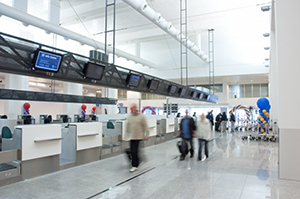
Passenger ProcessingStarting with Honolulu Airport, Hawaii say they are the first in the U.S. to move to completely automated self-baggage tagging with their new multi-airline check in kiosks.

Provided that Hawaiian passengers have self-printed boarding passes, they will be able to weigh, tag and check-in their baggage, leaving airport staff more time to assist passengers with oversized baggage or those with special needs.  This system will greatly reduce waiting time and streamline airport operations.

“Every minute saved in the check-in process improves our customers’ experience substantially, so this is a significant enhancement,” said Hawaiian’s Vice President for Customer Service Louis Saint-Cyr. “The kiosks reduced our customers’ check-in time to eight minutes. The ability to self-tag bags reduces the check-in time even further — by nearly half.”

There is a range of multi-airline check-in services out there, including the ARINC solution, vMUSE, and offering multi-airline check-in and bag drop facilities within an integrated suite of applications.  The vMUSE option maximises airport operations, eliminates the necessity for costly upgrades and gives smaller airports the flexibility of utilizing precious counter space.

ARINC offer interoperability with vMUSE solutions, using existing CUTE systems technology, allowing seamless operations for multi-airline check-in, self-printed boarding passes and bag drop facilities from an industry-leading, reliable provider.

Seal Dynamics, a division of Heico Aerospace will use ARINC’s AviNet mail from now on for all their critical Type B messages.

Seal Dynamics stock, manufacture and sell millions of components for the aviation industry, processing hundreds of orders each day.

It is important for them to ensure highly reliable and fast communication of these orders, often consisting of urgent replacement parts from their diverse range of products, to minimize delays or ground-time for their aviation partners – a costly exercise.

ARINC are world-leaders in communications solutions, serving hundreds of aviation businesses and handling millions of critical Type B messages every day.  AviNet mail is capable of delivering mission-critical Type B messages within one second and is the most reliable in the industry.

Type B messaging is used by aviation companies to deliver global mission-critical communications for a number of reasons, such as replacement aircraft components, weather data, flight planning and passenger reservations.

“We chose ARINC’s AviNet Mail because it provides us with high message reliability, ease-of-use, accessible support, alternative methods for accessing Spec2000 messages and on-demand traffic analysis,” said Vice President of Technology at Seal Dynamics, Marc Alter.

Yun Chong, ARINC Vice President of Global Network and IT Solutions, said “ARINC values the opportunity to serve a recognized market leader and we look forward to a long and mutually beneficial relationship.”

It was recently reported in the latest release of the Wingx Business Aviation Monitor that business aircraft flight departures fell by 10% in Europe over the past year.  The figures reflect a major decrease over the year, mostly due to March 2012’s strong figures, as March 2013 showed 20% more activity than February 2013.

The Euro Zone financial crisis has been blamed for the major decrease, as there were increases in flights from the Middle East, BRIC countries and East and West Africa.

Christoph Kohler, Managing Director of WINGX Advance, said, “March analysis indicates a slump which was certainly precipitated by further Euro Zone tensions, especially affecting demand in Germany. The overall picture is gloomy, but there is growth, in selective aircraft types and on specific routes.”

Growth was recorded, however, in the Russian Federation, Norway, Turkey and the Ukraine with a couple of activity spikes in Malta and Cyprus.  The relatively small business aviation market associated with Ireland also saw an increase.

Piston activity was badly hit, being 27% down over the year, business aviation charter activity coming down by 6% compared to March 2012.

This comes as business aviation services become more affordable to the sector and surprisingly the largest drops were felt by smaller aircraft, such as Cessna, Beechcraft and Piper aircraft, while the industry experienced a rise in usage of Ultra-long range, Bizliner and Heavy Jets.

ARINC with their development of ACARS in the 1970’s are well-known in the aviation industry and the clear choice when looking for support with CPDLC solutions.

Air Navigation Service Providers (ANSPs), having responsibility for a large number of aircraft in wide ranging airspace, require different support to individual airlines for obvious reasons.  ARINC’s services are in high demand in this area.

Controller Pilot Datalink communications (CPDLC) with Air Traffic Control (ATC) via VHF datalink Mode 2 (VDLM2) is set to replace ACARS messaging in the future, and ARINC will be advising airlines on their specifications for equipping, upgrading or retrofitting to enable use of CPDLC by February 2015.

ARINC already works with ANSPs across Europe – NATS (UK), DFS (Germany) and Skyguide (Switzerland) to ensure they implement the links by the end of this year.

Yanko Videv, ARINC EMEA Aviation Solutions datalink program manager said that they aim to engage with ANSPs “In the early stages of their requirement definition, to facilitate a smoother transition to CPDLC.”

The International Civil Aviation Organisation (ICAO) want to see a universal worldwide standard for datalink communications based upon ICAO Aeronautical Telecommunications Network standards, with voice communications used as a back-up.

Although the U.S. will not use the same system as Europe, for now, the Future Air Navigation System (FANS) standards will continue to be accepted in VDLM2 regulated airspace, under exemption, until harmonization occurs.

Seal Dynamics, one of the world’s largest and diverse suppliers of aviation parts and components becomes one of the latest customers for ARINC’s industry-leading AviNet Mail.

Based in the U.S. and with field locations across the globe, Seal Dynamics are committed to meeting customer demand, fulfilling hundreds of daily orders of FAA PMA approved, self-manufactured parts and components from OEM-approved manufacturers for the International market.

With a focus upon reliability and timely delivery of critical parts for airlines, Seal Dynamics needed a solution that provided essential back-up for their electronic ordering system.  Their reputation depends upon excellent service and efficient processing of parts orders to ensure the continuity of airline operations.

ARINC Incorporated, with their global reputation for the provision of innovative communications solutions proved that AviNet Mail is more than capable of the job in hand. Using Type B messaging services to handle critical communications is a daily occurrence for ARINC, serving many hundreds of aviation customers with decades of industry assurance of delivery and utmost reliability.

‘We chose ARINC’s AviNet Mail because it provides us with high message reliability, ease of use, accessible support, alternative methods for accessing Spec2000 messages and on-demand traffic analysis’ said Seal Dynamics Vice President of Technology, Marc Alter.

Yun Chong, ARINC Vice President of Global Network and IT Solutions said ‘ARINC values the opportunity to serve a recognized market leader and we look forward to a long and mutually beneficial relationship.’

Bag Drop Desks

Bag Drop Desks

Since the announcement from EasyJet of the imminent closure of their check-in desks, replacing them, instead with bag drop desks, the face of airline travel is set to change.

More than 80% of airline passengers now choose to check-in online and can do so from 30 days before departure to 2 hours before the flight, printing their boarding passes at home.

This innovation spells the end of the ritual of the queue at check-in desks at airports around the world, ultimately reducing airport congestion and speeding up the entire process of check-in, with the potential of increasing operational efficiency and productivity for airlines.

Bag drop desks do not have to be airline-specific.  ARINC have developed ExpressDrop desks, for use by passengers who have checked in online, travelling with various airlines, providing a single drop-off point to simplify, expedite and offer passengers an enhanced experience with greater control.

The idea is not a new one, by any means.  Ryanair closed their airport check-in desks in 2009, but does charge passengers inordinate fees if they forget to check-in online.

Another advantage to the introduction of ExpressDrop or other bag drop desks, is that waiting times are reduced.  This will produce great sighs of relief for travellers, who may arrive at the gate as late as 30 minutes before departure.

Infrastructure Security

Infrastructure Security

As global demand for oil and gas increases, further pressure is placed upon resources providers in terms of infrastructure security, an industry calculated to be worth more than $28.44bn in 2013.

Many countries around the world are experiencing alarming rises in issues such as terrorist attacks, civil unrest and criminal activity linked with provocation from economic instability and the growing competition of the world markets.

It has never been more crucial time for the introduction of necessary enhanced infrastructure security to protect current and potential future expansion of company holdings.

Visiongain, working in partnership with the U.S. Federal Government, has released a detailed report, highlighting the growing opportunities for oil and gas infrastructure security providers, identifying leading companies and providing valuable insight into world oil and gas market developments.

The unique report shows a representation of leading opinion and analysis into national, submarket and indeed, global forecasts for the next ten years.

The fatal crash of a Lebanese Hawker 850XP executive jet has been blamed on inadequate de-icing before it crashed on take-off according to Iraqi investigators. The accident happened as the Lebanon registered aircraft tried to take off from Sulaymaniyah in Iraq on route to Turkey on 4th February 2011.

When the crash happened weather data for Sulaymaniyah had included snow. Snow on the upper surface of the wing was not removed prior to take off according to Iraq’s ministry of transport.

The Hawker 850XP stalled before reaching sufficient speed and crashed 2100m from the runway. No one on board survived the burning aircraft, two executives from Asiacell and three crew members were killed.

A great aviation story in the news today! The woman was trying to get the tadpoles though customs in Guangzhou Airport in China travelling to South Korea. Customs officers noticed and made the woman spit them out in a bucket. It’s an offence in some countries to smuggle tadpoles and could result in a full scale alert.

When the woman was questioned said she was given the tadpoles by a friend and didn’t want to lose them. Airport staff said this is not the first time a passenger has tried to smuggle amphibians through airport security.

A South Korean woman tried to swallow a mouth full of tadpoles

A South Korean woman tried to swallow a mouth full of tadpoles