ARINC eBorders APIS is part of a suite of integrated Electronic Border Control solutions designed to improve border security with the provision of passenger and crew data in advance of arrival offering Immigration greater control over the flow of people to and from the country.

Paradise holiday destination, The Maldives have just awarded ARINC a five-year contract for the implementation of ARINC eBorders APIS at its international airports in a bid to improve efficiency and passenger flow in addition to the obvious security enhancement of advance passenger and crew information.

Mr Hamid Fathuhulla, Deputy Controller for the Department of Immigration and Emigration in the Maldives said, “We have chosen ARINC as our technology partner because of their industry leadership as well as proven expertise and experience of working with the world’s airports and airlines.  We are confident ARINC will meet our technology needs every step of the way as we continue to grow.”

ARINC offer tailored solutions according to the individual requirements of each customer and the industry standards of the international trade organizations and governmental mandates.  With decades of industry experience, ARINC remain world leaders in the fields of aviation, transportation and security, offering an extensive range of technological and communications solutions in the air, on the sea and on the ground.

Michael DiGeorge, ARINC Asia Pacific Managing Director said, “It is crucial for airports and other points of entry to meet their border security and control requirements while providing the highest levels of customer service.  At the same time, they need to manage increased operational costs as a result of compliance to new security requirements and mandates.  We are committed to helping the Maldives meet its current and future border security and control objectives.”


CPDLC Airservices, Australia’s air navigation service agency and the Dept of Defence have put out a request for tender for the creation of an aligned Air Traffic Management platform that is intended to harmonise the ATM & CPDLC requirements of both civil and defence movements.

The organisations want the new system to increase co-operation and reduce overlapping, improve communications via CPDLC and to streamline processes and equipment including training and subsequent expertise that can be shared across the workforce.

Airservices CEO, Margaret Staib said, “Through more flexible use of airspace, it will enable better management and prioritisation of an increasingly complex traffic mix. In an environment of projected growth, it will also allow us to connect the Australian aviation industry to deliver world-best industry performance.”

The aim is to bring Australian aviation airspace into a unified state, rather than accepting the limitations of separately managed volumes.  A shared and harmonised airspace, including CPDLC and air traffic management solutions will increase safety aspects and operational efficiency across the board in the increasingly complex range of traffic.

Air Marshal Brown, Chief of the Air Force said, “The streamlining of equipment and processes will bring with it shared expertise and facilities, creating economies of scale whilst delivering greater flexibility meeting the needs of airspace users.”

The US-EU spying scandal could stir up a hornets nest for the aviation industry regarding passenger data sharing if the allegations are proved to be correct.

The German report in ‘Der Spiegel’ suggested that the US’s NSA have targeted the EU with its spying activities. Concerns have been raised and an investigation is underway, with demands from Green Party Leaders to cancel the transfer of passenger data, in the form of Passenger Name Records (PNR), which include such information as passenger name, address details, destination and baggage, payment details and travel itinerary.

Arguably, the provision of PNR and Advance Passenger Information (API), now mandatory for US flights, has considerably reduced the risk of terrorist activity.  Since 9/11, understandable concerns became obvious and, after a thorough investigation, the provision of passenger data enables government bodies to screen passengers before boarding the aircraft, thus highlighting possible ‘high-risk’ passengers while streamlining the service for ‘low-risk’ passengers.

Many believe that PNR and API passenger data exchange is a necessary procedure for all aviation travel, business or commercial, inter-state or Trans-Atlantic, to enhance security measures.  A secure, reliable passenger data sharing service can offer reassurance to the aviation passenger, the airline and to border control and immigration services.

Where should the line be drawn when it comes to security?

Aviation communications providers work hard to ensure secure, efficient and fast delivery of PNR and API to appropriate government agencies, but, the trouble is that it is not clear how the governments are dealing with the passenger data once it has been ‘used’ for its purpose.

The agreement is that the passenger data is anonymized after five years. After six months the passenger name is removed and the passenger data is stored securely.  The PNR itself is only scrutinized if the passenger is ‘flagged’ as risky.

No doubt the debate will continue, certainly with the media frenzy continuing over Edward Snowden, the NSA ‘whistle-blower’!

passenger data sharing

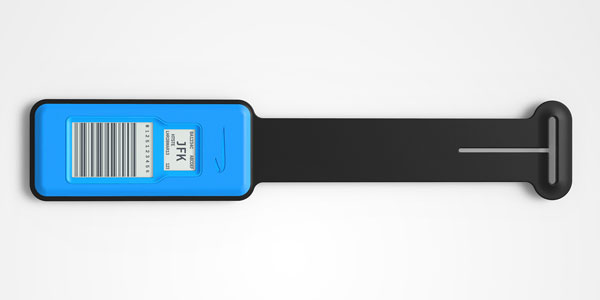
Self-Service Check-in eBag Tag

Frequent travellers, flying with British Airways, could soon be taking another step into the future of self-service check-in with the airline to trial an innovation in baggage tagging – the electronic bag tag.

The new tag will easily be updated using Smartphone and barcode technology, enabling passengers to simply scan their baggage at the self-service check-in bag drop point and move quickly through security to relax before departure, knowing that their luggage is fully trackable.

The bag tags, developed for the trial by Designworks, could eliminate the need for paper tagging, especially for frequent travellers, who could have their own, personalised baggage tag.  Designworks lead designer for the project, Lewis Freeman said, “This step into digital tagging of luggage is a huge leap forward enabling your luggage to become a connected object, providing a seamless experience for frequent travellers with British Airways.”

Self-service check-in is fast growing, using innovative, advanced technology and solutions, such as the ARINC vMUSE platform, used around the world.


Brisbane Airport has installed two 3m x 5m LED screens in the international departures area upon which visitors can post 40 character messages to their departing loved ones via SMS between 07.30 and 11.00 each day.

The screens have been added as part of Brisbane Airport’s gradual move to a total digital transformation.  In addition to SMS, the screens also display interactive and rich media content every 30 seconds for passengers and retailers at the terminal.

As well as looking great, the huge screens have created an ambience within the terminal that has been well received, according to Andrew Brodie, GM of Terminal Retail and Commercial at the airport.  He said, “Our retailers can also target and engage more effectively with Chinese and Korean passengers by promoting bilingual special offers aligned to specific flight schedules.  The bilingual ads have achieved an incremental uplift in sales against last year for specific product categories.”

Passengers are able to view local and International weather forecasts before departure, as well as the SMS messages, which can be seen from several areas of the terminal.

Brisbane Airport is the first in Australia to initiate the service.

brisbane SMS sharing

in-flight wifi

In-Flight WiFi

According to many airlines, in-flight WiFi provision gives them a ‘competitive advantage’ in the commercial aviation industry.

As the competition grows fiercer, it seems that in-flight wi-fi will become less of an advantage and more of a normality according to a report by ‘routehappy.com,’ a site that ranks airlines.  Their report says that currently 38% of US flights offer internet connectivity and long haul or the most popular routes, such as non-connecting California-New York are offering in-flight WiFi.

Although it is still a small percentage of flights overall, it shows that, as passenger demands for in-flight WiFi grows, the more likely that it will become standard practice and airlines will be looking to offer faster, better and cheaper in-flight WiFi to remain competitive.

The debate grows after the FAA’s announcement last week that it will be lightening up about the use of electronic devices on-board, allowing passengers on certain flights to carry on using their Smartphones instead of the insistence of powering down before take off.

Most airlines provide ‘GoGo’ for in-flight WiFi, but with dramatic price fluctuations and intermittent signal, the marketplace is broadening and the opening into business aviation for passengers wishing to work in the sky and on the move means that a push into the Ku-band for international connectivity is the way forward.

Aircraft in-flight Wifi provider, ARINC, already offer truly global connectivity with their Inmarsat/iridium satellite network connectivity and are leaders in the business of aviation communications.

Gogo expects that in-flight wifi for business travellers will become a required expense and not an optional one and are experimenting on new pricing models as it is still early days for in-flight wifi connectivity.

Only time will tell…

With the rise in international travel, imports and exports across Europe, border management is proving to be increasingly difficult, due to the simultaneous rise of illegal immigration, drug crimes and human trafficking.  As a result, border management is soaring to the top of the priority list in many European countries.

Border agencies are seeking new and efficient ways to lower the risks of these activities and up the border management in their countries.

The Border Management and Technologies Summit will address these issues and discuss solutions such as increasing the use of biometrics, access control, surveillance and advance profiling to name a few.

Industry-leading companies, such as ARINC, provide tailored electronic border management solutions to the marketplace as a part of their extensive suite of services, to enhance border control and passenger data management.

SunExpress, a joint venture between Lufthansa and Turkish Airlines plan to completely revamp its entire fleet of Boeing 737 with the Rockwell Collins Link 2000+ starting later this year.

The retrofitting will allow for compliance with Eurocontrol’s new CPDLC mandate that states that by 2015, all flights operating above 28,000 feet in European airspace must have CPDLC capability.  The mandate is currently under review for private aircraft, but will move forward in improving air traffic management and capacity throughout Europe under the supervision of Eurocontrol.

Controller-Pilot Data Link Communications (CPDLC) is clearly the future of cockpit efficiency, reducing the workload for pilots and allowing for greater air traffic management as the skies grow busier and traditional voice radio communications in congested airwaves makes controller-pilot communication more difficult.

CPDLC providers are preparing for the ultimate changeover and many, such as ARINC, offer an advisory service to airlines concerned with refitting or retrofitting aircraft with a range of solutions, enabling them to be CPDLC ready when the time comes.

Aero Icarus / Foter / CC BY-SA
Flight Planning iPad App

Flight Planning iPad App

This week JetBlue announced that they are training their pilot to switch to Apple’s iPad apps for essential flight planning access.

The iPad app is fast becoming popular in the aviation industry as airlines make the move to a paperless cockpit, offering flight decks greater flexibility with flight planning tasks, replacing laptops and bulky flight bags full of paper manuals, charts and associated flight planning paperwork.

American Airlines announced just days before that it has completed its plan for the introduction of more than 8,000 iPads fleet-wide. This all adds up to less weight, less fuel burned and huge improvements in the efficiency of the flight planning process all round.

ARINC Flight Planning services, which now includes the iPad app, fully realised the potential implications of improving flight planning and flight deck operations and began implementing the app after FAA approval in 2011.

JetBlue hope that, in addition to the electronic flight bag, the FAA will further approve apps for instrument approach and taxiway charts in the near future.  There is little doubt that, certainly for flight planning, the iPad is the way forward for the aviation industry.

Analysts from Research & Markets have forecast that despite increased operating costs, the Business Jet Global market should grow at an average annual rate of 9.4% over the four-year range of 2012-2016, in their new report ‘Global Business Jet Market 2012-2016’.

They attribute the market growth to a couple of factors including the rise in the number of global billionaires and an increasing demand from the emergence of certain economies, however there are concerns that increased operating costs could challenge this growth.

It is noted that in 2012, 28% of growth was attributed to emerging economies and could rise to 40% by 2030.

Companies such as Bombardier Inc, Dessault Aviation and Gulfstream Aerospace Corp. may dominate the market, with other vendors mentioned being; Airbus SAS, Embraer, The Boeing co and Hawker Beechcraft will all benefit from the growing order backlogs as growth is propelled by the major owner-operator segment of the market – billionaires.