Mission critical CommunicationsARINC Inc is progressing ‘aggressively’ with the completion of its contract with the Indonesian Government to modernize five of its C-130B aircraft for the Indonesian Airforce, it was announced today.

The project, which began in early 2011 is on schedule and on budget and will help to modernize the transport fleet and upgrade mission critical communications for humanitarian purposes.  There is structural work being carried out in addition to the retrofit of upgraded technology to enhance capabilities.

The work is being carried out by ARINC onsite, which enables the Indonesian Airforce to receive all the benefits of ARINC’s significant skills and knowledge, without having to bear the cost of the transportation of the aircraft to the Aerospace division of ARINC in Oklahoma.

All the parts required have been exported to the modifications facility in Indonesia and work is well underway.  The key milestones have been reached!

ARINC offer innovative solutions to mission critical communications with superior satellite services over the Inmarsat network.  They have been delivering mission critical communications for over 80 years and are well-placed in the industry, having an unparalleled reputation for excellence.

“ARINC Aerospace is uniquely qualified to perform this type of work,” noted Michael Young, Vice President of ARINC Aerospace. “We have far-reaching experience on multiple platforms and a broad range of capabilities. We are pleased that the project is going so well and that we are growing closer to the goal of enhancing the capabilities of the Indonesian Air Force.”


in flight wifiAviation Technical, Washington-based providers have been awarded the contract by New York-based low cost airline, JetBlue to install in-flight Wifi technology on their fleet of 130 Airbus A320 aircraft.  To installations are expected to near completion by the end of 2014.

Designed by LiveTV, who will give training and technical support to Aviation Technical Services, the technology will provide Ka-band connectivity.

JetBlue’s brand for the in-flight wifi is called ‘Fly-Fi’ and will use satellite networks for connectivity, rather than the more common Ku-band provision, which uses ground-based stations.  This will give faster and more reliable connection.

The Ka-band operates within a higher bandwidth and offering eight times more than the Ku-band, which is also more highly congested.

Other in-flight wifi providers, such as ARINC, use Iridium and Inmarsat satellite networks to provide a seamless global connectivity for their customers within the Ka-band with SwiftBroadband and their CabinConnect solutions.

A $130 million contract between a Beijing-based aircraft manufacturer and a General Aviation company to supply 300 small aircraft within the next five years could become the new commuter solution in China.

The companies want to introduce ‘mini airports’ at over 160 countries in the province and provide a short-haul service for passengers within a low-flying network.

All the aircraft will be manufactured with a maximum capacity of ten passengers and will target business passengers to boost more than just the aviation sectors in China.

Due to the terrain in China, in general, the daily commute for many passengers would be greatly reduced with aviation routes, rather than using the roads.  A 40km distance between two points can easily become 200km within the road network.

Chen Wei, Chairman of Beijing George Heintz Aircraft Manufacturing Co regularly takes a minimum of an hour’s drive into the City, but using aviation will cut the journey down to just 15 minutes.

The plan to open up low-altitude airspace is becoming an International trend, but is expected to be a fairly slow process in China.  Government regulators are being asked to consider the new plans and the benefits to not only general aviation, but many business sectors of the province.  It is hoped that plans can forge forwards within the next five years, although it seems unlikely that low-altitude regulations will be in operation before 2020.

Griffey at AOPA SummitCelebrities with a passion for aviation will appear at this year’s AOPA summit in Fort Worth to mingle with the members.  Appearances from Ken Griffey Jr, Major League Baseball player, football legend, Ed ‘Too-Tall’ Jones and Aaron Tippin, Country & Western singer are expected.

Ken Griffey is a pilot and will speak at the keynote address on Friday 11th October.  Aaron Tippin is also a pilot of a T-6 Texan and will play a free concert for the first 450 summit attendees at the Flying Saucer Restaurant.  He is a long-time supporter of AOPA and said, “I am just like any other aviator. I’m always looking for organizations that are going to look out for the interest of pilots, aircraft owners, and mechanics.”

Ed Jones is a local who has a passion for aviation and will attend an interactive Q&A session, where members will have the opportunity to ask him about his distinguished SuperBowl career of 15 years, his fellow players and his retirement.

“We look for celebrities who have a passion for aviation, who have served aviation in some way, or who have a unique connection to the local community where Summit is held,” said AOPA director of outreach and events, Chris Eads.


passenger communicationsIt was recently found, according to a new market research report by commercial aviation analyst, Adeline Fernandez that the passenger communications and in-flight entertainment sector market could reach $3 billion by 2017, compared to $2 billion in 2012.

The ever increasing demand for improved in-flight entertainment and the growing need for fast and cost-efficient passenger communications is fuelled by the huge wireless industry.  Most passengers now want to use their own devices and Smartphones on board and do not want to be subject to the traditional restrictions.

As technology is constantly evolving, more advanced use of devices is expected and greater bandwidth is required.  WiFi systems for passenger communications and in-flight entertainment are set to take over in commercial aviation from retrofit systems by manufacturing companies.

Commercial and Business aviation passengers now want to use their phones, devices and laptops as efficiently in the air, at 40,000ft as they do on the ground.  This will fuel the installation of wireless connectivity on board aircraft as airlines vie for passengers.

ARINC Common Use System BenefitsARINC has announced that London Heathrow (LHR) has renewed it current iMUSE, common use system contract until March 2015 by the AOC.

LHR remains the world’s busiest international airport, with over 75 million passengers passing through each year and is known as the hub of the civil aviation world.

An additional contract has simultaneously been awarded to ARINC to install the industry leading common use system in LHR’s new Terminal 2, expected to open its doors in June 2014, to support 378 check-in desks and boarding gates.  ARINC will also continue with the maintenance and support for all the equipment.  The new terminal is expected to service 20 million passengers.

Arinc, who have been working with LHR since 1999 have built a strong relationship with the airport.  David P Wilding, Chair of Heathrow AOC’s Shared System Board said, “Terminal 2, which is scheduled to open its doors to the public in June 2014, has been meticulously designed around the needs of passengers – with particular emphasis on enabling them to get to and from their flights as quickly as possible.  ARINC’s iMUSE, by processing passengers faster and more efficiently through sharing airport infrastructure and resources, has a pivotal role to play in this objective which is fundamental to LHR’s undertaking to provide world-class customer service.”

ARINC are delighted to extend and expand their relationship with Heathrow, especially their involvement with the common use system for the new Terminal 2.  Tony Chapman, Executive Director of ARINC EMEA for Heathrow said, “We look forward to continuing to support the AOC’s efforts of providing the most efficient passenger processing systems possible.”

automated baggage handlingAccording to ARINC, passengers are set to spend significantly less time waiting at airports in the near future as airline operators and airports invest in advanced technological solutions designed to increase operational efficiency from advanced passenger information systems to automated baggage handling.

“The passenger is the one who’s going to have more control over that whole experience than they currently have,” said Michael DiGeorge, Managing Director of ARINC Asia Pacific. “That process of going from check-in through immigration through boarding is going to get more invisible.”

Passengers regularly wait for an average of three hours, sometimes more, which is causing industry-wide concern, especially during peak-time congestion, with the real fear of the denial of landing rights during those times.

ARINC’s extensive collection of innovative products are targeted to improve passenger information screening and transmission, travel documentation and check-in, which in turn will increase the flow of passenger traffic through airport terminals and remove the stress for passengers, airlines and operational facilities.

With many Asian nation plans to build new airports and terminals, there is a strong likelihood of growing competition to provide the best experience for passengers and airlines.  It stands to reason that the facilities that can provide smooth and fast passenger experience are going to be the most successful in the future of an industry that is ever-expanding as demand and expectation grows.

It has recently been announced that United Airlines have accepted two Utah Valley University (UVU) aviation students to intern for them later this year.

UVU are understandably proud that their students have been selected form thousands of other competitors as this is the first time that two students from the same University have been selected at the same time to fill two of the six available positions.  Aviation professor and internship mentor, Jim Green said, ‘The quality of our aviation students is very high.  In past internships with United and other airlines, our students have proven to be hardworking, reliable and honest.  That, and the fact that we have good faculty and good flight instructors, has earned our aviation program great respect in the industry.’

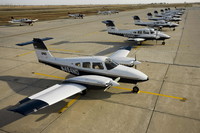
student pilots

One of the students will complete a 13-week internship in Houston, where she will undergo several hours of flight simulation training and will work alongside professional pilots.  This will help her to work towards her goal of attaining her transport pilot’s license.

The duration of the second internship will be for 3 months at the United Airlines Denver office.

The UVU aim to support their students and work hard to initiate the internships in order to kick start the aviation careers for seniors and graduates of the university.

They shape and educate the much-needed pilots, crews and aviation professionals of the future.

The New Delhi Civil Aviation Ministry has confirmed its mission to push more state governments into lowering taxes on jet fuel in a bid to ease the pressure on airlines with the rise in crude oil prices and the weakening value of the rupee.  This slide against the US dollar raises concerns as to the increase in prices that the struggling airlines will have to face for leasing commitments, maintenance and repairs, payments to expat crew members and staff costs abroad.

GoAir CEO Giorgio De Roni, said “Almost all airline costs are related to the dollar, including fuel. We have to face this reality. A week rupee is a big challenge for the industry.”

“The rise in ATF (aviation turbine fuel) prices will have an impact. We have been requesting the state governments to consider reduction in taxes they levy on ATF, keeping in mind the rising oil prices,” said Civil Aviation Secretary, K N Shrivastava.

Although some states, namely, Chhattisgarh, Rajastan, West Bengal, Jharkhand and Madhya Pradesh have brought down the taxes on jet fuel, the CAM are ‘pursuing other states to follow suit’, promising increased air connectivity in return.

This all comes with the added concern of price rises in air fares to sustain the airlines, which no one wants.

ARINC’s AviNet Mail was selected by more than 1,000 users during the first half of 2013; it was recently announced, lending weight to the claim that the aviation messaging solution is indeed industry-leading!

AviNet Mail and ARINC’s AviSec solutions reliably and securely deliver more than 30 million messages per day to over 30,000 users, figures that represent half the world’s critical type b messaging. ARINC’s cost-effective solution enables Type b and SMS messaging over a secure network and is used daily by airlines, airports, ground handling operations, caterers and dispatch operators, to name but a few…

One of the features of the system is that the AviNet Mail service can be accessed from anywhere with an internet connection and is operated upon a highly secure, private network.  Sensitive data can be reliably transmitted via a single user interface, enabling the low-cost transmission of passenger data, including advanced passenger information and PNR in addition to all other critical messaging.

“AviNet Mail is the industry’s leading platform because it enables customers to maximize operational efficiency and, ultimately, reduce Type B messaging costs,” said Laura Birt, Sales Director, Aviation Solutions at ARINC EMEA. “We are seeing this continuous rise in adoption and use because AviNet Mail is a highly reliable solution that ensures critical messages are communicated quickly and efficiently—and in line with our customers’ budgets.”

ARINC continue to provide innovative solutions for the aviation industry, staying ahead of the game in this ever-expanding sector.