Archive

Business Aviation News

ARINC AIM CSC

ARINC Inc will attend the Nuclear Information Technology Strategic Leadership workshop in Detroit with its AIM Security Computer & Cyber Security Solutions, it has been announced.

Frank Koren, Business Development Director at ARINC said, “As a leading provider of nuclear security systems mandated by 10CFR 73.55/54, we are highly involved in providing compliant security solutions that ensure the highest levels of safety and security for our customers.”

ARINC AIM cyber security solution is used for security command and control at more than forty nuclear plants across the US and Canada.  The CFR compliant software meets the mandatory regulations imposed by the Nuclear Regulatory Commission and the Canadian Nuclear Safety Commission and addresses the issues associated with IT and cyber security in nuclear-powered utilities.

in-flight wifiIt looks like the days of turning off our mobile devices on aircraft could one day be behind us as the demand grows for passenger in-flight wifi connectivity.  Many passengers now want to tweet their journey or update Facebook statuses as they fly, posting photos of the clouds, their meals or cities from the air.  Social networking, as we all know, is huge and in-flight wifi is a necessary fuel for that fire.

Recent surveys show that a quarter of British holidaying passengers out of 5,000 believe that free in-flight wifi is not only necessary, but a human right, according to HolidayExtras, although it is also recorded that 84% of these passengers are unwilling to pay the current high rates charged for in-flight wifi.

Now that the US FAA declared the use of the new models of mobile phones and device safe to use in ‘airplane mode,’ the floodgates are open in terms of demand for cheaper, faster in-flight wifi connectivity and this leaves many airlines thinking about the possibilities for revenue versus the inevitable costs involved with upgrades to their existing equipment.

Within the next few years, Inmarsat, the British satellite communications network, will be launching three new satellites, which will give global connectivity possibilities and could spell faster and cheaper in-flight wifi, but, until then, with only four commercial airlines currently offering free in-flight wifi, competition is slim and the cost implications for the passenger still high.

While business passengers enjoy the versatility of in-flight wifi, it looks to be a while before the demand is met for the average holidaymaker.

Good news for Air France travellers, who no longer have to wait for the all-clear and can now use the in-flight entertainment (IFE) as soon as they take their seats.

This relaxation of the IFE restrictions follows BA’s decision last year to let long-haul passengers watch their IFE screens straightaway.  After months of intense negotiations with the Civil Aviation Authority, BA became the first British carrier to do so.

IFE has come a long way over the past few decades; from simple in-flight movie provision to personal touch screen technology and internet connectivity.  IFE connectivity providers work hard to stay ahead of the game when it comes to innovation and continually update their services, products and solutions for airlines to maximize efficiency, cost-effectivity and enhance the experience of the passenger.

IFE providers, such as ARINC, have over eight decades of industry experience and are able to offer seamless connections and a vast range of solutions for both cabin and flight deck.

kevbo1983 / Foter / CC BY-NC-ND

Leading provider of airport services, ground handling and security, Airpro Oy has announced the signing of a new 3 year contract with ARINC for its type b messaging service, AviNet.

ARINC EMEA aviation solutions director, Alexis Hickox is delighted that Airpro Oy has selected ARINC for their type b messaging and other critical communications and says, “We believe that AviNet will provide Airpro Oy with an ideal messaging solution now and for years to come.”

Airpro Oy needs a reliable solution that meets cost-effective requirements for regular and dependable communications with flexible and interoperable access that remains seamlessly secure for type b messaging.

Mr Ari Haapanen, Airpro Oy’s MD said, “With AviNet, as a hosted solution, we are able to save significantly on our costs by removing the previous infrastructure which was no longer needed, replacing it with ARINC’s web-based solution.”

Airpro Oy believe that they will not only save money but make improvements to their systems with critical type b messaging, email and SMS messaging.


The European Aviation Safety Agency and EuroControl have established a co-operative plan for the improvement of aviation, focussing upon the implementation of the Single European Sky, with environmental protection, training and the development of the EU External Aviation Policy as priorities.

The co-operative plans will establish a common foundation, general framework and a programme on a formal basis, expected later this year.  There will be an evaluation of national civil aviation authorities’ mandates and the requirements of military airspace users in addition to overseeing the SESAR deployment.

EASA executive director Patrick Goudou said “the new framework is instrumental in the development of a more competitive air transport industry in Europe. EUROCONTROL believes this agreement will provide the optimal framework to combine the expertise and resources of the two European organisations, following the extension of EASA competences to ATM/ANS and aerodromes”

It is believed that EUROCONTROL will support EASA’s regulatory work with its air traffic and route management.

The new Single European Sky is a direct initiative borne from the heavy congestion over Europe.  Part of the directive spells the need for CPDLC capability in the cockpits to free up the airwaves.

EASA EuroControl Single Sky CPDLC

ARINC eBorders APIS is part of a suite of integrated Electronic Border Control solutions designed to improve border security with the provision of passenger and crew data in advance of arrival offering Immigration greater control over the flow of people to and from the country.

Paradise holiday destination, The Maldives have just awarded ARINC a five-year contract for the implementation of ARINC eBorders APIS at its international airports in a bid to improve efficiency and passenger flow in addition to the obvious security enhancement of advance passenger and crew information.

Mr Hamid Fathuhulla, Deputy Controller for the Department of Immigration and Emigration in the Maldives said, “We have chosen ARINC as our technology partner because of their industry leadership as well as proven expertise and experience of working with the world’s airports and airlines.  We are confident ARINC will meet our technology needs every step of the way as we continue to grow.”

ARINC offer tailored solutions according to the individual requirements of each customer and the industry standards of the international trade organizations and governmental mandates.  With decades of industry experience, ARINC remain world leaders in the fields of aviation, transportation and security, offering an extensive range of technological and communications solutions in the air, on the sea and on the ground.

Michael DiGeorge, ARINC Asia Pacific Managing Director said, “It is crucial for airports and other points of entry to meet their border security and control requirements while providing the highest levels of customer service.  At the same time, they need to manage increased operational costs as a result of compliance to new security requirements and mandates.  We are committed to helping the Maldives meet its current and future border security and control objectives.”

CPDLC Airservices, Australia’s air navigation service agency and the Dept of Defence have put out a request for tender for the creation of an aligned Air Traffic Management platform that is intended to harmonise the ATM & CPDLC requirements of both civil and defence movements.

The organisations want the new system to increase co-operation and reduce overlapping, improve communications via CPDLC and to streamline processes and equipment including training and subsequent expertise that can be shared across the workforce.

Airservices CEO, Margaret Staib said, “Through more flexible use of airspace, it will enable better management and prioritisation of an increasingly complex traffic mix. In an environment of projected growth, it will also allow us to connect the Australian aviation industry to deliver world-best industry performance.”

The aim is to bring Australian aviation airspace into a unified state, rather than accepting the limitations of separately managed volumes.  A shared and harmonised airspace, including CPDLC and air traffic management solutions will increase safety aspects and operational efficiency across the board in the increasingly complex range of traffic.

Air Marshal Brown, Chief of the Air Force said, “The streamlining of equipment and processes will bring with it shared expertise and facilities, creating economies of scale whilst delivering greater flexibility meeting the needs of airspace users.”

The US-EU spying scandal could stir up a hornets nest for the aviation industry regarding passenger data sharing if the allegations are proved to be correct.

The German report in ‘Der Spiegel’ suggested that the US’s NSA have targeted the EU with its spying activities. Concerns have been raised and an investigation is underway, with demands from Green Party Leaders to cancel the transfer of passenger data, in the form of Passenger Name Records (PNR), which include such information as passenger name, address details, destination and baggage, payment details and travel itinerary.

Arguably, the provision of PNR and Advance Passenger Information (API), now mandatory for US flights, has considerably reduced the risk of terrorist activity.  Since 9/11, understandable concerns became obvious and, after a thorough investigation, the provision of passenger data enables government bodies to screen passengers before boarding the aircraft, thus highlighting possible ‘high-risk’ passengers while streamlining the service for ‘low-risk’ passengers.

Many believe that PNR and API passenger data exchange is a necessary procedure for all aviation travel, business or commercial, inter-state or Trans-Atlantic, to enhance security measures.  A secure, reliable passenger data sharing service can offer reassurance to the aviation passenger, the airline and to border control and immigration services.

Where should the line be drawn when it comes to security?

Aviation communications providers work hard to ensure secure, efficient and fast delivery of PNR and API to appropriate government agencies, but, the trouble is that it is not clear how the governments are dealing with the passenger data once it has been ‘used’ for its purpose.

The agreement is that the passenger data is anonymized after five years. After six months the passenger name is removed and the passenger data is stored securely.  The PNR itself is only scrutinized if the passenger is ‘flagged’ as risky.

No doubt the debate will continue, certainly with the media frenzy continuing over Edward Snowden, the NSA ‘whistle-blower’!


passenger data sharing

Self-Service Check-in eBag Tag

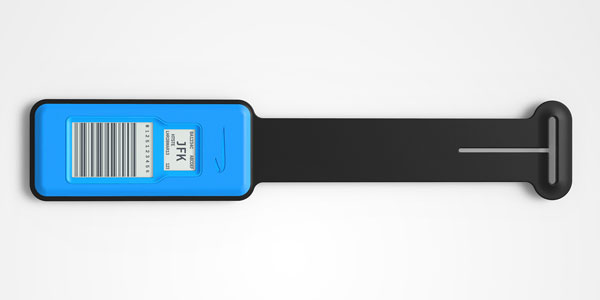
Frequent travellers, flying with British Airways, could soon be taking another step into the future of self-service check-in with the airline to trial an innovation in baggage tagging – the electronic bag tag.

The new tag will easily be updated using Smartphone and barcode technology, enabling passengers to simply scan their baggage at the self-service check-in bag drop point and move quickly through security to relax before departure, knowing that their luggage is fully trackable.

The bag tags, developed for the trial by Designworks, could eliminate the need for paper tagging, especially for frequent travellers, who could have their own, personalised baggage tag.  Designworks lead designer for the project, Lewis Freeman said, “This step into digital tagging of luggage is a huge leap forward enabling your luggage to become a connected object, providing a seamless experience for frequent travellers with British Airways.”

Self-service check-in is fast growing, using innovative, advanced technology and solutions, such as the ARINC vMUSE platform, used around the world.


Brisbane Airport has installed two 3m x 5m LED screens in the international departures area upon which visitors can post 40 character messages to their departing loved ones via SMS between 07.30 and 11.00 each day.

The screens have been added as part of Brisbane Airport’s gradual move to a total digital transformation.  In addition to SMS, the screens also display interactive and rich media content every 30 seconds for passengers and retailers at the terminal.

As well as looking great, the huge screens have created an ambience within the terminal that has been well received, according to Andrew Brodie, GM of Terminal Retail and Commercial at the airport.  He said, “Our retailers can also target and engage more effectively with Chinese and Korean passengers by promoting bilingual special offers aligned to specific flight schedules.  The bilingual ads have achieved an incremental uplift in sales against last year for specific product categories.”

Passengers are able to view local and International weather forecasts before departure, as well as the SMS messages, which can be seen from several areas of the terminal.

Brisbane Airport is the first in Australia to initiate the service.

brisbane SMS sharing