Archive

Monthly Archives: March 2013

It has recently been announced that the Electronic Communications Committee (ECC) has agreed to a key decision, regarding the use of Earth Stations On Mobile Platforms (ESOMPs), which will enable significant improvements to satellite broadband services for planes, trains and ships.

The changes and improvements should come within weeks of this announcement, following the identification by the EEC, of the technical and operational requirements for the use of ESOMPs in the geostationary satellite networks over certain parts of the ‘Ka-band’, ensuring existing fixed satellite and service networks are protected from interference.

Ka-band satellites use small spot beams which will lead to increased spectrum efficiency, allowing the use of smaller terminal antennae that can be mounted cost-effectively, to aircraft, ships or mobile land vehicles.  The use of such ESOMPs will provide increased spectrum efficiency and more capacity than existing mobile systems in the Ku-band range.
Ryanair has agreed to acquire 175 Boeing 737-800s with a list price of $15.6 billion. The deal yet to be finalised with take Ryanair’s and approved by its shareholders will take the fleet to over 400 aircraft in 2018. This deal is thought to be the largest ever aircraft order by a European carrier.

CFM International CFM56 engines will power the 737-800s and 75 of the new aircraft will replace part of the current fleet of 305-737s. The other 105 aircraft will allow for Ryanair to grow. The re-engined 737 Max due to enter service in 2017 is still being evaluated by Ryanair.

It has been announced that LTE-based data communications, despite the on-going development of LTE consumer networks, will not be accessible for mission critical communications until 2018, according to Critical Communications Broadband Group (CCBG).

It is not until 2020 that mission critical users can expect reasonable quality voice services using Long-Term Evolution technology.

Data-only LTE services are commercially operational, but consumer based voice LTE solutions are a long way off yet.

According to Phil Kidner, Chief Executive Officer of the TETRA & Critical Communications Association (TCCA) ‘Achieving industry synergy is crucial to ensure uninterrupted availability of mission-critical communications services. LTE is currently designed for commercial use.  There is no viable replacement on the horizon for the current technologies employed by critical communications users.

To provide a necessary footing for mission-critical communications, four key areas within LTE standards must be addressed, to ensure the moving-forward of the technology towards multimedia communications:

  • Group Communication System Enablers
  • Proximity-based Services
  • Public Safety Network Resiliency
  • Push-To-Talk (PTT)

The acceptance of GSCE and ProSe by 3GPP as WID’s that will be integrated into the planned Release 12 of 3GPP LTE specification in 2014 is notably a major breakthrough by the CCBG.

A weakness lies in the framework of Critical Networks Resilience in LTE design, being no provision for the accommodation of any potential loss of signal between the base station and the core communications network.  The hope is to include a solution in the planned Release 13 of 3GPP LTE in 2016.

Other mission critical data communications suppliers such as ARINC do offer a platform for communication needs suited to the military and government with simultaneous voice and data communications with optional guaranteed bandwidth for those high traffic critical services.

A agreement has been signed by Inmasat and Kymeta to develop a new satellite antenna that will enable business jets to use high speed broadband connectivity worldwide using Inmasat’s Global Xpress (GX) service

Only GX users will be able to use the propriety Kymeta Aero Antenna enabling the two company’s opportunities in the fast expanding business aviation market.

Managing Director of Inmarsat Global Xpress, Leo Mondale said, “Over the coming 10 years, some 10,000 new business jets are forecast to enter service. In this changing world, where enhancing the productivity and effectiveness of the business executive is paramount, the need to offer constant connectivity is non-negotiable. It is this absolute requirement to keep executives connected, wherever they are, that is driving demand for solutions which support smaller aircraft. Our partnership with satellite technology specialist, Kymeta, will make business jet travel an even smarter and more efficient option for executives”

CEO of Kymet, Vern Fotheringham added, “Our technology for flat-panel, beam-forming antennas will enable a number of new markets and a new generation of customers to benefit from lower cost, high-speed satellite internet connectivity anywhere in the world. We are excited to reach this milestone and engage with Inmarsat to bring next-generation broadband services into the global business aviation market.”

Inmarsat is a long standing player in the industry providing passenger communications solutions for both commercial airlines and business jets.

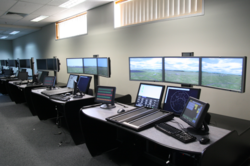
CPDLCThis year, at the ATC Global Exhibition and Conference in Amsterdam, advanced training solutions for ATC simulations were showcased in the shape of Adacel’s Aurora ATM system.

Elements of their Unified Training Solution (UTS) demonstrated the growing need for technological advancement, aiming to ‘Create the appropriate mix of tools to prevent bottlenecks that break the training continuum,’ and tailoring these solutions to meet the specific needs of the customer.

Adacel realise that high-definition ATC simulators are not enough to meet the expanding demands upon ATC training requirements and recognise that students need the appropriate tools at each specific stage of training, to ensure competency in every area, from terminology and communications through to advanced ATC skills required to become a competent controller with a firm and broad knowledge of complex technological advances in the industry.

Technology impresses upon the student the need for competency in ATM functionality for the effective control of air traffic in the areas of mixed and non-surveillance airspace.

Adacel’s Aurora ATM system demonstrates the latest technology, including automated conflict detection, 4D profile protection, dynamic airspace airspace allocation and controller pilot data link communications (CPDLC).

Award-winning training applications for operational ATM, speech recognition and advanced ATC simulations required for students today, to make them the competent operators of tomorrow.

This week the latest at ARINC was the news that it has won a major three year contract at 5 regional airports in Egypt to install its industry-leading passenger processing solution, vMUSE™. The Egyptian airports include Sharm El Sheikh, Luxor, Aswan, Borg El Arab and Abu Simbel. The ARINC CUPPS system fully compliant with the IATA CUPPS standard for common-use passenger systems.

Aviation Information Technology (AVIT) will be working in partnership with ARINC. In the contract, ARINC will install the core common use passenger processing systems (CUPPS) and provide remote third level support, AVIT will then handle first and second level support. There is a 14 week delivery and implementation schedule for all 5 airports which is due for completion by the end of May 2013, the team is currently on plan to achieve this.

Dr Ashraf Zaki, Vice President of EHCAAN said “Egyptian Airports Company (EAC) airports have been experiencing strong growth for several years, We believe that ARINC is an ideal partner to handle our continued expansion given their industry-leading technology and the tremendous airport experience they bring to the table, both globally and here in the Middle East.”

Tony Lynch, Regional Director for ARINC Middle East and Africa said “The ARINC vMUSE solution gives EAC the latest, state-of-the-art CUPPS platform, we have developed strong relationships in Egypt based on our excellent track record in delivering key projects such as Cairo Airport TB3 and Seasonal Terminal. We are pleased to be selected by EAC for these five airports and look forward to a long and mutually beneficial relationship.”

Giving smaller and mid-sized airports more flexibility to upgrade their operations is achieved by using ARINC’s vMUSE by eliminating software engineering and development costs.

EAC is a subsidiary of EHCAAN, and currently manages all 19 regional airports in Egypt. EAC airports serve all the different aspects of air travel.

Korean Air set up a dedicated charter team in 2007, now, having 3 VIP aircraft in its fleet, it is planning to boost demand for its business jet service by focusing on the Hong Kong and Chinese markets.

The VIP aircraft consists of a Boeing Business Jet, a Bombardier Global Express XRS that it flies internationally, and a Sikorsky S-76C+ helicopter that it operates within South Korea. It is planned that passengers on Korean Air‘s private jet charter service will earn First Class mileage points and will have access to the airline’s VIP lounges.

The airline also has a Flexjet Connect Service, which allows passengers to connect from a regular Korean Air flight to a private jet service for non-stop travel throughout the USA. A spokeswoman from the airline said “With many opportunities from Hong Kong and China, Korean Air is keen to capture a share of the business jet market with a focus in Hong Kong,” “We look forward to flying people to different cities from Hong Kong to China as well as various destinations around the world. With state-of-the-art aircraft, unparalleled services and competitive offerings, Korean Air is confident of capturing a share of the market in Hong Kong and in other countries in the region.”

Please see this link for a full range of business jet support and communications services.

Some of the industry’s biggest business jet manufacturers looked to take advantage of the interest by taking part in the second annual Abu Dhabi Air Expo, which took place last week in the capital. The three-day event is the only general aviation exhibition in the region.

“I think it’s fair to say business aviation is well established in the Middle East, but there is a notable shift now,” said Philip Nasskau, a spokesman for Bombardier.

Orders have been rising in the region, according to manufacturers, and the industry is projected to keep growing. Bombardier estimates that there will be 735 new business jets in the region by 2021, and a further 1,260 bought between 2022 and 2031.

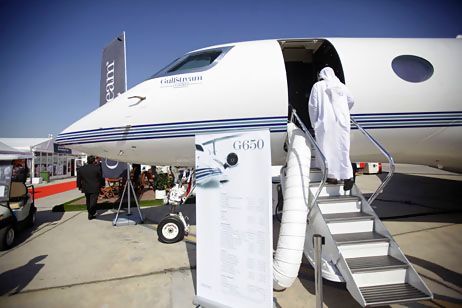
Gulfstream, a US-based manufacturer, has already enjoyed significant growth in the Middle East in the past five years and is expecting more. It had 146 aircraft in the region last year, up from about 110 in 2007. Heidi Fedak, the senior manager of social media and external communications at Gulfstream said “I expect growth in the region, especially now we have the Gulfstream G650 available for sale,” she added “The G650, which is being exhibited for the first time in the Middle East at the air expo, is the fastest business jet on the market, and can fly from Melbourne to Abu Dhabi in about 13 hours, shaving about two hours off the journey time of a larger passenger plane.”

Ten years ago, buyers would use consultants when choosing their aircraft, but today, many clients are directly involved in the purchasing process. “We are seeing a different buyer today than what we saw some time ago in the Middle East,” said Colin Steven, the vice president of sales and marketing for Europe, the Middle East and Africa at Embraer Executive Jets. “Today there is so much information out there that the guys understand range is the priority, comfort is the priority, so I want to go big and I don’t want anything small.”

The Middle East Market for Business Jets is Increasing

The Middle East Market for Business Jets is Increasing


I have been following a post this week from AOPA. They deem the following as the absolutes must haves:

Nav Trainer Pro ($4.99 on iTunes and Google Play) –  Help you practice and teach the use of aviation navigation equipment. It includes VOR, HSI, RMI, ADF, DME, and ILS simulation.

MyRadar Pro ($1.99 on iTunes) – The app that shows animated weather at your location. For $2.99, you can add a hurricane tracker.

PocketFMS EasyVFR (free in iTunes and Google Play) – The app allows users to create detailed flight plans on a computer, save them to Web storage, and load them on any mobile device. It provides route planning, weather, and notams, and computes performance, weight and balance, and fuel consumption.

XCSoar (free in Google Play) – It’s a tactical glide computer for glider pilots, paragliders, and hang gliders.

Aviation W&B Calculator ($9.99 in iTunes) – The app does your weight and balance calculations and has templates for 165 aircraft, ranging from the Beech Baron to the Stinson 108-1. Users also have the option to build their own aircraft templates.

Of courses, i’d like to add my own on to this list – working towards the EFB i love this one – iPad Flight Planning Apps


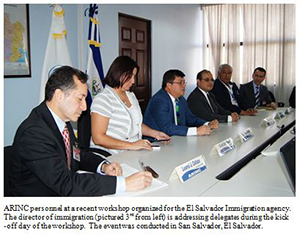
In Annapolis ARINC said it has started a series of workshops specialising on effective border security. These workshops are focusing on protecting borders from illicit activities, and have become a major concern for all nations. These situations have a significant impact on national security and immigration control. These workshops are starting in El Salvador and will roll out to ARINC’s entire customer base.

ARINC Conducting Border Security WorkshopsIn the course of these workshops, ARINC and its customers will discuss the positive results of implementing ARINC’s border security system, security trends, and share best practises and identify areas that can be improved. The courses are made up of senior officials and technical people from the various government agencies as well as airport operators, airlines and ground handlers.

Jorge Ramirez, Marketing Director of Global networks and IT Solutions for ARINC said ‘The ultimate goal of the workshops is to improve a country’s border security; these workshops are essential for our existing customers and ideal for countries in the process of evaluating effective border security solutions.’

34 of the 35 countries that have implemented border security systems ARINC is working with. ARINC’s complete portfolio in electronic borders uses its expertise gained in ARINC’s  aviation, governments, information technology, surface and maritime transportation and systems integration to deliver the most cost effective and efficient solution available.