Archive

Tag Archives: passenger processing

Announced by ARINC Managed Services (AMS), Aeropuertos Dominicanos Siglo XXI (AERODOM) will continue offering ARINC’s vMUSE Common Use Check-in system at two of the Dominican Republic’s leading international airports, De Las Américas (SDQ) and Gregorio Luperón (POP). Mike Picco, Vice President of ARINC’s Airports Systems Division. Said “ARINC has successfully partnered with AERODOM since 2005,” he continued “We are excited to be given this renewal for our technology and services, and believe it demonstrates our strong commitment to the Latin America and Caribbean region”.

Common Use Passenger Processing Systems

Common Use Passenger Processing Systems

Aeropuertos Dominicanos Siglo XXI (AERODOM) a private concessioner commissioned by the Dominican Government to develop, operate and manage six international airports in the Dominican Republic for a period of 30 years: De Las Américas, José Francisco Peña Gómez in Santo Domingo; La Isabela, Dr. Joaquín Balaguer in Santo Domingo Norte; Gregorio Luperón in Puerto Plata; María Montez in Barahona, and Presidente Juan Bosch in the province of Samaná;

Monika Infante, CEO of AERODOM said “We are pleased to be working with ARINC, a company with a well recognized expertise in passenger processing technology that makes airports more efficient”. “ARINC’s products and the high level of support it provides have a significant positive effect on our customers’ travel experience.”

Border and aviation security has again hit the headlines as it has come to light that security checks have not been carried out by government officials on asylum seekers in the UK,

The process of border security is a complex one that in aviation starts with the transmission of advance passenger information and passenger name records (PNR).

Airlines are obligated to submit this information when travelling between certain countries and face tough fines if they don’t comply.

For airlines, both commercial and in the business aviation sector, there are multiple options for transmission of this data, one of which is a service provided by ARINC called AviSec. This offers a per flight or flat rate pricing structure, geared towards cost efficiency for airlines or business jets.

As border security continues to be of grave concern, and airlines continue to have tighter regulation imposed upon them, it seems that it is the officials that need to be monitored to complete the enforcement process beyond the airport.

Independent Chief Inspector John Vine, of Borders and Immigration said of the current process for asylum seekers already in the UK that many cases were archived with little attempt to trace the asylum seeker. He added: “Security checks on controlled archive cases had not been undertaken routinely or consistently since April 2011. This was unacceptable. Through the inefficiency and delay of the Agency, those who would otherwise have faced removal will have accrued rights to remain in the UK.”

The government denies that the IPS is a faulty instrument for measuring its progress on migration for the UK. Yet there does not seem to be an accurate system for counting people in and out of the country and government has promised to reduce net migration (the difference between those entering and leaving the country) to “tens of thousands” by 2015.

Border Management

The e-borders scheme meant to do this activity, and is still a work in progress. Despite government assurances, according to experts when it comes to measuring how many people are leaving the country is unclear and the increasingly rigid process it is to get a visa for the UK, it seems there is no way of knowing if someone is still in the country when it expires. E-borders replaced the old paper-based embarkation system, scrapped in the 1990s.

IPS emigration estimates are based on interviews with just 2,000 people and there is currently no alternative source of data to measure them against. Instead the government relies on the answers given by a sample of travellers who agree to be stopped and questioned by a team of social survey interviewers at Heathrow and other main air, sea and rail points of entry to the UK.

E-borders which was primarily meant to improve security, when combined with a biometric identity card scheme, began collecting details of passenger and crews for inbound flights from outside the EU at nine airports in March. The plan now is to extend it to ports and railway stations by 2014 and to passengers from within the EU by 2015. But that will depend on persuading all EU countries to share passenger and crew list information – quite a number of them regard this as illegal under European free movement laws.

Electronic border schemes can be adopted by both airlines and airports. One product by ARINC, Electronic Borders, is designed to adapt to the changes in operational process and support new technology, enabling Border Control agencies to flex with changing demands and capabilities.

Today it is not enough to simply secure borders from unauthorised entry by known undesirables. Now it is necessary to manage the stay of travellers, from entry through to exit, to know who has been in the country and when they left.

The ARINC Border Management System delivers a full stay management capability, screening all travellers before they travel, and managing visitors throughout their stay. For more information please visit the ARINC Electronic Borders website.

Amsterdam Airport Schiphol provides one of Europe’s best reference sites for self-service bag drop and 12 units are in place in Departure Hall 2.

ICM Airport Technics has supplied its self-service baggage drop system to Qantas as part of the airline’s Next Generation Check-In programme.

ICM Airport Technics has supplied its self-service baggage drop system to Qantas as part of the airline’s Next Generation Check-In programme.

Amsterdam Airport Schiphol provides one of Europe’s best reference sites for self-service bag drop and this year, 6 new self-service bag drop systems were introduced in Departure Hall 2, taking the total number to 12. Among the latest airports to announce an intention to implement such systems is Bologna Airport, which is expected to complete the installation of 14 units by mid-2013. Aéroports de Paris has also successfully installed a system at Paris-Orly and will soon be extended to Paris-Charles de Gaulle.

The benefits of allowing passengers to take charge of the check-in and bag drop process themselves are clear. For the airline it means fewer agents are needed, passenger processing is faster and congestion around check-in desks is reduced. For the airport, it enhances the check-in capacity, reduces operational costs and allows for the optimisation of existing space. Airports and airlines need to decide whether to implement a one- or two-step solution. The first option allows the process of printing and attaching bag tags and depositing the bag into the system, completed in a single transaction. The second requires the passenger to print their bag tags at a self-service kiosk, before depositing their bag at a separate location.

As Vaessen explained, the implementation at Amsterdam Airport Schiphol makes use of the one-step process. “There were two main reasons for using one-step. The first was our home check-in passengers. More than 50% of our passengers check-in at home, so we didn’t want all of these to still have to go to a kiosk when they arrive at the airport and we simply wouldn’t have enough room for all of the kiosks. The one-step or two-step process depends very much on the infrastructure of the airport.”

The implementation by Qantas, ICM Airport Technics’ two-step solution is now operated across 8 airport terminals in Australia and London Heathrow a total of 84 units. Duncan Watson, Qantas Head of Global Marketing Operations uses the two-step process, explained that the process “maximises the available real estate for the airport departures concourse”. He added: “The two-stage process results in significant savings in both expenditure and footprint. It is better for the passenger to spend two minutes in Area A and subsequently 30 seconds in Area B, compared to two-and-a-half minutes in a single stage process.”

One product available for self service check-in is ARINC’s ExpressDropTM, the world’s first common bag drop application for passengers who have already checked in on the Web, at a self-service kiosk or on their mobile phone. For more details please visit the ARINC ExpressDropTMsite.

I wanted to take a look at a solution for aviation communications; AviNet Type B messaging from ARINC as it delivers an unbeatable combination of high value and low cost for both commercial and business aviation. GLOBALink ACARS®, passenger reservations, aviation weather data and flight planning are a few message types that can transmitted, and ARINC offers a free messaging audit.

For over 50 years ARINC has operated an IATA Type B and Type A message switching service and over 700 companies depend on their network. They comply with all IATA Type B and Type A standards as well as support IATA messaging between customers and trading partners in the aviation industry. By using AviNet Type B Messaging companies can effectively communicate and share vital information with business partners, operators, and applications globally.

Type B Customers are able to communicate with entities on other networks, including FAA NADIN I and II, AFTN, and SITA. ARINC supports ATA/IATA type B message, formats various message reassurance procedures such as the BATAP and IBM MQ Series. AviNet can also manage non-IATA messages in addition to standard ATA/IATA formats.

Type B Messaging can seem to be complex and confusing, but ARINC work closely with the client to provide a consultation on the current messaging environment and to find an appropriate Type B Messaging pricing scheme. They maintain that they typically save customers over 30% on their existing Type B Messaging costs.

To find out more: typebmessaging-avinet.com

The large number of applications submitted exceeding ICANN’s original projections can be explained, with the new gTLD program having a profound impact on the private sector’s increasing dominance over Internet information resources and ownership of critical registry technical infrastructure assets. It is projected only the private sector will take full advantage of the commercial possibilities offered by the introduction of new gTLDs creating new innovations.

The successful introduction of new gTLDs will also create new challenges of security for the private sector. Creation of Internet additional domains would expose to different security risks on the Internet. Applicants are expected to describe in details the security policies and procedures of the proposed registry, and to go to some considerable depth in explaining how denial of service attacks would be mitigated, and describe their computer and network incident response policies, plans, and processes; the types of defences that will be deployed against threats, etc. What ICANN considers as a robust response to the Security Question must show “evidence of highly developed and detailed security capabilities” amongst other requirements, coupled with an independent assessment report that demonstrates effective security controls as proof of conformance to the ISO27001 Certification Standard.

Cyber-security threats have now emerged as the defining security challenges of the global Internet economy. National Security operatives are now seized by the issue of Cyber-security. They are actually now more worried and concerned about security threats on computers and information resources than a physical terrorist attack that can be easily detected and disrupted in an airport. Sharing advance passenger information on airline passengers for example between the United States and European countries will make it more difficult for a terrorist to board an airline flying between Europe the USA. Moreover, increased and more efficient traditional spying has helped security and anti-terrorism agencies to more accurately identify and prevent terrorists from carrying out their wicked plans, but the identity of cyber-warriors remain very much anonymous, and pinpointing their exact geographical location remains a major technical challenge.

Advance Passenger Information (API), already obligatory in the USA and across all EU member states, is increasingly required by governments around the world.  Combined with Passenger Name Records (PNR), this information must be sent by the airlines to the destination country’s border security department to facilitate the passenger screening that is crucial for effective border management.

For more information on API and its transmission please visit this site from ARINC.

ARINC AviSec Messaging - Passenger Data Transfer

ARINC AviSec Messaging – Passenger Data Transfer

This week’s focus is on one of the solutions offered by ARINC for essential aircraft messaging and transmission of passenger name records and advance passenger information. ARINC has been providing high-performance, reliable messaging for the aviation industry for over 50 years. Passenger Data Transfer and Advanced Passenger Information solutions from ARINC are the most reliable in the world, and the focus is very much on creating solutions that are high value to the customer at a low cost at a flat monthly rate.

Daily, 16 million messages are sent to 3,000 customers, supporting the two main requirements of traveller intelligence delivery of Advance Passenger Information between carrier and government. API is obligatory in the USA and all EU member states and increasingly being required around the world. Combined with Passenger Name Records (PNR), this information must be sent to the destination country’s border security department for passenger screening and failure to supply the information airlines can obtain a hefty fine.

It is vital for aviation security that information is communicated with the highest reliability. There are a number of ways API and PNR can be delivered, but Type B is fool proof. AviSec handle and convert multiple formats from different airline systems and safely transmit data over ARINC’s highly resilient AviNet network.

ARINC AviSec Data Transfer Pricing can be delivered either Flights Per Month (FPM) or total flat rate for iAPP. They have a simple pricing structure makes it easy for airlines to understand and manage costs effectively.

With this exciting solution it is clear that aircraft messaging can be both affordable and reliable. To find out more please visit avisec-messaging.com.

This day and age it is very important that we ensure that border control is secure and therefore essential that no unauthorised travellers enter the country. This is where the Border Management Solutions from ARINC facilitate improved airport operations and border security whilst offering competitive pricing.

It is a legal responsibility of airline carriers that migration laws and regulations are adhered to and therefore a necessity to be aware of and comply with a wide range of legislation and regulations relating to national border control procedure and admittance. Failure to supply API and interactive API (IAPI) airlines can end up with huge fines.

Therefore, Messaging for Government Mandated Authority to Carry requests and responses and Advance Passenger Information is vital. With a flat monthly fee, whole service or charge per flight ARINC makes things simple and easy to ensure manageable costs.

ARINC controls the world’s largest private global network with a highly secure and reliable service that is competitively priced. For more info: electronicborders.com

This week we heard that the Border Agency currently has a backlog of 276,000 immigration cases and private companies are tendering for the contract to deal with them.
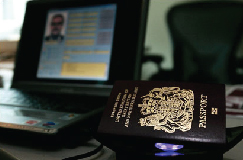
Business Aviation News - Border Management Solutions

Business Aviation News – Border Management Solutions

It is a sad fact that a third of immigrant overstay in the UK. Passenger records held in the e-borders database, which covers details of all flights outside Europe to and from Britain, will be checked and there will be careful monitoring of the 100 immigrants whose visas expire daily.

MPs sitting on the Commons Home Affairs Committee said the UK has become a ‘Bermuda Triangle’ for migrants, a country where it is ‘easy to get in, but impossible to keep track of everyone, let alone get them out.’

So what part do the airlines play in prevention of this problem?

The legal responsibilities of airline carriers are found in the migration laws and regulations of the state that grants those rights to land. All carriers must therefore be familiar with, and comply with, a wide range of legislation and regulations relating to national border control procedure and admittance.

This is detailed in Annex 9 of ICAO’s Convention on Civil Aviation, known as the Chicago Convention which covers the obligations on Carriers and states regarding the Facilitation of people and implementation of Border Control.

Having effective and harmonised guidelines to deal with:

•the communication of advance passenger information

•improperly documented travelers

•the denial of boarding to potential asylum-seekers

•and arrangements in regard to inadmissible passengers who are in transit

are important for airlines and airports to meet their obligations and provide the highest levels of customer service, as well as keep control of operational costs of staff and IT systems incurred as a result of new security requirements and mandates.

An effective solution for airlines?

The ARINC Border Management System is designed to adapt to the changes in operational process and support new technology, enabling Border Control agencies to flex with changing demands and capabilities.

Today it is not enough to simply secure borders from unauthorised entry by known undesirables. Now it is necessary to manage the stay of travellers, from entry through to exit, to know who has been in the country and when they left.

The ARINC Border Management System delivers a full stay management capability, screening all travellers before they travel, and managing visitors throughout their stay.

The ARINC Border Management system is a role-based system, managing entry and exit processes, and improving traveller flow at the primary line. The system supports secondary line investigative processes, enabling immigration, customs and other agencies to co-ordinate resources for a holistic view on potential threats.

For more information please visit ARINC Border Management Solutions

Director of Immigration for the Dominican Republic Jose Ricardo Taveras introduces ARINC representative Jorge Ramirez (far right).
(Government of the Dominican Republic)

The ARINC Electronic Borders solutions have been seen again in the news this week after ARINC announced that the government of the Dominican Republic had chosen them for all air and maritime border security solutions.

A press conference was held to introduce ARINC to the transport sector as the technology provider of choice for aviation and maritime advance passenger information (API) system solutions to help secure the nation’s borders.

ARINC’s ability to meet the government’s border security requirements with expertise, technology competence, and cost-efficiency defined them as the clear choice for Dominican Republic officials. Other providers did not have the qualifications to meet the necessary air and maritime technology requirements. The country has plans to work with ARINC to implement an advance passenger information system for ground transportation.

ARINC’s API and PNR solutions form part of the ARINC Electronic Borders portfolio, developed to meet today’s challenges in border security. For more detailed information on how ARINC can help airlines, agencies and operators manage the complete stay of passengers in a cost efficient way please visit electronicborders.com