Archive

Tag Archives: business aviation services

Business Aviation Communications Satellite ServicesThe scheduled shutdown of Aircell’s Airfone service will spell the end of business aviation’s use of Magnastar systems, but there are a number of roads that can be taken before deactivation takes place.

Although Airfone’s air-to-ground communications network will be over, Aircell is still offering discounts on many alternatives such as;

  • ATG2000
  • ATG4000
  • ATG5000 Gogo Biz

These systems will require upgrades to deliver Smartphone-based services to the tune of around $10,000.

If users have a satcom system, they will be able to continue using MagnaStar, with Teledyne Controls continuing to support MagnaStar as well.

Other business aviation communications companies, such as ExecJet Mobile and ARINC Direct can furnish aircraft with portable Iridium satellite communications equipment and software that can be used for essential flight deck comms, passenger communications and cabin services.

Costs for installations of these systems and software will be higher if the aircraft has no current Iridium transceiver in place.

The new ARINC Xplore device is due to be launched in spring 2014, but ExecJet BizJet mobile systems are available now. High numbers of aircraft operators are hurrying to replace equipment at hugely discounted prices as the shutdown becomes imminent.

Support for Russian Aviation from Global CompanyPlans are on the table for Moscow to develop the Ramenskoe Test Airfield into the fourth regional airport and the city are on the lookout for investors for the project.

Planners want to have a multi-functional centre, with facilities for International passengers and low cost airlines by 2015 and expanding capacity to 10 million passengers per year by the end of 2019.

The plans have an estimated cost of 7 billion rubles, or $214 million for the airfield development, well known for hosting the MAKS International Aviation and Space Show.  Ramenskoe airfield has been in operation since 1941 and has one of longest runways in Europe at 5,402 metres in length, enabling them to accept any type of aircraft with no weight restrictions.

The airfield was used during the Second World War having ground-attack and long range aircraft based there.  Many Russian aircraft have been tested there and today it houses aircraft of the Russian Emergencies Ministry and the Ministry of the Interior and Federal Security Service.

Investors are invited to bid under strict requirements – 25% minimum shares should be traded on the stock exchange; investors should not be affiliated with any airline operating regular passenger and cargo traffic; investors should not be an aircraft manufacturer and the company should have previous airport infrastructure construction.

Interest has already been attracted in the project, with three of the largest Russian private airport holdings.  Requirements are tight, as investors must also hold international certificates such as maintenance of foreign aircraft and passenger handling.

It is an exciting project and highlights the fast pace of the growing industry.  It is thought by some that the project may turn out to be designed for charter flights and growth in business aviation might suggest that to be a prudent measure.

Many companies are supportive of the emergence of Russia’s growing aviation sector.  ARINC have a focus with a Russian language website dedicated to the provision of critical Type B messaging.

The Dubai air show has been busy this year with aerospace companies doing deals behind the scenes for rich and powerful Middle-Easterners with sales for private jets and helicopters.

Demands are high for security, good, robust construction and high performance.

Eric Trappier, Chief Executive of French Dassault Aviation, said that over the next 10 years, “We hope to double our orders in the Middle East where we have strong work and which attracts more and more competitors in the field of business aviation.”

Mr Trappier says that business aviation is rapidly growing in the Middle East, because of the demand for flexibility from customers.

Dassault were there to promote the new range of 5X business jets, originally unveiled in October in Las Vegas, which are expected to enter service in 2017.

American Beechcraft believe the region is a ‘key market’ for business aviation and has a market share of 69% for the turboprop products in the Middle East and 88% in North Africa.

“We do see this is a very strategic market for us and we expect growth over the next five years,” said Richard Emery, President of Sales for Asia Pacific, Europe, Middle East and Africa, Beechcraft.

Luxurious Flying ApartmentsHe described some of the luxury aircraft as ‘flying apartments.’

Embraer Executive Jets announced a purchase agreement for a Lineage 1000 to Arab Wings.

Style and comfort is a big factor for the purchase of executive jets here in the Middle East.  The analogy of the flying apartment is pretty accurate, but also pretty luxurious, with the incredible designs.

French interiors designer Jacques Pierrejean said “The market has evolved with aircrafts that have changed in size. We are more and more carrying flying apartments.”  His latest project was the design for the interior of an Airbus Corporate Jet for Emirates, who earlier this year launched their VIP charter flights service.

The design is luxurious, with large living room space and mini suites with shower.  The movement towards larger aircraft is a reflection upon the demand for ‘home comforts.’

Business Aviation Services Affected During ShutdownAccording to a report this month by US Office of Management and Budget (OMB), the delays caused by the recent partial Government shutdown delayed 156 aircraft deliveries, costing Business Aviation $1.9 billion.

The FAA’s aircraft registration was closed for the 16-day duration and they are now working to clear the backlog of delayed registrations.

The shutdown came at a bad time for the aviation industry, with the fourth quarter traditionally being the busiest period for new shipments of aircraft.

At a Capitol Hill rally of aviation leaders held during the shutdown, Ed Bolen, the National Business Aviation Association (NBAA) president and CEO said, “Imagine if no citizen of the United States could buy or sell a car, purchase or refinance a home or if the sale of any other critical goods came to a complete and grinding halt – that’s what has basically happened in business aviation.  Because business aviation is more regulated than other industries, the shutdown has had a far more dire impact on business aviation than for other industries.”

In addition to these delays, the report commented that, with the vast majority of its workforce furloughed, the National Transportation Safety Board were prevented from fully investigating 48 aircraft accidents; only 2, it is revealed, were investigated, while the rest, and other ongoing inquiries have been put behind schedule.

All in all, the Government shutdown has caused a loss to the US economy of between $2 billion and $6 billion across all sectors including small business, import and export, health sectors and private-sector lending.

It has been found that the most serious and lasting damage may have been made to the quality of governmental workforces, with the system possibly viewed as being ‘broken’, future government and military employees just may not be attracted to these sectors.  The report says, “Government agencies and the military could find it hard to attract and retain the “kind of driven, patriotic Americans to public service that our citizens deserve and that our system of self-government demands.”

It has been announced that the UK Civil Aviation Authority (CAA) plan to look at what are deemed as unnecessary bureaucracy regulations within the UK general aviation industry this week.

The GA Red Tape Challenge, launched in April, includes proposed changes by the CAA which have been suggested by GA industry stakeholders and operators, in the hope that a deregulation of certain aspects of the industry will be affected.

It has been said by the European Aviation Safety Agency (EASA) that the Department of Transport in the UK can start to apply the same safety requirements expected of commercial aviation to non-commercial under EU regulations for the fitness and performance program (REFIT).  The CAA will be looking for clarification of the regulatory conditions for GA aircraft.

Robert Goodwill, aviation minister for the Department of Transport said, “General aviation is an extremely important sector of UK civil aviation and it is right that we do everything possible to enable it to thrive. That includes making sure that, where appropriate, we ease the burden on what are often smaller operators and businesses who find navigating a complex regulatory framework particularly challenging.”

“We are absolutely committed to improving the way we regulate GA. We have made a start, for instance deregulating in some areas and delegating responsibilities in others. But there is much more we can do,” said Dame Deirdre Hutton, chairman of the CAA. “The new, dedicated GA Unit is a formal recognition that GA needs a different and less onerous regulatory regime to commercial air transport.”

In the US, similar reforms are being proposed by the General Aviation Manufacturers Association, who are awaiting decisions to be made by the Senate in relation to smaller aircraft and the FAA’s regulatory conditions for the category.

For the first time in the organisation’s history, the National Business Aviation Association (NBAA) announced last week that its membership has now reached 10,000 registered members.

The 10,000th member is named as TCB Air LLC from Kalamazoo, Michigan.

The NBAA was founded in 1947 by a small group of the Wings Club who met in a New York hotel in 1946.  They realised the critical need for some organization within Business Aviation in the area of air space management and air traffic control.

Founding member, Mr Palmer J Lathrop or Bud to his flying associates, stressed the importance of the promotion and protection of the interest of business aircraft operators and led the way in an informal meeting of 13 aviators on May 17 1946.

Mr Lathrop wrote to the Presidents of a number of aviation companies and invited them to take representation at a further meeting to continue the important discussions.

A total of sixteen companies were eventually represented at the meeting on 21st November 1946 and led to the formation of the Corporation Aircraft Owners Association which was later to become the NBAA in 1953 following the Korean War, but the first A stood as Aircraft until 1997 upon its 50th anniversary, when the final decision was made to settle upon the National Business Aviation Association that it is today.

Aircraft Internet & Wi-Fi Services for Business AviationIn-flight Wi-Fi is not breaking news; its popularity continues to grow as passengers begin to expect more from flight operators in terms of connectivity.

In light of this, GoGo has introduced its latest in in-flight technology, giving Smartphone users the opportunity to make phone calls and text as though they were on the ground.

The GoGo air-to-ground connection will operate through the aircraft’s wireless network instead of the picocells, traditionally used for telephone connections.

New rules, sanctioned by the FAA, now give passengers permission to use their electronic devices; Smartphones and tablet technology during the entire flight, even during take-off and landing, of course, still subject to the requirements of the individual airlines.

Data transfers must still be restricted to ‘airplane mode’ and transmissions across cellular networks are still a ‘no-no’, but with a GoGo app, Smartphone users will be able to roam on the aircrafts in-flight service as though they were on the ground.

Other providers of such in-flight Wi-Fi solutions, such as ARINC Direct, offer seamless connectivity to business aviation passengers.  The business passenger places a generally higher demand upon the airline operators in terms of connectivity and welcome the ‘office-in-the-sky’ scenario.

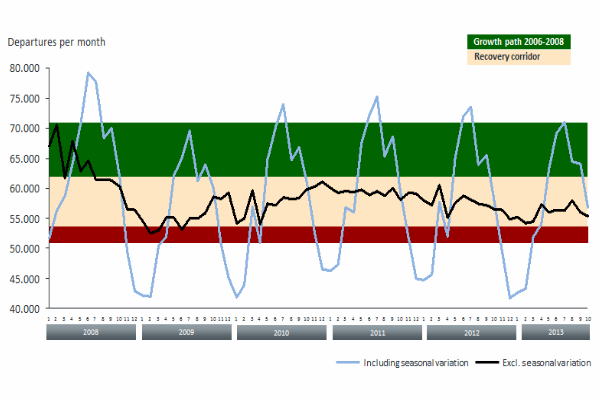
WINGX-October-2013 (1)October 2013 was the worst recorded month for European business aviation since October 2006, showing a 2.1% decrease in activity, according to WINGX Advance monthly report.

The number of Charter flights dropped by 3.5% year-on-year, which amounted to 800 fewer flights made on business jets than there were in October 2012.

There were a few regions that experienced growth; however, with Greece growing by 14% and Turkey growing by 3%, Italy reported a small increase, and Portugal the highest at 16%.

Richard Koe, managing director of WINGX Advance said, “The generally improving economic context in Europe is not yet feeding through to demand for business aviation.”

The Global Express from France’s Bombardier, was the most used aircraft, closely followed by the Citation CJ4, the King Air 350 and the Phenom 300.

Dassault Falcon 5X Business JetDassault Aviation have proudly unveiled their latest Falcon business jet at the National Business Aviation Association convention in Las Vegas.  The Falcon 5X is their largest and most technologically advanced business jet, with new flight control system and aerodynamics.

Eric Trappier, Chairman and CEO of Dassault Aviation said, “The Falcon 5X is the new benchmark for the creative use of advanced technology in business aviation. Using design and manufacturing software and systems pioneered by Dassault, we have been able to build a larger, more comfortable and more capable aircraft that is also more environmentally friendly and much more economical to operate compared to other airplanes in its class.”

Announced as an industry breakthrough, the Falcon 5X is a significant addition to the Dassault product line, with a fuel efficiency of up to 50% better than those in its competing class.  Style and functionality are on show in the 16-passenger capacity cabin, following extensive industry research into cabin technology and passenger requirements for a greatly enhanced flight experience.

“The Falcon 5X represents our biggest investment since the beginning of the Falcon programs,” says Trappier. “It demonstrates our commitment to maintaining the technology leadership that we have displayed in this market since our first business jet flew 50 years ago.”

Innovation and consideration also reach into the flight deck, where the new digital flight control system shows major advancements in precision, ease-of-operation and safety aspects and includes innovative head-up displays with digital radar capable of detecting further reaches than ever before.  Improved fuel efficiency is a breakthrough in today’s world of budgetary requirements and is addressed by the new-generation real-time self diagnostic Silvercrest engines.

“The Silvercrest engine is 15% more fuel efficient than other engines in its power class; emissions are dramatically lower than current standards, and the engine is remarkably quiet,” says Trappier.

The Dassault Falcon 5X is expected to take its maiden flight during early 2015 and will be priced in the region of $45 million.

Advance_Information_ManagementInformation management for aircraft involves the installation of avionics units and it has recently been announced that Boeing have awarded a contract to Teledyne to provide, develop and supply data acquisition systems for the next-generation 737 and 737 MAX.  The company have also been contracted to supply a new information management system for the 777, Next-gen 737, 737 MAX and the 747-8 production aircraft.

Information management systems are designed to improve flight safety and efficiency with a focus upon maintenance issues.

Information management is equally important on the ground and in the airport facility.  Flexible and scalable solutions are integral to enhanced ground security, both for physical security and advanced information management.

ARINC AIM provides comprehensive information management solutions designed and implemented to create an integrated control platform to enhance key infrastructure and mission critical messaging.

With individually tailored solutions for single and multi-use facilities, all aspects of security and information management can be encompassed, from intrusion detection and biometric control to data security and credential management.