
Archive

Tag Archives: border management systems

Automated Border ClearanceHamad International Airport in the State of Qatar has awarded a contract for 64 e-Gates, equipped with Automated Border Clearance Biometrics to be integrated into the infrastructure of the airport operations.

The technology, including face, fingerprint and iris recognition biometrics will bring enhanced automated border clearance, speeding up passenger processing and streamlining operations at the airport.

Vision-Box, who has been awarded the contract are honoured to be a part of the implementation of the state-of-the-art systems.  “The Middle-East is a market that continues to show enormous potential, where we have invested for some years now and we look forward to further contribute to the various on-going Identity Management programs, as well as supporting the different GCC initiatives in similar projects, by continuously investing in local resources” said Jean-François Lennon, Director of International Business Development at Vision-Box.

Automated Border Clearance Systems are in operation across the globe and can greatly improve operations within the terminal buildings, helping passengers and airport staff with the streamlining of procedures, which before could be exhaustive both physically and operationally.

Other eBorders providers, such as ARINC Inc, bring enhanced automated border clearance technology solutions, including automated baggage handling, self-service kiosks for check-in and bag drop and advanced passenger information systems for the delivery of vital and often mandatory passenger data.

ARINC eBorders APIS is part of a suite of integrated Electronic Border Control solutions designed to improve border security with the provision of passenger and crew data in advance of arrival offering Immigration greater control over the flow of people to and from the country.

Paradise holiday destination, The Maldives have just awarded ARINC a five-year contract for the implementation of ARINC eBorders APIS at its international airports in a bid to improve efficiency and passenger flow in addition to the obvious security enhancement of advance passenger and crew information.

Mr Hamid Fathuhulla, Deputy Controller for the Department of Immigration and Emigration in the Maldives said, “We have chosen ARINC as our technology partner because of their industry leadership as well as proven expertise and experience of working with the world’s airports and airlines.  We are confident ARINC will meet our technology needs every step of the way as we continue to grow.”

ARINC offer tailored solutions according to the individual requirements of each customer and the industry standards of the international trade organizations and governmental mandates.  With decades of industry experience, ARINC remain world leaders in the fields of aviation, transportation and security, offering an extensive range of technological and communications solutions in the air, on the sea and on the ground.

Michael DiGeorge, ARINC Asia Pacific Managing Director said, “It is crucial for airports and other points of entry to meet their border security and control requirements while providing the highest levels of customer service.  At the same time, they need to manage increased operational costs as a result of compliance to new security requirements and mandates.  We are committed to helping the Maldives meet its current and future border security and control objectives.”

With the rise in international travel, imports and exports across Europe, border management is proving to be increasingly difficult, due to the simultaneous rise of illegal immigration, drug crimes and human trafficking.  As a result, border management is soaring to the top of the priority list in many European countries.

Border agencies are seeking new and efficient ways to lower the risks of these activities and up the border management in their countries.

The Border Management and Technologies Summit will address these issues and discuss solutions such as increasing the use of biometrics, access control, surveillance and advance profiling to name a few.

Industry-leading companies, such as ARINC, provide tailored electronic border management solutions to the marketplace as a part of their extensive suite of services, to enhance border control and passenger data management.

High levels of illegal activity border-wide and corruption within the companies guarding Nigeria’s border has prompted a Chinese firm to apply to install electronic borders control equipment at a cost of approximately 244 million U.S. dollars.

Electronic border management deployment would tighten security immensely, reducing the temptation to try to access Nigeria’s borders illegally.  With enhanced security, and the reduction of illegal border activity, it will be possible for Nigeria to develop its borders and increase commercial promotion.

“Until now, what we had was a proposal from a private Chinese company with which we had also entered into a Memorandum of Understanding (MoU) to provide for an electronic border control and the cost of the equipment was approximately about 244 million U.S. dollars”, Interior Minister, Abba Moro said, adding, “With the assistance of the U.S. State Department, we realised that some components of the offer we got from the private firm was contained in what the State Department would be offering us”.

With the help of U.S. State Department, the Nigerian Interior Ministry hope to deploy advanced surveillance technology in addition to electronic borders equipment.

Business Aviation News - Border Management Solutions

Business Aviation News – Border Management Solutions

This week saw the introduction of tighter security measures in Fiji as the Immigration Department implemented the new Integrated Border Management System (IBMS) at Nadi International Airport and every other entry point countrywide.

The Fijian Government awarded the contract for installation to Public Sector Solution of Informatics International Limit, a Sri Lankan company who implemented the IBMS, state-of-the-art technology with features designed to enhance passenger profiling and visual verifications that can assist in the identification of high-risk passengers.

IBMS will change the face of security and enhance border management system control, maximising efficiency and productivity with features including access to data, passport and citizenship information, visa and permit modules.

“It will allow for a quick flow of all of our immigration processes and ensure there is quick turnaround time for each passenger that enter or leave our country,” said Major Nemani Vuniwaqa, Director of Immigration for Fiji.  “It strengthens our security system at all of our borders and ensures that we find people that may, in the past, slipped through.”

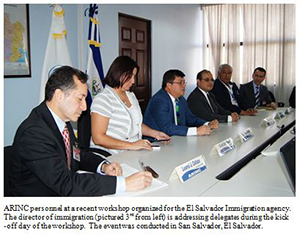
In Annapolis ARINC said it has started a series of workshops specialising on effective border security. These workshops are focusing on protecting borders from illicit activities, and have become a major concern for all nations. These situations have a significant impact on national security and immigration control. These workshops are starting in El Salvador and will roll out to ARINC’s entire customer base.

ARINC Conducting Border Security WorkshopsIn the course of these workshops, ARINC and its customers will discuss the positive results of implementing ARINC’s border security system, security trends, and share best practises and identify areas that can be improved. The courses are made up of senior officials and technical people from the various government agencies as well as airport operators, airlines and ground handlers.

Jorge Ramirez, Marketing Director of Global networks and IT Solutions for ARINC said ‘The ultimate goal of the workshops is to improve a country’s border security; these workshops are essential for our existing customers and ideal for countries in the process of evaluating effective border security solutions.’

34 of the 35 countries that have implemented border security systems ARINC is working with. ARINC’s complete portfolio in electronic borders uses its expertise gained in ARINC’s  aviation, governments, information technology, surface and maritime transportation and systems integration to deliver the most cost effective and efficient solution available.

Out in the news this week was a rather novel idea from the University of Arizona. Immigration interviews may never e the same again if the idea of automated lie detector tests takes off. The machine could ask the passenger a series of questions, and analyse different aspects of your behaviour: how your eyes are moving, how your voice changes, how you pause between answers, how you fidget.

Border Security Future

An image from a demonstration of the Embodied Avatar, from a video by BORDERS, the National Center for Border Security and Immigration at the University of Arizona.

The machine, an “Embodied Avatar kiosk” uses this data to assess how truthful your answers were. Whilst this is the latest technology in the field, it is unlikely to be at Gatwick in the near future. You are much more likely to start to see more of the automated border control systems in place!

At Helsinki Airport, as at many other airports the automatic border control system was introduced to help ease congestion of passenger processing during peak hours and travellers are swiping their passports themselves at border crossing checkpoints.

This year Helsinki Airport expects more than a million users to pass through its automated system, after it was reported that last year 600,000 passengers walked through at ease. Seppo Parkkinen the Kuopio-based musician travels internationally a dozen times a year spoke about the automatic passport control and said “It is much faster, you don’t have to wait and it works really well.”

Citizens holding biometric passports, of the European Economic Area, Switzerland and Japan can pass through the self-service passport control. Users scan their passport in a reader and later pose for a camera that uses facial recognition technology that compares their features with the digital photo embedded in the passport.

Business Aviation News - Border Management Solutions

Business Aviation News – Border Management Solutions

Departure control systems incorporating biometric passport information are becoming ever more affordable and within the reach of most airports. ARINC’s AviNet Airport system is specifically geared towards integration with existing systems and efficient passenger processing.

Currently 70% of Finns have a biometric passport according to Pentti Alapelto of the Finnish Border Guard. By the end of 2016 it is expected that that figure will be 100%. Alapelto explained “We also use the devices to help weed out passengers in cases where we believe someone is travelling with a false document,” as the high-tech readers also offer an additional layer of security to traditional passport control.

This week we heard that ARINC will be providing IT maintenance and support for Japan’s AVICOM Aircraft Communications Addressing and Reporting System (ACARS).

AVICOM is Japan’s service provider for aviation communications, performing the same role as the FAA in the USA. Since the 1990’s AVICOM has used ACARS, and has selected ARINC to provide a broader service and maintenance solution that meets increasingly demanding cost expectations. ARINC will provide dedicated on-site support at AVICOM’s Network Operating Center, in addition to remote support in locations across Japan. The complete ARINC managed solution comprises asset management, incident management, preventive maintenance and reporting.

“This is the first time we’ve been contracted to support an ACARS system and provide maintenance for back-end network infrastructure in this way,” said Jim L. Martin, Managing Director, ARINC Asia Pacific. “This engagement highlights the flexibility of our IT support capabilities to develop solutions for a variety of technical environments,” Martin continued.

For more information on ARINC’s services airport management please visit the AviNet Airport site. For specific information on ACARSs and the transmission of Type B Messages please visit the Type B Messaging site.

The government denies that the IPS is a faulty instrument for measuring its progress on migration for the UK. Yet there does not seem to be an accurate system for counting people in and out of the country and government has promised to reduce net migration (the difference between those entering and leaving the country) to “tens of thousands” by 2015.

Border Management

The e-borders scheme meant to do this activity, and is still a work in progress. Despite government assurances, according to experts when it comes to measuring how many people are leaving the country is unclear and the increasingly rigid process it is to get a visa for the UK, it seems there is no way of knowing if someone is still in the country when it expires. E-borders replaced the old paper-based embarkation system, scrapped in the 1990s.

IPS emigration estimates are based on interviews with just 2,000 people and there is currently no alternative source of data to measure them against. Instead the government relies on the answers given by a sample of travellers who agree to be stopped and questioned by a team of social survey interviewers at Heathrow and other main air, sea and rail points of entry to the UK.

E-borders which was primarily meant to improve security, when combined with a biometric identity card scheme, began collecting details of passenger and crews for inbound flights from outside the EU at nine airports in March. The plan now is to extend it to ports and railway stations by 2014 and to passengers from within the EU by 2015. But that will depend on persuading all EU countries to share passenger and crew list information – quite a number of them regard this as illegal under European free movement laws.

Electronic border schemes can be adopted by both airlines and airports. One product by ARINC, Electronic Borders, is designed to adapt to the changes in operational process and support new technology, enabling Border Control agencies to flex with changing demands and capabilities.

Today it is not enough to simply secure borders from unauthorised entry by known undesirables. Now it is necessary to manage the stay of travellers, from entry through to exit, to know who has been in the country and when they left.

The ARINC Border Management System delivers a full stay management capability, screening all travellers before they travel, and managing visitors throughout their stay. For more information please visit the ARINC Electronic Borders website.