Archive

Tag Archives: aviation operational messaging

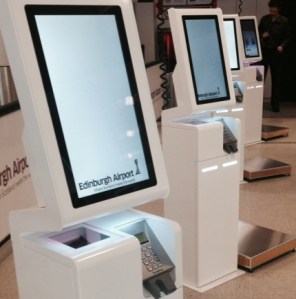
Single Bag Drop Solutions for Multi-Airline UtilisationEdinburgh airport has become the first to bring multi-airline bag drop system operation to the UK in a move that has seen them install ten, new self-service kiosks and web-based software that operates a fully common, shared bag drop facility for its passengers.

Operated by EasyJet and FlyBe, passengers will retain control of their entire check-in experience, from online check-in and self-printed boarding pass to baggage weigh in and luggage tag attachment, when they will be directed to a drop off point to dispatch their luggage.
Although new to Edinburgh and the UK, this system is in operation in CUTE platforms across the world and is designed to streamline airport operations. Using common-use functions for bag drop system operation speeds up the check-in process and allows cost-sharing within the terminal, also freeing up premium space.

This is just the beginning for Edinburgh airport, as they plan to continue a programme of investment for the installation of the latest technological solutions. Later this year, they plan to carry out a trial for a baggage storage facility, where passengers will be able to check-in luggage in advance of the flight.

David Wilson, chief operating officer at Edinburgh Airport, says: “New ownership has allowed us to be creative in the way we look at the check-in process. A huge amount of research, engagement and investment has gone into this new process and we’re delighted to officially launch the first multi-airline common bag drop facility in the UK with our partners at easyJet and Flybe.

ARINC Direct Business Flight Support ServicesAs Rockwell Collins see the business aviation industry growing, it makes sense that after its acquisition of ARINC Inc was finalised late last year, that the business aviation division, ARINC Direct brands and Rockwell Collins applications would gel perfectly in the business flight support services sector.

Rockwell Collins formed the Information Management Services division in January, placing Jeff Sanderski in the senior vice president role. It is a worldwide operation with offices in London and Singapore in addition to the HQ in Annapolis and a further US office in Houston with a total of 2,200 employees.

Around 22% of the business for this division lies in business aviation – a figure that Mr Sanderski sees growing as more private jet aircraft continue to be fitted with Rockwell Collins/ARINC Direct applications, including air-ground voice and data, ground-ground networks and business flight support services.

More About Advance Passenger InformationIt has been revealed that as many as 20 million passports per year may not be receiving proper consideration in the UK alone. These shocking figures come as the Home Office estimated that only 90% of Advanced Passenger Information (API) is being received. API is passenger data that is electronically gathered and transmitted to government and border agencies for checking and comparison to international ‘at risk’ registers. API can detect high risk passengers on ‘no-fly’ lists across the world and can ensure that terrorist activity is kept at bay.

If these estimates tell us that 10% of UK API is not being received, this could spell an average of 20 million passports that are not being checked properly. Interpol say that countries are not doing enough checks against its list of stolen passports. Globally, this figure could reach up to one billion passengers; a disturbing figure.

API is mandatory for all passengers travelling to and from the US and has been so in the wake of the official investigation into the tragic events of 9/11. Last year, the EU questioned the use of API with regard to the privacy aspect and raised issues about the use of the information, once gathered and checked.

Once reported stolen, UK passports are cancelled and deemed unusable for travel. International stolen passports are entered into the Interpol Lost and Stolen Database, accessible by border security agencies for comparison.

The Home Office are looking into the figures to clarify the situation and are working towards improving coverage.


Business Aviation Communications ProvidersBombardier’s brand new Learjet 75 will be revealed in the planned demonstration tour this month for the first time in Latin America. The beautiful new aircraft has an interior cabin design and technology based upon the Learjet 85 and is designed to carry eight passengers on a full fuel load. The maximum range of the aircraft is more than 2,000 nautical miles and with the addition of its modern design, it is hoped to help to grow the market in this region.

With its long-range capability, the Learjet 75 can fly passengers non-stop from Sao Paulo to Santiago and ensure comfort and accessibility for the duration. The business passenger has high expectations of communications in an aircraft and needs a high degree of connectivity for the ability to undertake business as effectively in the air as they do on the ground. Cabin services on the new Learjet 75 include a cabin management system with individual touchscreen monitors, full audio and video control.

The planned tour will begin with a static display in Toluca, Mexico at the Aero Expo and will also be shown at FIDAE in Santiago, Chile at the end of the month, showcasing at other events along the way in Mexico, Columbia, Panama, Brazil, Guatemala and Chile.

The new regional vice president of sales for Latin America Bombardier Business Aircraft, Stephane Leroy, said, “We are very proud to bring our new Learjet 75 to the region for the first time. This aircraft, with its fusion of modern design, Learjet heritage and top performance, was developed with the needs of our customers in mind. We are convinced that this new Learjet will not only maintain, but grow our market share in the region.”

Airport Operations Solutions ProvidersRaytheon, global defence contractors and Passur Aerospace, specialising in predictive analytics and business intelligence have formed an alliance to bring an enhanced perspective to airport safety and efficiency, it has been announced. The partnership will integrate Passur’s predictive analytics decision support software with Raytheon’s air traffic management systems and will work in unison with the FAA’s NextGen Terminal Flight Data Manager programme.

It is hoped that the collaboration will produce and process enhanced flight data and transmit it to air traffic positions and tower control. The information will allow airport operators and airlines to function efficiently within a seamless air traffic system, thus streamlining operations. The system will roll out with a demonstration this month at the Communications for Safety conference.

Jim McCoy, VP of Raytheon ATS said, “We are using analytics to create useful information and get it to the air traffic managers and operators who make crucial decisions regarding air traffic flow at all stages of flight. Rapid access to better information enhances safety, efficiency, and the curb-to-curb travel experience.”

“Passengers and operators are rightfully demanding a more predictable air travel experience,” said Jim Barry, PASSUR president and CEO. “Through the Raytheon/PASSUR collaboration, we achieve this objective and bring enhanced reliability to everyone involved.”

Global Coverage with Ground-Stations Networks for AviationRussia plan to deploy a maximum of seven new ground-stations in foreign countries in a bid to improve satellite navigational capabilities with Glonass system monitoring by the end of 2014. The new ground-stations will join 46 that currently operate within Russian territory, three in Antarctica and one in Brazil.

The news was announced at the Security Technologies exhibition conference earlier this month and the focus, according to Vladimir Klimov, Glonass Association Executive Director, is to create a worldwide Glonass augmentation network.

In order for high-precision navigation and communications to operate seamlessly, it is critical that satellite networks can communicate globally with a series of ground-based stations or receivers. High frequency data link communications for example, can only be seamlessly effective if geostationary satellite transmissions can form a truly global network, including remote, Polar Regions and vast oceanic expanses. This is made possible by overlapping coverage zones with carefully placed ground-stations and high frequency receipt and transmission technology is installed within aircraft.

Other aviation HFDL providers include ARINC who successfully achieve global coverage utilising the Iridium and Inmarsat satellite networks.

Web-Based Operations Solutions for AirportsA new partnership has been announced for the aviation industry of Casper and Cirrus Environment (UK) who will work together on the much-debated subject of noise monitoring.

The web-based noise management solution is an effective tool, combining automated analysis and reporting functionality to bring a supported noise management system to airports of all sizes. Portable, semi-permanent and permanent units can be used within the cloud-based network giving flexibility over a wide range of applications.

Cloud-based and web-based operations management solutions give access to permission-supported users across the industry in all sectors. This can bring effective and streamlined integration for operators; from airports operations to passenger processing and maintenance management on the ground and in the air. A growing number of aviation industry sectors are turning to web-based solutions as demands increase for cost-effectivity, sharing capabilities and communications speed and capacity.

Global Aviation Communications Solutions ProvidersWith a growing focus upon sustainable solutions for the aviation industry, the Agency for Science, Technology and Research (A*STAR) plan to demonstrate their R&D initiatives at the Changi Exhibition Centre; the location for the Singapore Airshow this year.

As the industry continues to expand and demands grow, with an expected 3.3 billion people expected to use commercial flights in 2014, globally, the industry needs some solutions – and fast. Aviation communications is just one area that will be addressed with the latest innovations and solutions, in addition to maintenance issues and analytics.

The very latest aviation communications technology will be on display including an electromagnetic compatibility tool which is designed to minimise interference and enhance evaluation of sensor systems onboard. There will be solutions for Software Defined Radio and Disruption Tolerant Networking that will allow for message routing in intermittently-connected networks with a focus upon reliability and performance.

In today’s busy skies, and with a forecast of ever-increasing traffic, airport and airline management has never been so critical. Operators are looking at sustainable aviation communications solutions to carry them forward in a competitive industry that never sleeps.

Aviation Information Management Solutions ProvidersAs we near the implementation of phase three of the Single European Sky ATM Research (SESAR), EUROCONTROL announce that they will be using MEGA’s software solutions to help describe the repository and conduct SESAR information management.

SESAR is a fundamental part of the program that will aim to supply and manage the modernisation of air traffic control over Europe in the Single European Sky initiative. Over the next thirty years, aviation management will be harmonised and unified and will include a unique air traffic control for both civil and military aviation.

Information management allows for sharing resources and information, including security data, research and collaborative decision making. MEGA are proud to see ‘our solutions used in transformation projects that will bring everyday benefits to so many people.’

Innovative Solutions for Passenger ServicesGoogle Glass will appear at Heathrow Airport as Virgin Atlantic trial the technology for six weeks to assess improvements in passenger services, check-in and processing.

It is hoped that a touch of glamour will also appeal to the industry with the simultaneous trial of the Sony SmartWatch 2, with both technologies expected to benefit the provision of enhanced customer service.

The SmartWatch and Google Glass will be connected to Virgin’s passenger services system and to a concierge dispatch app, which will send passenger data to the glasses at the beginning of the check-in process.

The app technology will also collect and transmit passenger data, which is hoped will benefit the passenger in terms of enhanced experience. If the trial is successful, Virgin hopes to deploy the technology across their network.