Archive

Tag Archives: aviation news

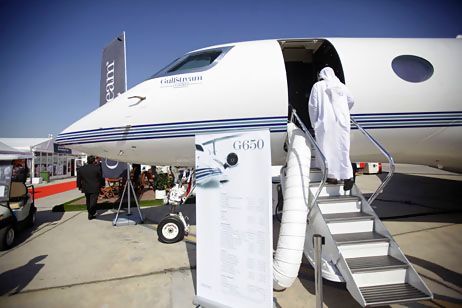
Some of the industry’s biggest business jet manufacturers looked to take advantage of the interest by taking part in the second annual Abu Dhabi Air Expo, which took place last week in the capital. The three-day event is the only general aviation exhibition in the region.

“I think it’s fair to say business aviation is well established in the Middle East, but there is a notable shift now,” said Philip Nasskau, a spokesman for Bombardier.

Orders have been rising in the region, according to manufacturers, and the industry is projected to keep growing. Bombardier estimates that there will be 735 new business jets in the region by 2021, and a further 1,260 bought between 2022 and 2031.

Gulfstream, a US-based manufacturer, has already enjoyed significant growth in the Middle East in the past five years and is expecting more. It had 146 aircraft in the region last year, up from about 110 in 2007. Heidi Fedak, the senior manager of social media and external communications at Gulfstream said “I expect growth in the region, especially now we have the Gulfstream G650 available for sale,” she added “The G650, which is being exhibited for the first time in the Middle East at the air expo, is the fastest business jet on the market, and can fly from Melbourne to Abu Dhabi in about 13 hours, shaving about two hours off the journey time of a larger passenger plane.”

Ten years ago, buyers would use consultants when choosing their aircraft, but today, many clients are directly involved in the purchasing process. “We are seeing a different buyer today than what we saw some time ago in the Middle East,” said Colin Steven, the vice president of sales and marketing for Europe, the Middle East and Africa at Embraer Executive Jets. “Today there is so much information out there that the guys understand range is the priority, comfort is the priority, so I want to go big and I don’t want anything small.”
The Middle East Market for Business Jets is Increasing


The Middle East Market for Business Jets is Increasing


I have been following a post this week from AOPA. They deem the following as the absolutes must haves:

Nav Trainer Pro ($4.99 on iTunes and Google Play) –  Help you practice and teach the use of aviation navigation equipment. It includes VOR, HSI, RMI, ADF, DME, and ILS simulation.

MyRadar Pro ($1.99 on iTunes) – The app that shows animated weather at your location. For $2.99, you can add a hurricane tracker.

PocketFMS EasyVFR (free in iTunes and Google Play) – The app allows users to create detailed flight plans on a computer, save them to Web storage, and load them on any mobile device. It provides route planning, weather, and notams, and computes performance, weight and balance, and fuel consumption.

XCSoar (free in Google Play) – It’s a tactical glide computer for glider pilots, paragliders, and hang gliders.

Aviation W&B Calculator ($9.99 in iTunes) – The app does your weight and balance calculations and has templates for 165 aircraft, ranging from the Beech Baron to the Stinson 108-1. Users also have the option to build their own aircraft templates.

Of courses, i’d like to add my own on to this list – working towards the EFB i love this one – iPad Flight Planning Apps


This year Nextant Aerospace is launching an attempt to enter Europe’s market, after achieving the European Aviation Safety Agency certification for the 400XT in November last year.

According to the U.S. company’s president, Sean McGeough, its remanufactured and reinvented take on Hawker Beechcraft’s Beechjet 400 is delivering an improved performance at reduced cost. “There is a great opportunity for selling an aircraft like this in a down market,” McGeough briefed at the London-area Farnborough Airport.

The alteration of Beechjet 400s into 400XTs involves a 6,000-hour remanufacturing process at Nextant’s factory in Cleveland, Ohio. The new aircraft is more than 85 percent original and qualifies for bonus depreciation under U.S. tax rules. New features include the Williams FJ44-3AP engines and a Collins Pro Line 21 avionics suite. The airframe has an aerodynamic makeover involving redesigned pylons, streamlined engine cowlings, a new engine beam and mounting system and an improved horizontal stabilizer.

With an initial with two-year warranty (three years for the engines), the 3,050-pound-thrust FJ44-3AP turbofans promise a 32-percent improvement in specific fuel consumption compared with the Beechjet 400A’s Pratt & Whitney CanadaJT15D-5s. The 400XT’s range is 2,005 nm, carrying four passengers and NBAA IFR reserves. Close to that of the CJ4 and Phenom 300, the 400XT with a high-speed cruise of 460 knots, is 16 knots faster.


Biofuels showcased at Avalon Air Show

Biofuels showcased at Avalon Air Show

The Avalon Air Show saw a lively exchange of ideas about aviation biofuels in general and Australia’s opportunities in particular.

The Australian aviation biofuel objective is ambitious, established in 2011, the aim is for 5 per cent of aviation fuels to come from sustainable fuels by 2020, representing two commercial-scale plants. By 2050 the target is 50% sustainable fuels. Forestry residues, stubble, bagasse, seed oils, tallow pongamia, algae, coppice and eucalyptus trees are the biofuel ideas. It is thought that ultimately 4.5 gigalitres can be obtained from lignocellulose, sustainably, over 1 billion US gallons per year.

Another contender that has intrigued by Airbus is mallee, an oilseed crop. It is thought 14,700 hectares of existing capacity would be available in the near term, just in one region they studied in Victoria. Producing 150,000 bone-dry tons of biomass would result in 85,000 tons of bio-oil which could be upgraded to 12-18 mega litres of jet fuel.
 

Out in the news this week was a rather novel idea from the University of Arizona. Immigration interviews may never e the same again if the idea of automated lie detector tests takes off. The machine could ask the passenger a series of questions, and analyse different aspects of your behaviour: how your eyes are moving, how your voice changes, how you pause between answers, how you fidget.

Border Security Future

An image from a demonstration of the Embodied Avatar, from a video by BORDERS, the National Center for Border Security and Immigration at the University of Arizona.

The machine, an “Embodied Avatar kiosk” uses this data to assess how truthful your answers were. Whilst this is the latest technology in the field, it is unlikely to be at Gatwick in the near future. You are much more likely to start to see more of the automated border control systems in place!

ARINC Cabin ConnectIn the news again and again are the developments for inflight broadband. Some passenger groups hail it as an essential, other just see it as a rip off. One news report this week suggested that supply outweighed demand – but no commercial airline or private jet wants to be left behind the times.

This week we heard that the U.S. Federal Communications Commission (FCC) issued an order implementing Ku-band rules for the operation of satellite earth stations on aircraft enhancing competition and promote the widespread availability of Internet access to aircraft passengers – potentially starting the rise of low cost wifi on airplanes.

Providers to the aviation industry often differentiate their products by aircraft wifi for business aviation, and in flight wifi for commercial airlines.

Up until now, L-band licenses (1-2GHz) could be obtained from the FCC to offer connectivity to airborne aircraft over Mobile Satellite Services (MSS). The new rules will allow the FCC to process ESAA applications up to 50% faster and will speed the deployment of ubiquitous airborne broadband services, including Internet access.

This month we have heard another story of airline struggling to deal with costs. Chanchangi airline has said that high cost of aviation fuel in Nigeria is a huge setback for domestic airline operations.

Airlines now have to look at every aspect of their business in order to balance the books. There are lots of areas that you can make cut backs but using route optimisation as a part of flight planning is one, and getting a good deal on aviation messaging is another.

But even with these basics in place fuel remains crippling. Using a contract fuel supplier will help – but this year at the Avalon air show Australia showcased aviation biofuels as the roadmap for the future. More on that story later…

Australian aviation biofuels showcased at Avalon

Australian aviation biofuels showcased at Avalon – picture courtesy of ABC

Gulfstream

Gulfstream

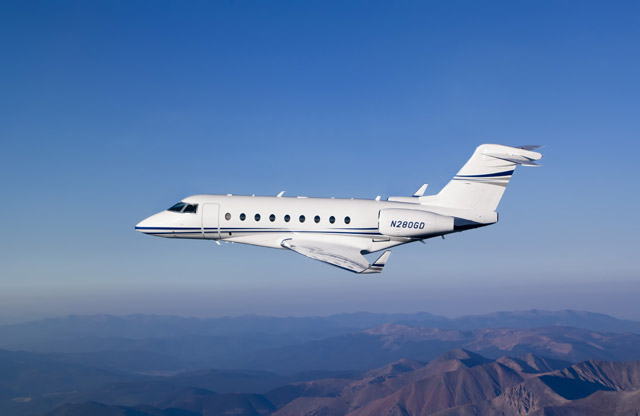
European validation for the Gulfstream G280 business jet after Israel and the USA certificated the super-midsize aircraft. The G280 was introduced in 2008 as a replacement for the G200 is a 10-seat aircraft manufactured by Israel Aerospace Industries in Tel Aviv and completed at Gulfstream’s headquarters in Savannah, USA. Gulfstream delivered 17 midsize-category jets – including the G280’s smaller stablemate the G150 – during 2012. This tally is expected to climb to 26 in 2013.

Mark Burns, Gulfstream president for product support said “The 250h internal testing programme – among the most extensive voluntary reliability programmes ever implemented by Gulfstream – incorporates pilot check rides, maintenance on auxiliary power units, engine run qualifications, technical operations, publications validations and basic servicing and handling at typical fixed-base operators.”

Gulfstream’s G280 business jet has recently set 15 new city-pair speed records as part of a company-driven programme to demonstrate the reliability of the super-midsize aircraft, the most significant from Aspen, Colorado, to Fort Lauderdale, Florida, and another from Honolulu to Savannah.

The G280 flew the 3,034km (1,640nm) from Aspen-Pitkin County airport to Fort Lauderdale-Hollywood International airport in 3h 21min, at an average speed of Mach 0.84. The G280 also achieved a flight of 7,630km from Honolulu to Savannah in 8h 19 min, at an average speed of Mach 0.80. Certificated by the US National Aeronautic Association and forwarded to the Switzerland-based Fédération Aéronautique Internationale for ratification as world records.

ARINC will continue to provide and maintain the adaptable vMUSE™ platform for the Common Use Passenger Processing Systems (CUPPS). The long term relationship of ARINC and Munich began in 2003 and now to continue with ARINC’s CUPPS solution in MUC Terminal 2 until December 2014.

“We are impressed with the ARINC vMUSE platform and the support we have received over our long partnership. The ARINC team has regularly exceeded our agreed upon benchmarks and SLAs.” Said Marco Butz, Manager Technology and Infrastructure at Munich airport.

ARINC will continue to provide the premium on-site service and a centralized state-of-the-art firewall solution is due to follow during 2013. Tony Chapman ARINC Senior Director, Integrated Travel Solutions commented “We are delighted to continue working with one of our long-standing and valued customers, as we believe it reflects both the quality of our service and commitment to the highest standards of performance,” he continued “Munich Airport is focused on providing the best possible services for its customers, and ARINC’s technology helps make that achievable.”

Thought to be the first cooperation between business operators, 8 Europe major business air charter companies have joined together to form a strategic alliance under the name of AirClub.

Christian Hatje, svp business aviation of PrivatAir and chairman of AirClub, says: “History has been made. AirClub is the first ever alliance of business jet operators and will operate more than 100 business jets. We will combine the strength, purchasing power and expertise of some of Europe’s leading players within the industry to provide clients with premium service, top aircraft availability and flexibility as well as the highest possible standard of safety and comfort.

Founding members ACM Air Charter, Air Alsie, Air Hamburg, Corporatejets, FlyingGroup, GlobeAir, Masterjet and PrivatAir aim to offer their customers flexibility and increase customer service. Based in seven different countries, AirClub will gather resources and knowledge, providing a wider range of solutions and tailored approaches to customers’ needs.

“We will strive to launch our own AirClub online booking system, allowing customers to choose from a vast, diversified fleet located all over Europe, as well as a special member’s programme to complement the latter early next year. Booking a private jet through our online system will be as easy as renting a car.” Continued Hatie.

“GlobeAir is very proud to be a part of the first, and so far only, corporate jet alliance. We are always looking for ways to upgrade our customer service and partnering with other operators offers our customers the benefit of an extended fleet. Said Mauro de Rosa, chief marketing officer Europe at GlobeAir AG and deputy chairman of AirClub, “AirClub is an absolute milestone in today’s business aviation and we are convinced it will further enhance our standing as an industry.”