Archive

Tag Archives: aviation news

Although US budget cutbacks effects air traffic control the airport security sector is still expected to grow, and terrorism is still a threat, analysts have said.

In the wake of the September 11 attacks screening passengers and surveillance at airports has boomed. Because airport security is one of the areas that has been hit in the US by budget cuts, the expected growth on air travel will mean an increase in spending on airport security.

Didier Brechemier, an expert at the Roland Berger consultancy said “Airport security is a market niche which is outperforming that of the aviation. It grows along with the volume of passengers which is growing itself by five to six percent per year.”

3 billion passengers will travel by air this year according to the International Air Transport Association (IATA), this is nearly double the amount of people that flew in 2001. IATA also expects this number to double by 2030.

According to Philippe Nguyen, president of the IPE Investment Fund “The airport security screening market is worth some $10 billion (8 billion euros) annually” The Visiongain business information service said “If physical security at and around airports is included the market is worth over $22 billion”

Visiongain has noted that national governments are increasing spending on developing new airport facilities and expanding existing ones to meet increasing air travel, with spending on enhancing security also rising. Visiongain said “Contract sizes and financial data released by companies involved in the industry indicate this and would suggest that the market will continue to expand”

Europe and the US have the largest airport security markets while the Asia Pacific region is on course for the largest growth in the aviation sector.

In the next 10 years China is expected to construct 70 new airports.

Other boosts for security companies include changing the restrictions on carrying on board planes certain items, and the change of the rules of liquids should also boost this sector.

At a recent security conference IATA chief Tony Tyler said “that a right balance needs to be struck between risk and regulation. If we don’t find the right balance soon we will lose the goodwill of our passengers and shippers, clog our airports, slow world trade, and bring down the level of security that we have worked so hard to build-up”

Plenty of commercial opportunities are expected as growth will rest on new technologies. Better target screening is expected by use of information on travellers available to border control agencies will rely heavily on technology and data gathering. Many companies are now offering a full suite of airport security and passenger processing solutions.

India has handed over an advanced passenger information system to the Maldives.

The Maldives biggest source of revenue is from tourism and the authorities there have been handed an Advance Passenger Information System (APIS) providing a safe and efficient immigration service to travellers.

The system was installed at the Male’s Ibrahim Nasir International Airport and according to authorities marks a ‘giant step’ for the country to provide a much better service to travellers.

The APIS will give the Border Control System advanced information about people travelling to and from the country. The population of the Maldives is about 350 000 and has around 1 million visitors per year.

Dnyaneshwar M Mulay the High Commissioner of India to the Maldives handed over the APIS to Maldives’ Controller of Immigration & Emigration Mohamed Ali.

For more information on APIS please see this link.

The installation of the world’s first GE H80 800 HP fuel-efficient engine in a King Air C90 has caused much excitement in Nashville, as Drumm and Lakeshore Aviation teamed up with Avfuel Fixed-base Operator (FBO) Smyrna Air Center.

Having flown King Airs for years, I’m excited to see this program take off,’ said Greg Ryan, GE Aviation Sales Director.

The impeccably restored King Air C90 is latest addition to the Lakeshore Aviation charter fleet and features the new engine, developed by GE Aviation following their acquisition of Czech-based Walters Company.  The H80 is a combination of the Walters’ M601 engine and GE’s 3D wizardry to produce a more powerful, durable engine with the all-important advanced fuel efficiency.

We’re seeing faster speeds, yet we’re burning less fuel.  The extended service live of 3.600 flight hours between overhauls will result in a significant reduction in maintenance costs,’ said Curt Drumm, President of Lakeshore Aviation, commercial rated pilot and the organization’s charter captain. ‘This is GE’s first engine for being used on business turboprop aircraft and the improvements it brings to the turboprop flying experience are incredible. Pilots love it because it’s just fun to fly.


Connect - providing airborne communications addressing and reporting system

Connect – providing airborne communications addressing and reporting system

ARINS Direct hope to launch its Connect low-cost business aviation communication service before the National Business Aviation Association (NBAA) convention this October in Las Vegas. They have just a few regulatory hurdles and technical issues to resolve.

Designed to provide airborne communications addressing and reporting system (ACARS) messaging via an Apple iPad application, the service is the future of ACARS’s communications traditionally provided by the like of the ARINC AviNet service.

James Hardie ARINC Direct director said “We were looking at having the box ready for the second quarter of this year, but we’re a little bit behind with some of the things we’ve had to do to refine things, We’re very confident that by NBAA we’ll be in full production offering it up to customers, and in between we’ll be looking to do some trials as well”

“Connect” currently is only a working title for the product and fresh branding will be announced at the EBASE show in May.

At the 2012 NBAA convention the product was announced and a pre-production version will be available for demonstration at the EBASE show.

James Hardie added  “It is designed to provide airborne communications addressing and reporting system (ACARS) messaging via an Apple iPad application, high quality voice communications using an iPhone or Android device, and email. We’re looking to enable connectivity into new markets and also into existing markets with this box. If they’ve got an Iridium phone system then this box can take the place of some of that, using the antenna infrastructure. We’ve had an awful lot of interest from all sorts of operators, from medevac to charter. They might buy this equipment and put it on board a charter aircraft that they are managing for another individual.”

Connect is also being offered as a low-cost enabler for on-board services. “We think there’s an opportunity there to enable across a much wider range of aircraft because of technological developments in terms of miniaturisation of equipment and better understanding of interference issues, a lot of those issues that were around at the top of people’s agendas a few years ago are very much resolved. The next iteration will be looking at developing a user interface for the data link in the cockpit, which would be done through the iPad and connecting to the Arinc Direct box.”

James Hardie added the Connect iPad app is “essentially an electronic flight bag providing a paperless cockpit capability”.

At the request of their customer various new features have been added including “Cloud” connectivity for continuous synchronisation.

Carrying on James hardie said “If you write something down on your iPad it’s appearing on the co-pilot’s iPad, and as long as the aircraft has got a connection to the ground then we can provide data back to our cloud servers. They’ll store that information so if there are any problems with it, it can be regenerated and the content of your flight plan is accessible in flight and after the flight by everybody.”

Other  features to be included shortly include ad hoc flight planning within the app, as well as “just before flight” activities such as weight and balance sign-off.

It has recently been announced that the Electronic Communications Committee (ECC) has agreed to a key decision, regarding the use of Earth Stations On Mobile Platforms (ESOMPs), which will enable significant improvements to satellite broadband services for planes, trains and ships.

The changes and improvements should come within weeks of this announcement, following the identification by the EEC, of the technical and operational requirements for the use of ESOMPs in the geostationary satellite networks over certain parts of the ‘Ka-band’, ensuring existing fixed satellite and service networks are protected from interference.

Ka-band satellites use small spot beams which will lead to increased spectrum efficiency, allowing the use of smaller terminal antennae that can be mounted cost-effectively, to aircraft, ships or mobile land vehicles.  The use of such ESOMPs will provide increased spectrum efficiency and more capacity than existing mobile systems in the Ku-band range.

Ryanair has agreed to acquire 175 Boeing 737-800s with a list price of $15.6 billion. The deal yet to be finalised with take Ryanair’s and approved by its shareholders will take the fleet to over 400 aircraft in 2018. This deal is thought to be the largest ever aircraft order by a European carrier.

CFM International CFM56 engines will power the 737-800s and 75 of the new aircraft will replace part of the current fleet of 305-737s. The other 105 aircraft will allow for Ryanair to grow. The re-engined 737 Max due to enter service in 2017 is still being evaluated by Ryanair.

It has been announced that LTE-based data communications, despite the on-going development of LTE consumer networks, will not be accessible for mission critical communications until 2018, according to Critical Communications Broadband Group (CCBG).

It is not until 2020 that mission critical users can expect reasonable quality voice services using Long-Term Evolution technology.

Data-only LTE services are commercially operational, but consumer based voice LTE solutions are a long way off yet.

According to Phil Kidner, Chief Executive Officer of the TETRA & Critical Communications Association (TCCA) ‘Achieving industry synergy is crucial to ensure uninterrupted availability of mission-critical communications services. LTE is currently designed for commercial use.  There is no viable replacement on the horizon for the current technologies employed by critical communications users.

To provide a necessary footing for mission-critical communications, four key areas within LTE standards must be addressed, to ensure the moving-forward of the technology towards multimedia communications:

  • Group Communication System Enablers
  • Proximity-based Services
  • Public Safety Network Resiliency
  • Push-To-Talk (PTT)

The acceptance of GSCE and ProSe by 3GPP as WID’s that will be integrated into the planned Release 12 of 3GPP LTE specification in 2014 is notably a major breakthrough by the CCBG.

A weakness lies in the framework of Critical Networks Resilience in LTE design, being no provision for the accommodation of any potential loss of signal between the base station and the core communications network.  The hope is to include a solution in the planned Release 13 of 3GPP LTE in 2016.

Other mission critical data communications suppliers such as ARINC do offer a platform for communication needs suited to the military and government with simultaneous voice and data communications with optional guaranteed bandwidth for those high traffic critical services.

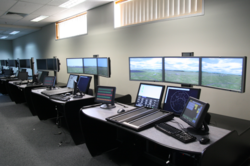
CPDLCThis year, at the ATC Global Exhibition and Conference in Amsterdam, advanced training solutions for ATC simulations were showcased in the shape of Adacel’s Aurora ATM system.

Elements of their Unified Training Solution (UTS) demonstrated the growing need for technological advancement, aiming to ‘Create the appropriate mix of tools to prevent bottlenecks that break the training continuum,’ and tailoring these solutions to meet the specific needs of the customer.

Adacel realise that high-definition ATC simulators are not enough to meet the expanding demands upon ATC training requirements and recognise that students need the appropriate tools at each specific stage of training, to ensure competency in every area, from terminology and communications through to advanced ATC skills required to become a competent controller with a firm and broad knowledge of complex technological advances in the industry.

Technology impresses upon the student the need for competency in ATM functionality for the effective control of air traffic in the areas of mixed and non-surveillance airspace.

Adacel’s Aurora ATM system demonstrates the latest technology, including automated conflict detection, 4D profile protection, dynamic airspace airspace allocation and controller pilot data link communications (CPDLC).

Award-winning training applications for operational ATM, speech recognition and advanced ATC simulations required for students today, to make them the competent operators of tomorrow.

This week the latest at ARINC was the news that it has won a major three year contract at 5 regional airports in Egypt to install its industry-leading passenger processing solution, vMUSE™. The Egyptian airports include Sharm El Sheikh, Luxor, Aswan, Borg El Arab and Abu Simbel. The ARINC CUPPS system fully compliant with the IATA CUPPS standard for common-use passenger systems.

Aviation Information Technology (AVIT) will be working in partnership with ARINC. In the contract, ARINC will install the core common use passenger processing systems (CUPPS) and provide remote third level support, AVIT will then handle first and second level support. There is a 14 week delivery and implementation schedule for all 5 airports which is due for completion by the end of May 2013, the team is currently on plan to achieve this.

Dr Ashraf Zaki, Vice President of EHCAAN said “Egyptian Airports Company (EAC) airports have been experiencing strong growth for several years, We believe that ARINC is an ideal partner to handle our continued expansion given their industry-leading technology and the tremendous airport experience they bring to the table, both globally and here in the Middle East.”

Tony Lynch, Regional Director for ARINC Middle East and Africa said “The ARINC vMUSE solution gives EAC the latest, state-of-the-art CUPPS platform, we have developed strong relationships in Egypt based on our excellent track record in delivering key projects such as Cairo Airport TB3 and Seasonal Terminal. We are pleased to be selected by EAC for these five airports and look forward to a long and mutually beneficial relationship.”

Giving smaller and mid-sized airports more flexibility to upgrade their operations is achieved by using ARINC’s vMUSE by eliminating software engineering and development costs.

EAC is a subsidiary of EHCAAN, and currently manages all 19 regional airports in Egypt. EAC airports serve all the different aspects of air travel.

Korean Air set up a dedicated charter team in 2007, now, having 3 VIP aircraft in its fleet, it is planning to boost demand for its business jet service by focusing on the Hong Kong and Chinese markets.

The VIP aircraft consists of a Boeing Business Jet, a Bombardier Global Express XRS that it flies internationally, and a Sikorsky S-76C+ helicopter that it operates within South Korea. It is planned that passengers on Korean Air‘s private jet charter service will earn First Class mileage points and will have access to the airline’s VIP lounges.

The airline also has a Flexjet Connect Service, which allows passengers to connect from a regular Korean Air flight to a private jet service for non-stop travel throughout the USA. A spokeswoman from the airline said “With many opportunities from Hong Kong and China, Korean Air is keen to capture a share of the business jet market with a focus in Hong Kong,” “We look forward to flying people to different cities from Hong Kong to China as well as various destinations around the world. With state-of-the-art aircraft, unparalleled services and competitive offerings, Korean Air is confident of capturing a share of the market in Hong Kong and in other countries in the region.”

Please see this link for a full range of business jet support and communications services.