Archive

Tag Archives: ARINC

ARINC, world-leading aviation communications providers also lead the way in the global security market with solutions for highly advanced information management, including ARINC AIM.

ARINC AIM (Advanced Information Management) offers integrated security technologies to the nuclear, military, ports, transportation and government facilities for real-time situational awareness capabilities.  For access control, vehicle and number plate recognition software, biometrics, video systems and identity management, ARINC AIM central command, control and monitoring can protect the critical infrastructure of sensitive, high security facilities.

ARINC uses an intelligent network of advanced technological solutions to provide critical installations across the globe with unique informational security.  Airport facilities and sensitive nuclear installations rely upon ARINC AIM for critical security and monitoring, multi-level controlled access and full system redundancy with resilience for communications, peripheral equipment as well as servers.

ARINC AIM furnishes clients with the reassurance of reliability, seamless integration and utmost efficiency of successful, continuous operations.  The name ARINC has remained synonymous with reliability for decades.  Groundbreaking innovative solutions continue to pave the way for technological advancements from flight deck to ground level security platforms.

Dassault Falcon, part of Dassault Aviation and responsible for the sale and support of Falcon Jets throughout the world, recently announced that they had received approval from the FAA & EASA for the new flight deck system EASyII to be installed on all EASy-series Falcons.

The move comes after development of the new flight deck communications system with enhanced data-link capabilities for the communication of CPDLC and other expanding Air Traffic Management technologies.

The new system will help to streamline flight deck comms and aid the reduction of miscommunication of air-ground voice messaging.

“The EASy flight deck has received an enthusiastic reception from Falcon operators due to its ability to streamline the workflow in the cockpit and enhance situational awareness,” John Rosanvallon, President and CEO of Dassault Falcon Jet, said, “EASy II offers new functionalities and improved capabilities based upon extensive customer feedback, new regulations and operational changes that accompany a new set of air traffic management tools.”

CPDLC messaging via data-link is faster, more efficient and can significantly reduce the flight deck workload, offering pilots and coordinators greater flexibility.

EASYII for CPDLC

EASyII CPDLC

According to experts in Asia, the growth in the business aviation industry and other sectors spells great news for the economies of those countries, but improvements are needed in both infrastructure and regulatory systems to sustain that growth and improvement.

The regional differences are as much to blame in China, for example, the huge costs involved with private and business passenger processing are unrealistic and described as ‘outrageous’ by Chris Buchholz, Hong Kong’s Metrojet Executive Director.

Mr Buchholz said, “Governments outside China must do much more to unlock this market.”

Lead times can be wearing, as military governed airspace in China can encounter permit delays of as many as seven days to process,  and flexibility is almost non-existent, due to the strict insistence of fixed flight planning in advance – this, of course, is not much use to business and private jet aviation.

Similar problems are encountered all over Asia, with India’s infrastructure described as “Woefully inadequate” by the President of the Business Aviation Association for India (BAAI), Karan Singh, who commented, “There’s limited parking, and the airlines always get priority, especially at Bombay and Delhi. Ground handling is provided by state-owned companies that have been known to charge $1,500 for a bus to transfer passengers from the ramp to the terminal.”

On a more positive note, there are signs of the rigidity of these attitudes changing, as more Asian Companies take the step of using business and private jet travel, raising awareness of the need for greater infrastructure in this sector.

“The mindset is changing now that Indian companies regard business jets as tools, rather than toys,” Singh noted.

There is a long way to go yet, as tax implications for jet purchasers is still high, and, while Asia moves towards business aviation, and the expectation for growth is encouraging, there are still hurdles to jump, not only in terms of infrastructure and regulation, but also in attitude.

Leslie Merszei, managing director of Orient Sky, a Bangkok-based broker said, “There are too many clients and too little inventory. Most business jets in the region are not available for charter,” adding that according to many Asian beliefs, outsiders can bring ‘bad luck’ if they charter their aircraft.

Orient Sky do not share this belief, with their plans to market around a dozen business jet aircraft later this year.

Although Asian business aviation is far from the models presented by Europe and the US, experts predict the fast-growing industry could double, due to the rise in corporate and indeed person wealth increases continent-wide.

After the devastating events of 9/11, the demand, and subsequent investment in airport perimeter security skyrocketed with an estimated 650 million U.S. dollars spent in that sector between 2001 and 2011.

Although the FAA shelled out $58 million in grants to improve safety, a recent Frost & Sullivan report expects a steep drop in demand for perimeter security in terms of new fencing and security systems in airports, as no new airports are expected to be built in the U.S. in the foreseeable future.  Most works in the perimeter security sector will be repairs and refurbishments over the next five years and those will mostly be granted to local firms and suppliers, it is estimated.

“You will see some stagnation and a decline [in the market],” said John Hernandez, Frost & Sullivan senior aviation industry analyst, “It will never go up to the point it went up to after 9/11.”  Mr Hernandez added that the security enhancement area of the industry sector, the area that provides security cameras, sensors and monitoring, could, “Look rosier.”

It has been recently discussed that passenger data, if utilized and analyzed properly, could improve profitability for the airline industry.

Of course, this is a highly debatable subject in some sectors, due to concerns over security and data-sharing, not just passenger data, but all kind of data ranging throughout global industry.

However, passenger data is already accessed via a ‘cloud’ by government and security agencies and is carefully tagged to ensure the passenger data or any other information does not fall into ‘other’ hands.

The implementation of a ‘Data Lake’ could be the answer, enabling secure access to passenger data and related data that could be used by authorized analysts to weigh up the global aviation industry possibilities for improvement and increased profitability.

So, What is a ‘Data Lake’ & How Could it Affect Passenger Data?

A ‘Data Lake’ is basically a common storage pool with each piece of data being tagged with appropriate security information.  This will, through the use of metatags, control who is able to access the information, be it passenger data for an airline or fuel prices, for example.  The security information will stay with the data, tagging it in with certain criteria for analytical value.

The idea will place analytical information within fast and easy, but above all, secure and controlled reach of analysts, with those security tags firmly in place!

ARINC have announced that Michael DiGeorge MD of ARINC’s Asia Pacific will speak at the Future Travel Experience Conference, hosted in Hong Kong’s Asia World Expo.

ARINC will be exhibiting their latest developments in Common Bag Drop solutions and innovations such as Roving Agent and VeriPax, the Passenger Reconciliation System.

Mr DiGeorge will moderate a working panel session to highlight the theme of the event, which is ways to facilitate rapid passenger growth, while enhancing the passenger experience by speeding up processing of those passengers and their baggage.

ARINC’s common bag drop solutions include the Self-Service Baggage Drop desks, which give the passenger greater control of their journey, enabling them to check-in online, and then process their own baggage at these dedicated points, used for multiple airlines.  Passengers can tag their own baggage, drop their baggage and save time queuing, also helping airport terminals to save valuable space and giving them greater flexibility with staffing, removing the need for airline dedicated desks.

Mr DiGeorge said, “I am pleased to be sharing strategies to help airlines and airports make the best possible decisions regarding passenger and baggage processing methods.”

Ghana is the latest country to implement biometrics to improve airport security and enhance border control.  The Ghana Immigration Service (GIS) recognised the need to streamline the immigration process with the implementation of electronic border control, visa and permit applications and the installation of electronic gates at Accra’s Kotoka International Airport to enhance airport.

GIS director and Commissioner of Police Dr Peter A Wiredu said, “To maintain Ghana’s economic development, we need an immigration system that can meet the challenges of rapid growth in international travel.”

The GIS has awarded the contract to implement the scheme to Gemalto, who will, with the assistance of Avalon Biometrics, install the fully computerized system.  Dr Wiredu added, “Gemalto has contributed to more than 80 successful government programmes worldwide and has all the required project management skills, reputation and expertise to deliver the country’s new IT infrastructure.”

The eGhana project, which encompasses this initiative, will also set up an online portal, data centre and network upgrade for visa applications and issuance of permits.  The project will allow Ghana to monitor the movements of its borders, as growth continues and will enhance passenger experience with faster, controlled processing while maintaining airport security like never before.

Airport security systems such as that offered by ARINC – AviNet Airport – are becoming increasingly popular worldwide as they offer airlines the chance to improve security whilst concurrently improving efficiency.

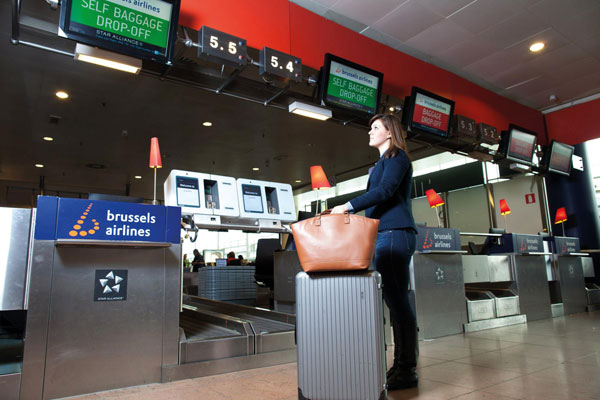
Brussels Airport and Brussels Airlines have announced their plan to test self-service bag drop over the next few months for passengers travelling within Europe.

Passengers who have checked-in online and have self-printed or mobile boarding passes will be able to use the self-service bag drop desks to weigh, measure and check-in their luggage, then print a baggage label from the self-service bag drop counter to attach themselves.

The airport will use the Dutch company, Type 22’s Scan & Fly, user-friendly technology, in two kiosks for the test, which is set to run until the summer.

“During the trial stage we will test the user-friendliness of the technology,” said Peter Cornillie, Brussels Airlines Vice President Ground Operations. “If the results are positive, the automated baggage check-in system will become a permanent option for all of our passengers travelling within Europe.”

Self-service bag drop is the way forward to streamline airport operations with common-use desks for multiple airlines, widely used in the U.S. using world-leading ARINC technology solutions.

ARINC Self Service Bag Drop

ARINC Cabin ConnectA new Ka-Band delivered high-speed broadband service was on display for the first time for visitors to the Hamburg Aircraft Interiors Expo last week.  GX Aviation, launched by Inmarsat, will be supported by new avionics developed by Honeywell and will be commercially available in early 2015.

Jack Jacobs, Vice President of Marketing Product and Management, Honeywell Aerospace said: “The consumer demand for fast, global in-flight connectivity continues to grow at a monumental rate. People want to be connected no matter where they are and have the same Internet experience that they have at home.”

The world-leading satellite communications company, Inmarsat, plans to change the face of in-flight connectivity with GX Aviation, designed to provide throughputs of up to 50Mbps with uninterrupted global broadband coverage, offering like-for-like, ground-based comparative connectivity.

“The world is changing and airlines are seeking to keep up with passengers’ expectations. Our new GX service, which can be combined with our existing L-band solution, enables airlines to capitalise on already installed hardware to provide high speed broadband service with complete geographical coverage for all aircraft requirements, both in the cockpit and the cabin,” says Inmarsat’s Miranda Mills, Vice President of Aerospace.

The in-flight wifi debate continued last week as service providers all have a different approach to bandwidth.

Bill Sullivan, Director for Strategy and Business Development at ViaSat, commented, “People value speed, whether at home or in mobile environment. We have built a system around a very high speed experience. So we are taking that and bringing it into the airline sector.”

However, not everyone agrees that speed is the answer, especially when in-flight wifi provision is so expensive.  Row 44’s John Guidon argues,

“Just talking about speed is not satisfactory. It doesn’t explain the totality of the experience,” adding, “Really people are most interested in, in my opinion, page load time.”

There is no doubt that connectivity for in-flight wifi is in demand.  It is not a question of whether aircraft need it; it is now an account of which service to choose.  Ka-band wifi will provide speeds of at least 12Mbps per passenger, with even faster speeds being achieved with Ku-band or satellite in-flight wifi operations.

Most airlines recognise passengers’ growing demands for in-flight wifi and with the buzz created by the different broadband connectivity providers, the market is exploding.