Archive

Tag Archives: airports news

Automated Immigration | Airports NewsInteresting reading this week from Rockwell Collins, as we reviewed an article about how baggage systems must keep up with the latest advancements in automated immigration systems.

Rockwell Collins’ Tony Chapman spoke about some of the challenges faced by airport operators with the enhanced performance of systems such as the US’ Automated Passport Control, ‘APC allows travellers to use self-service kiosks to speed the immigration process,’ he said. ‘For airports, driving the pre-clearance process to other countries eliminates immigration queues on arrival to the U.S., as passengers have gone through the process before landing.

This means that baggage handling systems must be able to keep up with the latest expedited clearance solutions, or risk severe ground delays and queues as passengers wait for their luggage.

This challenge is added to an already-growing pile of challenges airport operators are facing. With strict regulations across the entire operational environment, airports already have to maintain compliance, meet bottom-line budgets and increase passenger experience.

The introduction of automated baggage handling solutions is aiming to create a seamless passenger journey through the airport environment, and Rockwell Collins do know what they are talking about.

Read the full article here to find out more.

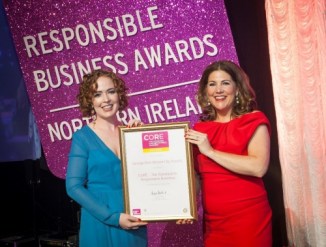
Belfast City Airport win prestigious award | Airports NewsBelfast City Airport is delighted to announce that is has become the first UK airport to win the Gold Level CORE award at the recent Business in the Community Responsible Business Awards.

The CORE accreditation looks at corporate responsibility, both activity and in performance, and Belfast’s George Best Airport has won this year, following last year’s success as being named Northern Ireland’s Most Responsible Business.

Belfast City Airport has been judged on its contributions to people, planet and places, and the airport has felt this has been a key part of its endeavours.

Michelle Hatfield, corporate services director at Belfast City Airport, said, ‘Corporate Responsibility is central to our business and it is a real credit to our employees who have worked hard to ensure we are playing our part, as a major employer, in our local community.’

‘We are constantly striving to improve our standards and to be recognised with a Gold Level CORE award is a testament to the efforts of all our employees.’

The airport has a commitment to education, the environment and the local community and is involved with initiatives such as the Community Fund, supporting 120 local projects. Another contributory initiative is its role in the High Flyer’s apprenticeship scheme, an adopted school and other environmental projects.

Congratulations to the ten organisations that achieved CORE this year – the Standard is extremely high and you should all be very proud of your commitment to responsible business,’ said Kieran Harding, MD of Business in the Community. ‘CORE strategically supports companies to develop and improve their approach to corporate responsibility. By completing the Standard, companies gain a better understanding of their strengths and weaknesses, providing a baseline for next steps and further improvements.’

Montreal Airport Green Airport Transport | Airports NewsCanada’s Aeroports de Montreal (ADM) has taken another important step in its bid to become more environmentally aware this month, as it received its first electric vehicle conversion as a part of the Quebec government initiative – Ride & Drive.

The new truck, which is 100% electric, will be used primarily by ground handling personnel in a maintenance role, as they inspect runways, and supervise outdoor maintenance and emergency tasks.

The reusable electric drive motor is said to have an incredible lifespan of a million kilometres and should lower greenhouse gasses by up to nine tonnes per year. This system is also expected to reduce vehicle operating costs for the airport by 80% and maintenance costs by half.

The environmentally-friendly airport has done much over the past year to improve its vehicle record, including an initiative to make airport taxis friendlier. Since November last year, 70% of taxis working out of the airport have a hybrid engine, which in itself has an estimated impact of reducing C02 by 8,700 tonnes.

There has also been an effort to encourage users of hybrid and fully-electric vehicles with the installation of additional charging stations at the airport site. By Autumn 2018, there is a plan in place to double the current figure of 28 stations. The airport has plans to introduce a bus service for passengers to and from the terminals, which will be eco-friendly.

Investment in the projects has been healthy, and the airport announced it has spent more than $2.8 million in just eco-friendly solutions just last year. The airport operators feel that this initiative is super-important, and is really making a difference.

Sustainable development has become an essential condition for the success of organizations and Aéroports de Montréal is committed to this new reality,’ said Martin Massé, ADM’s vice president of public affairs.

In this regard, ADM’s commitment is resulting in concrete actions. In 2017, we invested more than $2.8 million in environmental protection projects which, like this initiative, are making a difference in our day-to-day operations.

Angela Gittens at the ACI Conference | Aviation BlogThe 28th ACI Europe/World Annual General Assembly, Conference and Exhibition is approaching fast, and there are just a few weeks left before some of the airport industry’s biggest names and leaders join the leadership panel in Brussels to discuss some of the most important issues facing the aviation industry.
The leaders panel has now been finalised, and attendees can look forward to hearing keynote speakers over three full days:

  • Bongani Maseko, CEO, Airports Company South Africa and chair of ACI World
  • Arnaud Feist, CEO, Brussels Airport Company
  • Dr Michael Kerkloh, CEO, Munich International Airport and president, ACI Europe
  • Thomas Woldbye, CEO, Copenhagen Airport
  • Joseph Lopano, CEO, Tampa International Airport
  • Martin Eurnekian, Executive Director, Corporacion America, and vice-chair, ACI World
  • Fred Lam, CEO, Airport Authority Hong Kong.

The theme this year is ‘Airports as Brands and Businesses’ and the conference will be looking at the evolution of the airport into a business building a brand relationship with its customers.

The conference and exhibition will also be focussed around the ever-increasing challenge of airport capacity as passenger numbers continue to grow year-on-year. How do airports ensure that they maintain mandatory compliance, keep passengers moving, look after baggage, maintain watertight security and at the same time make sure that passengers stay happy and bottom line operational budgets stay intact?

Attendees at the conference will find out what the biggest names in the industry think about these challenges, and how the industry itself is working to meet these demands while keeping systems and processes efficient and cost-effective.

ACI World director-general, Angela Gittens said, ‘Our assembly provides a unique opportunity for industry leaders from all regions of the world to share their expertise and experience and debate and explore ways we can continue to adapt and grow. ACI is the only truly global voice for the airports industry and our assembly is the perfect venue to foster dialogue among airports as well as with stakeholders in the aviation industry as a whole.

The exhibition promises to deliver a wealth of networking opportunities, and will showcase a wide range of airport solutions, including, but not limited to:

  • IT solutions
  • Bag drop systems
  • FIDS
  • Passenger boarding bridges
  • Duty free retailers
  • Commercial technology
  • And much more.

To find out more about the conference and exhibition, and to register for your place, please click here.

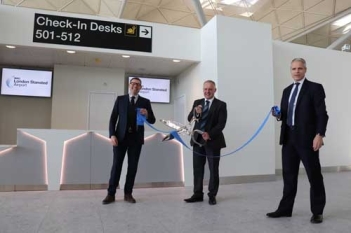
Stansted Airport Opens New Check In Area | Airports NewsFlight passengers using London Stansted Airport this month will experience a new section of check-in area, opened earlier this month as a part of its £600 million transformation project.

The latest milestone marks success for London Stansted’s transformation programme, as passenger numbers increase steadily. The eight new check-in desks are hi-tech and ready to meet the growing numbers of travellers using Stansted. Eventually, plans are for a total of 30 new counters to help create an improved passenger experience and enhance the operational productivity of the airport.

Paul Willis, London Stansted’s transformation director said, ‘We’ve been working hard since the end of last year and it’s been fantastic to watch the project move away from the planning stage and come to life. We’re delighted to reach this major milestone in our transformation programme.’

Other plans included in the first phase of the transformation programme are:

  • Upgrades to the airfield
  • Upgrades to the car parks
  • New upper deck seating areas

Airports of all sizes around the world are turning to the latest passenger check-in innovations to improve operations and increase the experience for passengers moving through the airport environment.

There is a passenger processing revolution occurring in the world’s busiest airports, and the addition of self-service kiosks and biometrics technology is helping to strengthen airport security – meeting increasing mandatory requirements, while reducing queues and helping airports manage costs.

What’s next for Stansted’s transformation project?

Phase two of the project will be focussed on the construction of a new arrivals building, which is expected to open in 2020 at a cost of £130 million. The new building will include enhanced baggage reclamation points and immigration department, improved access and a new retail shopping area, in addition to a larger public forecourt for passengers arriving at the airport.

The project is expected to be fully completed in 2022.

WestJet Launch New Service from Halifax to London Gatwick | Airports NewsIt was announced a few days ago that WestJet, Canadian low-cost airline, has launched a new daily non-stop direct service from Halifax-Stanfield International Airport and the UK’s London Gatwick.
The new service will run initially until 26 October 2018 and will be served by the B737-8 MAX – the latest addition to the airlines’ fleet.

The new service marks an important link to the UK and connections to Europe, and according to the Minister of Business and Tourism for Nova Scotia, Mr Geoff MacLellan, will help to ‘further connect our people, cultures and business, making it even easier for UK tourists to visit.

The airline hopes that the new service will strengthen its commitment to develop new links to European markets, and believes that the Boeing MAX demonstrates its commitment to using fuel-efficient, guest-friendly aircraft as a part of its future.

Tom Coyle, WestJet’s interim executive vice-president said, ‘This service also demonstrates our commitment to support efforts on the part of Nova Scotia and Atlantic Canada to enhance trade and tourism, and grow the economies of both Canada and the United Kingdom.’

Not only this, but also a major milestone for the airline will be another inaugural flight, planned for 31 May 2018, which will leave Halifax land in Paris, marking the first time the airline will land on mainland European soil. Exciting times ahead for WestJet, and we wish them every success.

Find out more about WestJet on its official website here.

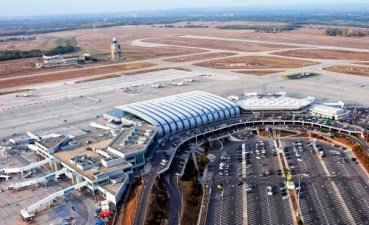
Budapest Airport Achieves Carbon Neutral Status | Airports NewsBudapest Airport has happily flexed its green muscles this week, by achieving the coveted Carbon Neutral status in ACI’s Airport Carbon Accreditation program.

Hungary’s major airport worked hard to meet the criteria, implementing a range of energy-saving features throughout the terminals and making changes to critical services over the last ten years – and they’re still not done with the carbon-saving initiatives!

Budapest Airport’s environmental director, Gabor Szarvas, is delighted to receive this accreditation, particularly as they are the first airport in the Central-Eastern European region to qualify. ‘In Europe, only thirty airports are in the elite club of carbon-neutral operations, and in Central-Eastern Europe we are the first to receive this accreditation,’ he said.

The airport has reduced the CO2 emission per passenger by as much as 44% over the last five years, and is determined to go even further. Szarvas continued, ‘Since passenger traffic has been increasing significantly, we are continuously working on making the airport operation greener, in the framework of our Greenairport programme.’

The Greenairport program was launched just three years ago, and its aim was to make the operation of the gateway airport ‘sustainable via joint environmental actions.’

Still in the pipeline of improvements yet to come at Budapest Airport include:

  • Increase the number of electric vehicles at the airport
  • Commission charging stations
  • Completion of heating and cooling technologies in Terminal 2B

The installation of LED-based lighting systems, and the refurbishment of district heating pipes and water supply pumps has all contributed to the milestone achievement for the airport and it continues to work towards even greater carbon reductions.

In addition to achieving this coveted status, Budapest airport is also working to encourage its partners to adopt similar sustainable practices, and is promoting its success to show other organisations and authorities what can be achieved with determination, investment, commitment and a firm strategy in place.

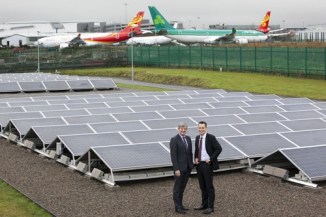
Solar Farm at Dublin Airport | Airports NewsAn energy agreement between DAA, the Irish airports operator, and ESB energy provider has resulted in the opening of a 268-panel-strong solar farm at Dublin Airport.

The solar farm has been installed on top of a reservoir system, which provides 500 million litres of water to the passenger terminals, offices and businesses located on the airport grounds. The new solar farm is expected to deliver over half the airport’s energy requirements of the water system.

The agreement was put in place to attempt to achieve energy targets of a 33% reduction in consumption for the airport by 2020, and the partners have been working closely together to determine the opportunities to implement low carbon technologies.

This achievement will also build on Dublin Airport’s current reputation in a European carbon management certification program, under which it is already Airport Carbon Accredited.

Dalton Phillips, DAA’s Chief Executive, said, ‘Over the past three years Dublin Airport succeeded in reducing its carbon footprint by 5,000 tonnes, which is equivalent to a 10% reduction in carbon emissions under its control.

We are looking forward to building on this performance and making even more energy savings that will also benefit the travelling public through sustainable environmental performance and annual cost savings.’

LAS Passenger Technologies | Airports BlogLas Vegas McCarran International Airport (LAS) has recently renewed a 20-year long-standing contract with Rockwell Collins to further focus on improving passenger technologies.

As a part of its Terminal 1 upgrade, LAS will replace 176 common-use self service kiosks with new units and hope to maintain its position as one of North America’s leading international airport hubs.

Our team is constantly evaluating the airport’s infrastructure and operations seeking ways to enhance customer service, maximize efficiencies and increase flexibility,’ said Samuel Ingalls, assistant director of Aviation over Information Systems for LAS. ‘Over the past two decades we have had great success in managing our soaring passenger volume through the implementation of common use processes and other cutting-edge technologies such as those provided by Rockwell Collins.

LAS will adopt and implement a range of Rockwell Collins solutions to strengthen its position and improve passenger experience:

  • ARINC cMUSE – the cloud-native passenger processing system offers increased flexibility and reduced support and implementation requirements.
  • ARINC SelfDrop – Rockwell Collins’ automated self-service baggage system is undergoing trials at LAS which will continue under the renewed contract.

Additional airport systems from Rockwell Collins will continue to be supported:

  • ARINC MUSE – the reliable CUPPS system to enhance airport operational cost-effectivity.
  • RFID bag tags – providing advanced baggage tracking features.
  • ARINC BagLinkTM – improving accuracy and efficiency for baggage loading.
  • Self-Boarding Gates – automated gate technology.
  • Local DCS – delivering a stand-alone check-in and boarding system.

Tony Chapman, senior director, Airport Systems Marketing and Strategy for Rockwell Collins said, ‘Rockwell Collins and LAS work together on a continual basis to ensure our solutions are meeting and exceeding the demands that passenger influx has on its airport operations. As we look further into the future, the integrated working team will look even closer at how biometrics and other disruptive technologies will enhance the curb-to-curb airport experience.’

Birmingham Airport Passenger Experience Investments | Airports NewsIn readiness for a busy summer period, Birmingham Airport has announced its investments to improve passenger experience in the journey through the airport, including new flight information displays and digital signage, redevelopment of security areas, boarding gates and a refurb of the current passenger waiting areas for boarding and security.

The whole airport site will enjoy some investment, as new restaurants and eateries, retail areas and a new 178-room Hilton Garden Inn are set to open later this year.

The major airport hub has experienced record growth, as have many airports around Europe during last year alone. This year will also see new long-haul routes for Birmingham, including to New York, Toronto and Boston, in addition to more short-haul destinations.

Airports all over the world are now putting more importance on passenger experience, and investments are becoming commonplace as passenger traffic increases. Infrastructure investment has been key during the last decade, to ensure a scalable approach is taken to rising passenger numbers, increasing mandatory regulations and the surge in passenger expectation.

Birmingham airport has confirmed that additional staff will be recruited in key ‘front-of-house’ locations, and the latest in digital signage will be in place before the beginning of the busy summer season.