Archive

Tag Archives: airport security

Maintaining Airport Security Whilst Improving Passenger ExperienceBy the end of February passengers at McCarran International Airport will be able to apply for PreCheck, a scheme that will allow expedited check-in for up to five years at a cost of $85.

The scheme will be run by the Transportation Security Administration PreCheck Application Center, based in the Airport Terminal 1, and will follow more than 100 airports across the country that currently operate the screening program.

Passengers will apply for a Known Traveller Number, which will be granted after rigorous identity verification processes, fingerprinting and immigration status investigations, allaying fears from opposers of the scheme, who raised initial concerns about maintaining high security for airline passengers.

Once membership is granted, successful applicants will pay an $85 fee for a five-year period of expedited processing. PreCheck will allow passengers to pass through airport security without being held up by the usual process of removing their shoes for screening or without removing laptops and TSA-compliant liquids from their hand luggage.

Rosemary Vassiliadis, Director of aviation for Clark County welcomes the scheme, saying “At McCarran, our priority is a positive travel experience for passengers and expedited screening provides just that.”

Solutions from ARINC AIM

Mohammed Ahli – Director General – Dubai CAA

With the Gulf airports aiming to increase passenger numbers to 450 million per year by 2020, and the development of new terminals at both Doha and Abu Dhabi, the Arabian Gulf States are investing heavily in airport security, an industry currently estimated to have a global value of $22 billion.

Much of this investment is focussed on innovative technologies designed not only to improve security and efficiencies for the airport but also to improve the passenger experience, as

Mohammed Ahli, director general of the, Dubai Civil Aviation Authority (DCAA) explained,  “It’s crucial to adopt innovative technology, improve security and streamline efficiencies to offer a seamless passenger travel experience.”

Airport Show, the Middle East’s largest airport industry event, provides a welcome opportunity for companies to showcase the technologies vital in achieving this aim. Both Intertech Vision Group, which already has 140 installations in the region, and ARINC, a security and systems integration company offering an Advanced Information Management system (AIM) will be attending,

Stephen Horner, International Business Development Director, Integrated Security Solutions, ARINC, said: “There are many security and systems integration opportunities throughout the GCC region. ARINC has provided integration and security solutions for more than 30 years to a security industry of equal age. We are able to provide ‘best fit’ technology and solution to airports. We wish to showcase our wider capability in delivering integrated security solutions, command and control facility as well as airport solutions.”

Provision of Passenger Data to Enhance SecurityConcerns are growing for security chiefs about the increasing risk of potential terrorists being allowed to travel freely around Europe after the release and use of passenger data was blocked on human rights grounds earlier this year.

Cressida Dick, Assistant Commissioner of the Met expressed a warning that young men are able to fly to Turkey, hire a car and drive across the border into Syria. Her concern is that a ‘small number could fall under the spell of terrorists and return to Britain with deadly skills and motivation’.

Passenger data has been effectively used to identify potential high-risk passengers, alerting government agencies and border control before those passengers touch down at their destination. Supporters of the share of this data, referred to as Advanced Passenger Information (API) say that the information is critical to help track terrorists, people traffickers and serious criminals that regularly traverse international borders.

The system was developed after the terror attacks of 9/11 and is mandatory for passengers travelling to and within the U.S. and other parts of the world.

API is delivered electronically via the DCS of airlines. Providers maintain reliable, secure delivery and limited access to the information.

The Civil Liberties Committee of the EP claim that the passenger data storage system raises privacy concerns and critics are unhappy about the data being kept for five years, which could lead to passenger profiling.

As the EU Counter-Terrorism Coordinator points out that the numbers of fighters travelling to Syria is increasing, it has made a call to put airline passenger information availability back into practice, giving security officials the ability to track the movements of particular groups across Europe.

The head of MI5, Mr Andrew Parker, revealed that spies had observed ‘hundreds of people’ travel to Syria and added that some had indeed returned to the UK.

It is unclear how, when or even if, the use of passenger data may return to the forefront of aviation travel in Europe.

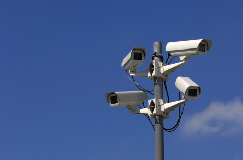
security surveillance systemLong Island MacArthur Airport (LIMA) have upgraded their security surveillance system to an advanced digital system as part of a plan to enhance the airport ready for potential passenger growth and expanded air service.  LIMA have leveraged previous investments by choosing a security surveillance system to integrate with their existing technology.

LIMA have selected IPVideo Corporation to provide the upgrades to the public airport that is owned by the town of Islip.  LIMA serves almost two million passengers per year, averaging 500 flights every day, both commercial and private charter aircraft, of which it houses 250.

The new system will operate high resolution cameras with facial recognition capability to aid border control to identify persons of interest.  The cameras have a timeline feature which will enable higher levels of customer service and allow operators to locate lost items or even cars in the parking facility.

Physical security surveillance system operation is critical across the globe to guarantee secure and safe passage for passengers and staff at border control facilities.  The reassurance of today’s technological advances can be felt industry-wide.

A solution that is scalable and flexible is often required and is offered by companies such as ARINC, who have an eighty-year record of excellence in the aviation industry.  Their physical security surveillance systems are used throughout the industry and also in nuclear facilities.

airport security Indmex Aviation and OPEN Inc have collaborated to offer an integrated solution for airport situational awareness and incident response, it has been announced today.

The companies will provide runway incursion warnings and a records information management system for airport first responders and hope to initiate integrated airport EMS incident response systems.

Scott Streicher, Operations Director for OPEN, the creators of SafetyPAD for Emergency Medical Services, which is already used by Fire and EMS teams at some of the worlds busiest airports, said “After speaking with airport operations directors and airport emergency responders, it was clear to us that there is an unmet need for solutions that solve ongoing challenges at airports resulting from increased operations by both aircraft and vehicles on the airport surface. With the INDMEX partnership, we will be able to fulfil that demand.”

The solution is hoped to boost security and accountability for airport personnel with vehicle and personnel tracking and can be deployed over a range of mobile devices.

Airport security providers, such as ARINC, offer technological solutions to integrated physical and advanced information security.  The use of biometrics and other applications can serve to enhance monitoring capabilities of all system and subsystem activity.

After the devastating events of 9/11, the demand, and subsequent investment in airport perimeter security skyrocketed with an estimated 650 million U.S. dollars spent in that sector between 2001 and 2011.

Although the FAA shelled out $58 million in grants to improve safety, a recent Frost & Sullivan report expects a steep drop in demand for perimeter security in terms of new fencing and security systems in airports, as no new airports are expected to be built in the U.S. in the foreseeable future.  Most works in the perimeter security sector will be repairs and refurbishments over the next five years and those will mostly be granted to local firms and suppliers, it is estimated.

“You will see some stagnation and a decline [in the market],” said John Hernandez, Frost & Sullivan senior aviation industry analyst, “It will never go up to the point it went up to after 9/11.”  Mr Hernandez added that the security enhancement area of the industry sector, the area that provides security cameras, sensors and monitoring, could, “Look rosier.”

Although US budget cutbacks effects air traffic control the airport security sector is still expected to grow, and terrorism is still a threat, analysts have said.

In the wake of the September 11 attacks screening passengers and surveillance at airports has boomed. Because airport security is one of the areas that has been hit in the US by budget cuts, the expected growth on air travel will mean an increase in spending on airport security.

Didier Brechemier, an expert at the Roland Berger consultancy said “Airport security is a market niche which is outperforming that of the aviation. It grows along with the volume of passengers which is growing itself by five to six percent per year.”

3 billion passengers will travel by air this year according to the International Air Transport Association (IATA), this is nearly double the amount of people that flew in 2001. IATA also expects this number to double by 2030.

According to Philippe Nguyen, president of the IPE Investment Fund “The airport security screening market is worth some $10 billion (8 billion euros) annually” The Visiongain business information service said “If physical security at and around airports is included the market is worth over $22 billion”

Visiongain has noted that national governments are increasing spending on developing new airport facilities and expanding existing ones to meet increasing air travel, with spending on enhancing security also rising. Visiongain said “Contract sizes and financial data released by companies involved in the industry indicate this and would suggest that the market will continue to expand”

Europe and the US have the largest airport security markets while the Asia Pacific region is on course for the largest growth in the aviation sector.

In the next 10 years China is expected to construct 70 new airports.

Other boosts for security companies include changing the restrictions on carrying on board planes certain items, and the change of the rules of liquids should also boost this sector.

At a recent security conference IATA chief Tony Tyler said “that a right balance needs to be struck between risk and regulation. If we don’t find the right balance soon we will lose the goodwill of our passengers and shippers, clog our airports, slow world trade, and bring down the level of security that we have worked so hard to build-up”

Plenty of commercial opportunities are expected as growth will rest on new technologies. Better target screening is expected by use of information on travellers available to border control agencies will rely heavily on technology and data gathering. Many companies are now offering a full suite of airport security and passenger processing solutions.

January has brought about a hive of activity in the aviation industry and we have recently seen aviation leader ARINC release a new site for their Advanced Information Management product (AIM).

AIM is a U.S. market leader in nuclear power integrated security systems, and also provides access, command-and-control for secure government facilities, military installations, seaports, and airports—anywhere that real-time situational awareness is required for the safety and security of personnel, passengers, and facilities.

The ARINC AIM Solution integrates with and delivers the following, according to the customer’s needs:

  • Intrusion Detection
  • Access Control
  • Video Management
  • Credential Management
  • Biometrics-based Identity Management
  • Vehicle Identification
  • Asset Management
  • Integrated GIS

Providing security solutions for critical infrastructure ARINC say “We deliver a combined and comprehensive suite of security solutions
to applications, by field-proven engineering, management staff, and PMI-based project management expertise to deliver mission-critical security systems around the world.”

To view the new site please follow this link.