Archive

Tag Archives: airport operations

Critical Data Transfer Solutions ProvidersByron Capital Markets have recommended a ‘strong buy’ option for FLYHT Aerospace Solution, which includes critical data transfer solutions, aircraft operations management and fuel management system for aviation operators.

“FLY sits at a significant revenue inflection point in 2014 with several events serving as catalysts in the near and medium term”, says the Byron report, “Airbus currently has a backlog of 1,600 planes to be cleared in three years.”

Next-generation messaging systems are set to be mandatory in the skies by February 2015. The strict regulatory requirements is an expected solution for congested airwaves and will mean that critical data transfer can be seamlessly reliable, while lessening the workload in the cockpit.

“Crowded skies, aging fleets, outdated communications are stifling airline the industry,” states the Byron report, “Increasing globalization and trade between developed and emerging markets has and will continue to spur air travel, crowding skies further. Carrier fleets are aging. Workhorses such as the Boeing 737 and 767 are nearing 20 years’ old and are fuel inefficient compared to the current alternatives.”

Other providers of critical data transfer solutions are working hard to ensure that aviation operators are ready for the changeover by this time next year.

Airport Operations Management ProvidersA major shake-up has seen Tulsa International become independent from the City of Tulsa in a move, initially approved by Mayor Dewey Bartlett, that has now been officially agreed by Tulsa Airports Improvement Trust (TAIT).

The agreement will now give the airport more freedom for airport operations management, although, the city of Tulsa will retain control of the airport through TAIT board members appointed by the Tulsa City Council, Tulsa Airport Authority will now lease the airport from the city on a 25-year term.  This will allow it to contract out or hire in for services such as legal, IT and human resources support which were previously provided by Tulsa City which was then reimbursed by the airport. However, some services will continue to be provided by the city and Tulsa International’s 150 employees will remain on their current pension plan.

Passenger numbers at Tulsa International declined 0.3% to 1.316 million in 2013, with an overall decline of 18.5% since 2007. This decline is set against an overall operating budget of $58.5 million in 2013, though airport officials believe the leasing arrangement will enable them to make savings of $500,000.

Other Innovations in Border Security ControlDubai World Trade Centre (DWTC) this month hosted Intersec 2014, with emaratech, the technology and management consulting company owned by the Investment Corporation of Dubai, taking centre stage with its innovative and forward looking border control solutions dubbed “Intelligent Travelling.” Thani Alzaffin, Director General and Board member of emaratech explained that the company had partnered with SRI to produce a suite of technologies, “demonstrating robust security screening and innovative border control solutions.”

IRIS on the move technology (IOM) offers the potential to deal with increasing passenger numbers; reducing both the time it takes to pass through border control and the solving the problems associated with attempting to identify passengers in a busy or limited environment.  Offering non-contact technology, the simple walk-through design of the IOM PassPort SL is able to capture both dual-iris and facial images, without a requirement for the passenger to stop.

Similar benefits can be readily applied to vehicle access points with the IOM PassThru™Drive-up Iris Recognition System, which can replace RFID cards, and can link drivers immediately to their known identity, with the added advantage of being able to record events. In fact emaratech believe the system will become increasingly popular for identification management in many high-traffic environments, including general transportation, employee access and public events.

Other Providers of Baggage Handling SystemsIncheon, South Korea’s busiest airport, is to get a 42km, state-of-the-art baggage handling system courtesy of the contract recently awarded to electronics giant Siemens and Posco, the South Korean steel makers.

Capable of handling over 22,000 pieces of luggage per hour, the new system will comprise over 216 check-in counters in departures, 10 carousels in arrivals, 14 make-up carousels and 18 laterals, with an additional storage facility for up to as many as 2,000 pieces of luggage.

Completion is set for September 2017, readying the airport both for the influx of visitors to the 2018 Winter Olympics and the completion of Incheon’s new U.S. $2.5bn (£1.6bn) Terminal 2, which will increase airport’s annual passenger capacity to 62 million. The new infrastructure is planned to seamlessly integrate into the existing, and will be controllable by both IT and automated systems.

Siemans is already familiar with Incheon’s current baggage handling capability. In 2008 the company upgraded systems in the airport’s satellite terminal to handle up to 56,000 items of baggage every hour and has provided ongoing IT support ever since.

Providers of Automated Baggage HandlingA new report by Global Industry Analysts, Inc (GIA) titled ”Airport Baggage Handling Systems” has focussed upon the rapid growth in the industry in the last few years.

The continuing rise in air traffic, and the emerging markets of developing countries is encouraging operators to build or upgrade terminals to increase capacity, and concomitant with this is the installation or upgrade of baggage handling facilities.

The trend report offers a useful, if brief, insight into the corporate initiatives and developments of key players in the baggage handling industry, looking at their products and analysing their prospects for growth.

The report covers a wide range of companies including: Rapiscan Systems, Aanestad AS, Daifuku Co. Ltd., JBT AeroTech, Portec, Logan Teleflex Ltd., Glidepath and Siemens AG.  Key markets, such as Asia-Pacific, are also discussed, together with projections and estimates for global projections to 2017.

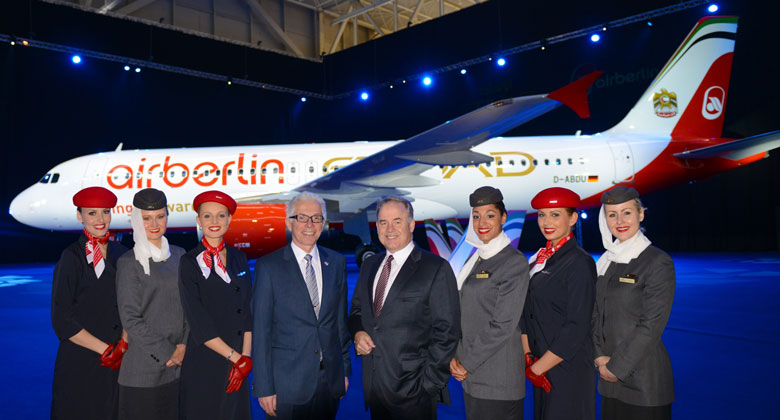
Air-Berlin-Etihad-livery-780The Gulf carrier Etihad has continued its foray into the European aviation market with the unveiling of an Airbus A320 in joint livery with Air Berlin at an event hosted by both Wolfgang Prock-Schauer, CEO of Air Berlin and it’s Vice Chairman, James Hogan, also President of Etihad.

Last year Etihad notably purchased a 49% stake in Air Serbia, formerly known as Jat airlines, and has announced plans to further strengthen its European presence with the purchase of a one third stake in Darwin, which will become Etihad Regional. However, Hogan was circumspect regarding recent reports that Etihad would also soon be announcing an investment in the ailing Alitalia, stating the importance of due diligence and the formation of,  “a clear plan to move to profitability.”

Clearing recent speculation regarding European carriers LOT Polish Airlines and the Latvian Air Baltic, Hogan stated there were no plans to invest in either.

Leading Providers of Advanced Passenger Information SystemThe National Business Aviation Association (NBAA) has responded to the new rules implemented by Mexico’s National Institute of Immigration for reporting of Advanced Passenger Information, saying their application to private flights arose, “primarily from a need for enhanced security measures in Mexico, as well as a desire for better accounting of taxes paid by arriving and departing passengers.”

The NBAA has also updated its own APIS (Advance Passenger Information System), developed in conjunction with ARINC, to comply with the legislation. Several third-party companies, amongst them Universal Weather & Aviation and FltPlan have stated that they are also able to help customers comply. The regulations require reporting to occur electronically within 30 minutes of departure if a flight will take more than an hour, whilst shorter flights must be reported after the doors have closed.

APIS Solutions for Mandatory Passenger Data TransferNew rules from Mexico’s National Institute of Immigration (INM) have prompted FltPlan to expand the capabilities of its current eAPIS system. FltPlan president Ken Wilson said the rules now require Advanced Passenger Information System (APIS) manifests be submitted within 30 minutes of any aircraft closing its doors, and warned that breaching them could result in fines of up to $5,000.

Wilson reflected that FltPlan’s five-year plus experience in eAPIS systems and their early adoption of U.S. Customs and Border Protection certification for submission of passenger information made for a relatively easy transition when working with the Mexican government.

FltPlan, which recently exhibited at NBAA’s Schedulers & Dispatchers conference in New Orleans, said its aim was to provide a low-cost, specialist solution. Current annual subscription rates to its eAPIS system are $249, and the Mexico service an additional £200, with $20 per manifest ($40 for a round trip from the U.S. to Mexico).

Commercial Air Travel Centenary YearAir passengers taking advantage of the recent holidays to travel to far-flung climes, or those regularly nipping a few thousand miles to be united with friends and family have good cause to celebrate this centenary year of commercial air travel.

It’s hard to imagine that this globally vital industry, averaging over 8 million passengers and 140,000 tons of cargo per day began 100 years ago with a single passenger, Abram Pheil, Mayor of St. Petersburg; travelling with a ticket won at auction for $400.  It was an inauspicious start for an industry that today carries around 50 million tons of cargo worth in the region of $6.4 trillion per year, a figure representing some 35% of the value of all traded goods.

With funding organised by Percival Fansler, Pheil as passenger, and Tony Jannus as pilot, the 23 minute flight of Thomas Benoist’s airboat across Florida’s Tampa Bay on New Year’s Day 1914 went down in history not just as the inaugural journey of the St. Petersburg-Tampa Airboat Line, but that of commercial flight.

As the International Air Transport Association (IATA) announced a year-long celebration of the centenary it’s certainly worth considering how far commercial flight has come in that time. Last year annual passenger numbers reached 3.1 billion, exceeding all previous records, and this year it’s anticipated records will be broken again with 3.3 billion journeys. The figures are staggering enough but even more so when one considers they are equivalent to 44% of the global population.

The contribution of commercial flight to all aspects of modern life is well-recognised by IATA director-general and CEO Tony Tyler who said, “The first flight provided a short-cut across Tampa Bay. Today, the aviation industry re-unites loved ones, connects cultures, expands minds, opens markets, and fosters development.”  But the centenary year is not just about looking to aviation’s past, nor even to its present success. As Tyler says, “A hundred years is something worth celebrating. And we look forward to creating an equally remarkable legacy for commercial aviation’s second century.”

Solutions from ARINC AIM

Mohammed Ahli – Director General – Dubai CAA

With the Gulf airports aiming to increase passenger numbers to 450 million per year by 2020, and the development of new terminals at both Doha and Abu Dhabi, the Arabian Gulf States are investing heavily in airport security, an industry currently estimated to have a global value of $22 billion.

Much of this investment is focussed on innovative technologies designed not only to improve security and efficiencies for the airport but also to improve the passenger experience, as

Mohammed Ahli, director general of the, Dubai Civil Aviation Authority (DCAA) explained,  “It’s crucial to adopt innovative technology, improve security and streamline efficiencies to offer a seamless passenger travel experience.”

Airport Show, the Middle East’s largest airport industry event, provides a welcome opportunity for companies to showcase the technologies vital in achieving this aim. Both Intertech Vision Group, which already has 140 installations in the region, and ARINC, a security and systems integration company offering an Advanced Information Management system (AIM) will be attending,

Stephen Horner, International Business Development Director, Integrated Security Solutions, ARINC, said: “There are many security and systems integration opportunities throughout the GCC region. ARINC has provided integration and security solutions for more than 30 years to a security industry of equal age. We are able to provide ‘best fit’ technology and solution to airports. We wish to showcase our wider capability in delivering integrated security solutions, command and control facility as well as airport solutions.”