Archive

Business Aviation News

in-flight wifi

In-Flight WiFi

According to many airlines, in-flight WiFi provision gives them a ‘competitive advantage’ in the commercial aviation industry.

As the competition grows fiercer, it seems that in-flight wi-fi will become less of an advantage and more of a normality according to a report by ‘routehappy.com,’ a site that ranks airlines.  Their report says that currently 38% of US flights offer internet connectivity and long haul or the most popular routes, such as non-connecting California-New York are offering in-flight WiFi.

Although it is still a small percentage of flights overall, it shows that, as passenger demands for in-flight WiFi grows, the more likely that it will become standard practice and airlines will be looking to offer faster, better and cheaper in-flight WiFi to remain competitive.

The debate grows after the FAA’s announcement last week that it will be lightening up about the use of electronic devices on-board, allowing passengers on certain flights to carry on using their Smartphones instead of the insistence of powering down before take off.

Most airlines provide ‘GoGo’ for in-flight WiFi, but with dramatic price fluctuations and intermittent signal, the marketplace is broadening and the opening into business aviation for passengers wishing to work in the sky and on the move means that a push into the Ku-band for international connectivity is the way forward.

Aircraft in-flight Wifi provider, ARINC, already offer truly global connectivity with their Inmarsat/iridium satellite network connectivity and are leaders in the business of aviation communications.

Gogo expects that in-flight wifi for business travellers will become a required expense and not an optional one and are experimenting on new pricing models as it is still early days for in-flight wifi connectivity.

Only time will tell…

With the rise in international travel, imports and exports across Europe, border management is proving to be increasingly difficult, due to the simultaneous rise of illegal immigration, drug crimes and human trafficking.  As a result, border management is soaring to the top of the priority list in many European countries.

Border agencies are seeking new and efficient ways to lower the risks of these activities and up the border management in their countries.

The Border Management and Technologies Summit will address these issues and discuss solutions such as increasing the use of biometrics, access control, surveillance and advance profiling to name a few.

Industry-leading companies, such as ARINC, provide tailored electronic border management solutions to the marketplace as a part of their extensive suite of services, to enhance border control and passenger data management.

SunExpress, a joint venture between Lufthansa and Turkish Airlines plan to completely revamp its entire fleet of Boeing 737 with the Rockwell Collins Link 2000+ starting later this year.

The retrofitting will allow for compliance with Eurocontrol’s new CPDLC mandate that states that by 2015, all flights operating above 28,000 feet in European airspace must have CPDLC capability.  The mandate is currently under review for private aircraft, but will move forward in improving air traffic management and capacity throughout Europe under the supervision of Eurocontrol.

Controller-Pilot Data Link Communications (CPDLC) is clearly the future of cockpit efficiency, reducing the workload for pilots and allowing for greater air traffic management as the skies grow busier and traditional voice radio communications in congested airwaves makes controller-pilot communication more difficult.

CPDLC providers are preparing for the ultimate changeover and many, such as ARINC, offer an advisory service to airlines concerned with refitting or retrofitting aircraft with a range of solutions, enabling them to be CPDLC ready when the time comes.

Aero Icarus / Foter / CC BY-SA
Flight Planning iPad App

Flight Planning iPad App

This week JetBlue announced that they are training their pilot to switch to Apple’s iPad apps for essential flight planning access.

The iPad app is fast becoming popular in the aviation industry as airlines make the move to a paperless cockpit, offering flight decks greater flexibility with flight planning tasks, replacing laptops and bulky flight bags full of paper manuals, charts and associated flight planning paperwork.

American Airlines announced just days before that it has completed its plan for the introduction of more than 8,000 iPads fleet-wide. This all adds up to less weight, less fuel burned and huge improvements in the efficiency of the flight planning process all round.

ARINC Flight Planning services, which now includes the iPad app, fully realised the potential implications of improving flight planning and flight deck operations and began implementing the app after FAA approval in 2011.

JetBlue hope that, in addition to the electronic flight bag, the FAA will further approve apps for instrument approach and taxiway charts in the near future.  There is little doubt that, certainly for flight planning, the iPad is the way forward for the aviation industry.

Analysts from Research & Markets have forecast that despite increased operating costs, the Business Jet Global market should grow at an average annual rate of 9.4% over the four-year range of 2012-2016, in their new report ‘Global Business Jet Market 2012-2016’.

They attribute the market growth to a couple of factors including the rise in the number of global billionaires and an increasing demand from the emergence of certain economies, however there are concerns that increased operating costs could challenge this growth.

It is noted that in 2012, 28% of growth was attributed to emerging economies and could rise to 40% by 2030.

Companies such as Bombardier Inc, Dessault Aviation and Gulfstream Aerospace Corp. may dominate the market, with other vendors mentioned being; Airbus SAS, Embraer, The Boeing co and Hawker Beechcraft will all benefit from the growing order backlogs as growth is propelled by the major owner-operator segment of the market – billionaires.

This week it has been announced that a pilot has written an iPad app that will handle the commuter and on-demand flight ops calculations, such as departure gradients, approach planning, flight time tracking and climb performance, to name a few.

The new app for the iPad, called the ‘Aviation Pilot Duty and Performance Calculator’ is the latest in a line of innovations introduced since the iPad impact on the cockpit began saving the Pilot hours of complicated, intricate work involving reams of paper that would have to be carried.

The iPad has been a major contribution to the paperless flight deck and with the many apps on the market, such as the ARINC Direct iPad Flight Planning App, especially designed and developed for business aviation users, the Pilot and flight ops crew can look forward to a truly streamlined, optimized cockpit.

iPad flight planning app

Following pressure from private airlines, Bangladeshi Ministry of Civil Aviation and Tourism have removed the fee structure for aeronautical operations for private airlines.

While the non-aeronautical fees for parking and access to hangar facilities will remain, private domestic airlines will no longer pay the fees associated with takeoff and landing, it was announced at the CIRDAP auditorium last week.

The Minister for Tourism, M Faruk Khan said, “It is to save the industry and these airlines will now be able to cut down operating costs.”

The move comes as a drastic measure in a bid to save the remaining three private airlines in Bangladesh.  Over the past 17 years, six operators have folded and the future of private aviation is in jeopardy if changes to the fee structure are not implemented.

Minister Khan blames previous Governments for the decline of the industry.  Tasbirul Islam, Managing Director of United Airways, urges further cuts to be made in non-aeronautical fees, but welcomes the decision to waive aeronautical fees.

bangladeshi private aviation

Ben-Gurion International Airport in Israel is going to trial a new automated baggage security system which is hoped will shorten waiting times for passengers during security checks.  The system will scan, using an automated baggage system, for explosives and other potentially dangerous material, separating those bags for further screening, before delivering the cleared baggage for loading onto the aircraft.

The new system should help to streamline airport operations and enhance passenger experience, while maintaining strict pre-flight security.

Worldwide, airports are realising the increased efficiency of automated operations, including passenger processing and the groundbreaking self-service check-in and automated baggage drop solutions. 

It is easy to see, with current industry-leaders offering technologically advanced check-in and baggage solutions on the ground and in the air, that the future of airline travel could be fully automated, safe and with reduced waiting times.

automated baggage scan

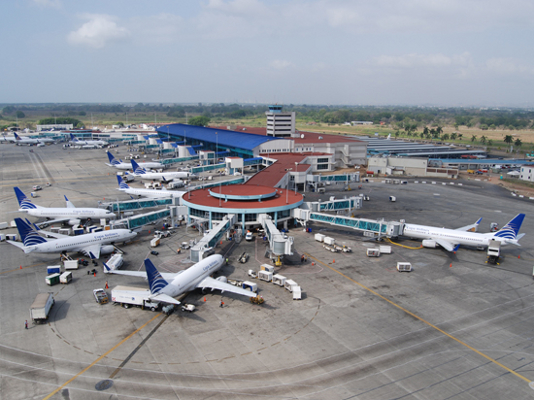
Panama’s Tocumen International Airport with the support of the ICAO has chosen ARINC AviNet Messaging Solution for the analysis of the airport’s operational data and capturing advance passenger information (API).

ARINC also provides baggage source, load and movement messages which encompasses critical data about weight, baggage and movement for arriving and departing aircraft.

Finding ARINC’s AviNet to be the most effective solution available, Juan Carlos Pino, Tocumen’s GM said, “The new solution will assist the airport in capturing both operational and advance passenger information data from international air transport carriers.”

ARINC AviNet will be used for the on-going analysis, through the transmission of API messages, which supports Panama’s border security requirements and aims to improve airport operational efficiency.

ARINC Global Networks and IT Solutions Vice-President, Yun Chong agrees and says, “Tocumen International Airport is joining other industry leaders who are using operation data analysis to improve airport efficiency.”

ARINC AviNet for Tocumen

ARINC, world-leading aviation communications providers also lead the way in the global security market with solutions for highly advanced information management, including ARINC AIM.

ARINC AIM (Advanced Information Management) offers integrated security technologies to the nuclear, military, ports, transportation and government facilities for real-time situational awareness capabilities.  For access control, vehicle and number plate recognition software, biometrics, video systems and identity management, ARINC AIM central command, control and monitoring can protect the critical infrastructure of sensitive, high security facilities.

ARINC uses an intelligent network of advanced technological solutions to provide critical installations across the globe with unique informational security.  Airport facilities and sensitive nuclear installations rely upon ARINC AIM for critical security and monitoring, multi-level controlled access and full system redundancy with resilience for communications, peripheral equipment as well as servers.

ARINC AIM furnishes clients with the reassurance of reliability, seamless integration and utmost efficiency of successful, continuous operations.  The name ARINC has remained synonymous with reliability for decades.  Groundbreaking innovative solutions continue to pave the way for technological advancements from flight deck to ground level security platforms.