Archive

Business Aviation News

Australia Ramps Up Border Control | Automated Border ProtectionIt has been announced that a major project to install automated border control e-gates in 8 airports across Australia has been completed.

A total of 83 e-gates have been installed since the project began last year, and already more than 10 million travellers have successfully passed through.

The Australian government committed to the project to ensure border control processes were not only efficient, streamlining Advance Passenger Information processing and reducing the time taken to process passengers, but also enhanced border protection at the country’s international checkpoints.

Peter Dutton, the Australian Minister for Immigration and Border Protection said, ‘This milestone delivers on the Australian Government’s commitment towards streamlined border control processes and enhanced border protection capability at our international airports. [This technology is] critical to improving our ability to accurately confirm the identity of travellers.’

Smart device apps making airports efficient | Aviation Industry NewsAs airline passenger numbers continue to increase around the world, airports are making sound investments in apps to assist passengers with self-service and automated solutions to make the processes of check-in, security and baggage handling easier. Airports are realising that these investments are already paying off in increased passenger experience and in the increased efficiency for the airport operator.

Common-use check-in and bag drop desks have been operating in global airports successfully, and with an estimated 80% of passengers now checking-in online using smart devices and their desktops, the introduction of apps has further streamlined the entire process of checking-in. Airports are also able to provide additional travel information to passengers via these innovative applications, which is another way travellers are gaining even greater control of their journey, increasing passenger satisfaction significantly.

Large airport services providers, such as Rockwell Collins, deliver technological advancements that enable airport operators to achieve greater efficiency across the airport environment, with solutions such as automated check-in kiosks, bag drop facilities and more common-use applications that can be accessed directly from smart devices. The addition of ARINC ExpressDrop has given airports the opportunity to address off-site baggage handling, further adding to efficiency, and helping to reduce waiting and queueing times.

As air travel continues to increase by an average of 5% every year, self-service passenger processing innovations seem an obvious path for airport operators to take.

Vladivostok International Airport Acquired | Aviation NewsIt has been announced that Russian Vladivostok International Airport has been acquired by a consortium, including Basic Element, the Russian Direct Investment Fund (RDIF) and Changi Airports International (the investment arm of Changi Airport).

The consortium aims to ‘create a high-tech aviation facility’ to raise standards in the region and to create a key hub. Already, the consortium has begun to expand the airport’s route network, and believes that the location of the airport is ideal to become the ‘gateway between Russia and the Asia-Pacific’.

Changi Airports International CEO, Lim Liang said, ‘Together with our partners, RDIF and Basic Element, we will develop Vladivostok International Airport as one of the best air hubs in the region with strong air connectivity and top-class service – two of our priority areas. We will showcase the uniqueness and vibrancy of Vladivostok and Russian Far East to the rest of the world through the airport, and open up this region to the vast opportunities in international trade and tourism.’

POD Point and Airparks EV Charging Points | Airports NewsElectric vehicle (EV) charging stations are soon to be operational at Birmingham and Luton airports, and will be free to use for drivers of electric vehicles using the car parks. These will become the first off-airport parking facilities to offer free vehicle charging.

The airport car parking facilities, run and managed by Airparks, will see the EV stations installed by POD Point, the leading provider of electric car charging units in the UK. Erik Fairbairn, CEO of POD Point noted that ‘this is a move that simply makes sense for all parties.’ Continuing, he said, ‘It not only gives EV drivers a clear destination of choice for knowing their car will be secure and well managed while away, but also peace of mind of knowing that whatever time of day they land back, their car is charged and ready to go.’

Airparks, the latest partner for POD Point, is proud to be the first off-airport car park to offer the free facility. Andrew Bird, GM at Airparks said, ‘We’re committed to constantly evolving our products to benefit our customer’s needs; and this new service means that people driving electric vehicles can use Airparks’ car parks and return from their trip to a fully charged vehicle. The EV market is growing year on year and we hope that Airparks will be the car park of choice for EV owners flying from Birmingham and Luton.’

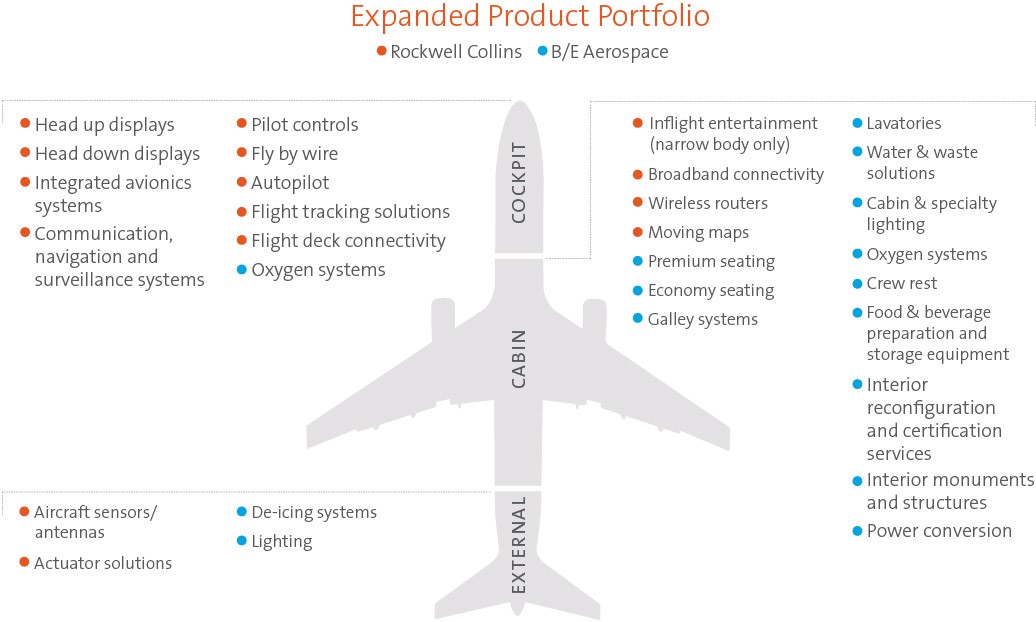
Announced on October 23, Rockwell Collins is set to further expand its cockpit and cabin solutions product portfolio with the acquisition of B/E Aerospace for the sum of $8.4 billion.

B/E Aerospace began life in 1987 as Bach Engineering, and has enjoyed success since then, expanding with acquisitions such as EECO Inc, PTC Aerospace Inc and Aircraft Products Gallery, changing its name to B/E Aerospace Inc in 1992.

Its strong position in the cabin interiors sector has spread to aerospace consumables and logistics, distribution and energy services.

Growth since its inception in 1987 has been significant, and B/E Aerospace now employs more than 10,000 personnel over 35 facilities around the world.

Acquisition of B/E Aerospace will add value to Rockwell Collins’ considerable portfolio, as the image below demonstrates.

Rockwell Collins Expanded Product Portfolio | B/E Aerospace

Improving Passenger Facilitation with Self-Service Bag Drop | Business Aviation NewsToronto Pearson International Airport has announced that it is to implement a new self-service bag drop system to improve operational productivity and passenger experience.

Canada’s largest airport, who saw 41 million passengers through its gates in 2015, look forward to automating the baggage handling process, which is set to give airlines greater flexibility, and improve the efficiency of the entire check-in process for passengers, who can use mobile devices to check-in online and download their boarding passes.

All over the world, international airports are seeking new, technologically-advanced methods to streamline the passenger processing systems; making the process easier and less time-consuming for travellers, while maintaining critical airport security and improving resource management.

Providers of airport passenger facilitation systems, such as Rockwell Collins, are driven by IATA standards, the need to increase passenger experience, and the use of biometric solutions to ensure airport security remains of paramount importance.

The automation of baggage handling systems in airports is the way forward, giving passengers greater control of their journeys, cutting waiting time and reliance on IT infrastructure, and improving passenger flow with identity management solutions.

With more than 80% of the world’s airline passenger traffic now checking in online, and arriving at the airport with pre-printed boarding passes, it is clear that automation, and the introduction of self-service bag drop features is set to change the way the public travel.

Gatwick airport runway expansion | Business Aviation BlogAccording to a UK government poll, around 63% of London councillors are prepared to support Gatwick airport’s plans for expansion, compared to just 44% for Heathrow.

The announcement from Gatwick, who has also pointed out that it will require no public funding, unlike Heathrow, comes as both airports reiterate that a new runway is necessary for the UK since the Brexit result has continued to damage the country’s economic position.

Gatwick and Bechtel can deliver second runway by 2025

Gatwick airport has also announced that it is ready to deliver its second runway by 2025, following a strategic partnership with Bechtel, one of the world’s longest-standing, respected engineering companies, who work with clients to increase economic growth.

If the UK government give the go-ahead to Gatwick, the expansion project can begin almost immediately, with significantly lower environmental impact, and lower financial risk.

Bechtel’s Amjad Bangash, general manager for infrastructure said, ‘We are delighted to be confirmed as Gatwick Airport’s partner for the second runway programme. We have provided Gatwick with robust plans for a second runway and are confident that this low risk project can be built to the highest quality, safely and sustainably – and that it can be operational by 2025.’

Airport Messaging News | Business Aviation BlogIt has been announced that a 2-year old memorandum of understanding between Air China and Lufthansa will be implemented at the beginning of the summer season of 2017 to provide jointly-operated flights in and out of China-Europe.

The joint venture will enable the two airline operators to collaborate more closely to increase the number of code-share flights and will also include subsidiaries of Lufthansa, Austrian Airlines and Swiss International.

Carsten Spohr, of Lufthansa said, ‘This ground-breaking joint venture will fundamentally strengthen our competitive position on routes between Europe and China.’

Chairman of Air China, Cai Jianjiang said, ‘[The joint venture] is another major step of Air China’s globalisation strategy. We will further expand network coverage in China and Europe, enhance the flight connections in beyond markets and optimise flight schedules.’

Airports News | Business Aviation BlogIreland’s Shannon Airport has become the first international airport in the world to take part in a pioneering EU-funded trial for passenger screening using a new pre-clearance check point.

The initiative takes a combination of European and US pre-clearance check points, and amalgamates the best of each into one new concept, designed to comply with dual regulations.

The trial will focus on improving passenger experience, while making the most of the technology to enhance airport security screening. Currently, US-bound passengers must move through two separate screening systems, and queue separately each time.  The new system utilises just one check point, performing both screening requirements for compliance with each mandate.

Today, passenger experience is high on the priority list for airport operators, where traffic is increasing at an average rate of 5% every year. It is critical to maintain passenger flow to minimise airport congestion, yet equally, if not more important to realise security goals concurrently.

The trial of the new passenger screening check point will begin this month and run for an initial ten-week period.

Beating the queues and improving security through technology | More about passenger facilitationAs the world remembers the 15th anniversary of the tragedy that was 9/11, the latest border scheme to come out of the UK has been branded a ‘gimmick’ by staff unions, who called for increased staffing instead.

The UK Home Office has said that under the new scheme, travellers could choose to pay between £5 and £17.50 for a ‘fast-track’ passage through its borders. The proposed scheme will not be available at all airports, and will be trialled at Gatwick airport, leaving skeptics in some doubt that current staffing levels will be sufficient to cope with the different lanes. Concerns have also been raised for passengers who will not be willing to pay being left facing longer delays than they were before.

Branding the proposal as ‘ridiculous’, a spokesperson for the Public and Commercial Services union said, ‘This is a ridiculous idea that exposes just how understaffed our borders are. What happens if everyone opts to pay £5? We’re back to square one. Instead of gimmicks like this, the Government needs to properly invest in staff to work at ports and airports because the shortages are there for all to see.’

Nick Trend, consumer expert for Telegraph Travel said, ‘This confirms a growing trend of airports charging for services which should be efficient and free,’ following news that some UK airports already charge for a fast-track service. Continuing, he said, ‘The risk from the consumer point of view is that airports deliberately allow the queues to build up so that frustrated passengers feel the only way to have a decent experience of the airport is to pay more for the privilege.’

Technology is in place to streamline passenger facilitation and processing in an increasing number of airports around the world. Strengthening border control is of paramount importance in a world that has seen dramatic improvements since 9/11. Border technology providers, such as Rockwell Collins’ ARINC airports, aim to improve passenger flow with Common Use Identity Management – using integrated systems to increase airport resource management, security and passenger experience.