Archive

Tag Archives: flight deck communications

Rockwell Collins' ARINCDirect Bundles to Further Enhance Connectivity

Rockwell Collins acquired ARINC Inc last year in its largest purchase in its history at $1.4 billion. In the last 10 months, Rockwell Collins have folded ARINC into an information management services organisation with the former Air Routing International – now Ascend Flight Information Solutions and Computing Technologies for Aviation (CTA) businesses. Combined and branded as ARINCDirect, the marketplace is presented with a robust suite of flight planning and international-trip software with communications technology for enhanced aircraft and ground communications solutions.

Combining Ascend and ARINCDirect online, with an integration of mobile applications and consolidated customer billing was the first job for the aligned sales teams and progress was measured in subscriptions to the newly-bundled offerings.

“When we started out here, our objective was to look at where are the Ascend customers that might have different connectivity than Arinc, where are the Arinc customers that might use different international trip planning—and synch those customers up so that we can provide a combined value proposition,” Jeff Standerski, senior vice president of information management services, said. “We’ve been able to do that on 60-plus tails already within a nine-month period.”

As one of the biggest names and forefront players in the business aviation sector, Rockwell Collins’ ARINCDirect promises further advancement in the industry with ‘bundled’ features and integration with leading avionics systems, such as Pro Line Fusion suites and the improved iPad planning application.

Providers of Inflight Connectivity Systems for Business AviationWith the onboard Wi-Fi revolution firmly underway and becoming increasingly standard on today’s business aircraft, maintenance personnel and connectivity providers are finding that their workloads are becoming more complex. According to NBAA Maintenance Committee Chairman, Jim Sparks, nowhere is this more of an issue than in the business aviation community, with technicians having a different ‘need to know’ than their counterparts in general aviation.

“In business aviation, technicians have a somewhat different ‘need to know,'” said Sparks. “In our case when you talk about an [Airframe and/or Powerplant] A&P you speak of an all-purpose technician — meaning you have to service tires or diagnose slow Internet access. … You get into the world of the airlines [and] yes, in many cases they have the technology and they have the specialists who deal with it. They’re not necessarily A&Ps, they’re more network specialists because they don’t have to have the return to service authority that an A&P technician does.”

Inflight connectivity in the modern business jet has evolved at an astonishing pace. Business passengers are able to operate at 45,000 feet as effectively as they can in their ground-based offices. It is becoming clear, according to Mr Sparks, that training standards have not been as fast to evolve and demand is growing for skilled technicians in the industry.

“The current requirement for the need to know of A&P technicians was established by the FAA and is pretty much based on technology from the 1960s or earlier; it just has not evolved over the years,” said Sparks. “There are some A&P schools, some affiliated with colleges or universities that have stepped it up where they provide more knowledge than is required. But the basic requirements for an A&P, they have not changed. If you go to an A&P school to get an A&P license that’s all you’re going to get, and you’ll have a basic understanding of ‘60s and ‘70s technology equipment.”

The NBAA and the FAA are beginning to work towards to evolution of training standards for A&P technicians. Nextech for NextGen is a program that includes formal development called ‘Project Bootstrap’, providing guidance to the FAA in the revision of basic requirements.

The phases of the program will address the need for filling the gaps in these areas and also for the physical installation and maintenance of advanced IFE systems.

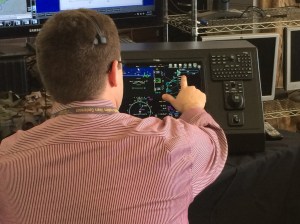
Rockwell Collins' ARINC HFDL CapabilitiesRockwell Collins demonstrated the capability of their Pro Line Fusion flight deck to be utilised as a ground control station last month as a part of a flight demonstration with the University of Iowa College of Engineering Operator Performance Laboratory (OPL).

Alex Postnikov, principle engineering manager at the Rockwell Collins Advanced Technology Center said that the aim of the flight was to ‘test the operational capability of a distributed Flight Management System using a certified digital communications link.’

The flight was conducted with a surrogate unmanned aircraft with a safety pilot onboard in order to test some of the repurposed Rockwell Collins technology for manned aircraft, with a view to applying that to unmanned aircraft.

“One of the big parts of the certification with the FAA is being able to handle lost link procedures. Today in the military world, when you lose a link, the [unmanned] aircraft essentially starts spiralling up with the hope of getting a line of sight to the radio. When it is unable to do that for some time it just flies in a straight line to the point of origin or where it is launched from,” said Postnikov. “Imagine doing something like this in the NAS. You cannot do that. The aircraft cannot just spiral up and just fly it in a straight line somewhere. So you have to follow the Standard RNP procedures, you have to use the standard navaids that are understood by everybody who flies in the NAS. That’s the piece that we believe has very strongly positioned us because the Pro Line Fusion has that capability. While this test focused on demonstrating the datalink capability, the emphasis of the September flight test was to “ensure that we can exercise our distributed Flight Management System (FMS).”

The only part of the flight test that was not automated was the take-off and landing procedures. The test team artificially broke the data link between the aircraft during the test and the modified Pro Line Fusion ground station, which was connected to the radio that was in communication with the aircraft.

Cost is a major issue with HFDL communications and Rockwell Collins are, through their acquisition of ARINC last year, offering cost effective solutions for aircraft messaging across the world, whether in manned or unmanned aircraft.

Global SwiftBroadband Providers for Flight Deck CommunicationsL2 Consulting Services, avionics engineering, integration and installation services providers, have announced a contract from Cobham SATCOM to develop the STC for AVIATOR SwiftBroadband installations for Hawaiian Airlines 767-300 series aircraft. The certification will apply for the use of ACARS Ground Gateways (AGGWs) for FANS and ACARS safety messages.

With the design phase already in action, prototype installations and certification is on track for the projected completion deadline during the first quarter of next year.

President of L2, Mark Lebovitz said, “This FANS 1 Controller Pilot Data Link Communication and Automatic Dependent Surveillance Contract to implement over SwiftBroadband Safety Services certification project is intended to support the FAA’s initiative to evaluate communication technologies that are expected to be viable in meeting the needs of the aviation community. We are delighted that Cobham SATCOM has entrusted our company with such a significant program to support FANS Evaluation flight trials towards meeting ICAO GOLD RCP240 requirements for support of 30/30 NM operations.”

AVIATOR SwiftBroadband is capable of delivering voice and data communications in addition to the provision of other critical services, such as aircraft tracking data, support for Electronic Flight Bag (EFB) and Ethernet connectivity for devices such as the Aircraft Interface Devices (AIDs).

Datalink Solutions Providers for Mandatory CommunicationsThis week, at the European Regions Airline Association assembly, speakers echoed the concern that is spread across the aviation industry about the upcoming mandatory regulations in Europe for CPDLC cockpit upgrades that are averaging $500,000 per aircraft in retrofit costs. Sectors are hoping for a delay to the mandate, which is intended to be in place by February 2015.

Also at the assembly, Steven Tyler, IATA director general says he has grown tired of trying to fight for reform in other areas.

Echoing the thoughts of many members, he said, “Everybody agrees with [changing the rules], but nothing ever happens. So the only conclusion you can reach is the reason they’re there is somebody likes it the way it is, and ‘the somebody’ is the governments. We can all agree it would be a good thing, but it’s just not happening, and the reason it’s not happening is because people like it the way it is. It may be illogical, it may be hypocritical, but I’m afraid that’s life. And that’s why I haven’t put all my own energy and all the energy of the organization, of IATA, into campaigning on this particular issue, because it would be wasted effort.”

Other Providers of Flight Deck Communications Solutions for Business JetsBombardier and Marshall Aerospace Group have signed a conditional letter of agreement to develop a Future Air Navigation System (FANS) 1/A+ avionics upgrade for the Bombardier Challenger 604 business jet. The upgrade will be aimed at the enhancement of pilot to air traffic communications to enable access to the North Atlantic Tracks, which offer shorter, faster routes.

The ICAO developed FANS 1/A+ as a part of the NextGen Air Traffic Management program, with a view to providing better management of high-volume airspace. FANS-equipped aircraft stand a greater chance of maximising operational productivity and profitability.

Vice-president of Bombardier Business Aircraft said. “We are pleased to be working with Marshall on this project.”

Flight Deck Weather Solutions ProvidersAccording to major airlines, improved use of satellite and datalink communications technology has resulted in fewer incidences of turbulence and will continue to do so as more and more airlines utilise the high-performance tools at their fingertips.

Using the latest solutions for communications and navigation, airlines and traffic control have gained a greater understanding of flying conditions resulting in better flight planning and route optimisation to circumnavigate storms and minimise ground delays.

According to the Bureau of Transportation, 36% of all delays in 2013 were weather-related. This sounds like a pretty high occurrence, but when compared with the figures of 2003, they are down by a whopping 50%.

The threat of turbulence has been a challenge to airline operators, due to its invisibility on radar or satellite charts. Meteorologists at Kansas’s Aviation Weather Centre produce global weather forecasts every six hours and are now able to predict areas of turbulence using complex weather models and informative reports from pilots and sensors on some aircraft. This enables dispatchers to re-route aircraft if necessary to avoid these areas in advance and thus preventing the chaos that could ensue in busy airspace.

Using modern aviation technology it is hoped that the numbers of injuries as a result of turbulence, which has been estimated at an average of 36 people per year since 2002, according to the FAA, will be cut dramatically as reliable solutions are maintained.

Today, communications and navigation systems are streamlining not just efficient operation in the aircraft and on the ground, but are improving the entire flight experience for the passenger.

Aircraft Information Manager Certified by EASAEASA has certified the Rockwell Collins Aircraft Information Manager, the secure data transfer system for their avionics Pro Line Fusion, Pro Line 21 and Pro Line 4, for 22 models of business aircraft.

Aircraft Information Manager (AIM) can assist airlines and operators with the secure upload of critical flight updates and downloads of maintenance information using WiFi and cellular data connections across the globe. With automatic transfer, including Flight Management System (FMS), electronic charts, navigation and more, depending upon the avionics generation, the AIM system is set to take the business aviation industry by storm.

EASA certified the system for the following models of aircraft:

  • Falcon 50/50EX/2000 and 2000EX
  • Citation XLS+
  • Challenger 300/601/604 and 605
  • Gulfstream G150
  • Hawker 750/800XP/850XP and 900XP
  • King Air 200GT and 350
  • Piaggio P-180 Avanti II
  • Beechjet 400A Pro Line 21 Upgrade

Greg Irmen, vice president and general manager of flight controls, information systems and commercial systems for Rockwell Collins said, “This is the first round of AIM certification in Europe. In addition to Europe, we are planning certifications in Asia, Africa, and Central and South America.”


Other Providers of CPDLC SolutionsHungaroControl, Hungary’s Air Navigation Service Provider, have announced the modernisation of ATC with the implementation of Controller Pilot Data Link Communications (CPDLC) under the Single European Sky initiative.

CPDLC reduces the reliance upon voice communications and can streamline the messaging system between pilots and ground operations, improving efficiency and safety through reduction of pilot workload in the cockpit. CPDLC uses VDLM2 avionics to enable aircraft FMSs to receive data link communications regarding route clearances, weather information and other mission critical transmissions.

“HungaroControl is also in the vanguard of developing the CPDLC technology in Europe, and we are convinced that using data link communication may considerably improve flight safety and the capacity of air navigation service providers,” said Kornél Szepessy, chief executive of HungaroControl.

The CPDLC changes in Hungary will fall in line with the mandates for the Single European Sky by February 2015.

A small eruption of Iceland’s Bardarbunga volcano has prompted the closure of airspace over the immediate area this weekend. The position of the volcano, under the ice of Europe’s biggest glacier has airlines on alert as the world watches the situation unfold.

Scientists flew over the ice cap on Saturday, but could see no obvious signs of the eruption on the surface, but Icelandic authorities have issued a red warning – meaning that there is a high probability of ‘significant emission of ash into the atmosphere’ and have declared a no-fly zone of 100 nautical miles by 140 nautical miles around the eruption as a precaution, but have not closed down the North Atlantic side.

There is international concern, however, following the disruption of 2010, when more than 100,000 flights were cancelled amid fears of the effects of volcanic ash upon jet engines.

There is still a chance that the eruption could remain contained beneath the ice, which is between 100 and 400 metres thick. The thickness of the ice can affect the ash levels of an eruption, according to Melissa Pfeiffer, Icelandic Meteorological Office volcanologist. “The thicker the ice, the more water there is, the more explosive it will be and the more ash-rich the eruption will be,” she said.