Archive

Tag Archives: common use

ARINC have announced that Michael DiGeorge MD of ARINC’s Asia Pacific will speak at the Future Travel Experience Conference, hosted in Hong Kong’s Asia World Expo.

ARINC will be exhibiting their latest developments in Common Bag Drop solutions and innovations such as Roving Agent and VeriPax, the Passenger Reconciliation System.

Mr DiGeorge will moderate a working panel session to highlight the theme of the event, which is ways to facilitate rapid passenger growth, while enhancing the passenger experience by speeding up processing of those passengers and their baggage.

ARINC’s common bag drop solutions include the Self-Service Baggage Drop desks, which give the passenger greater control of their journey, enabling them to check-in online, and then process their own baggage at these dedicated points, used for multiple airlines.  Passengers can tag their own baggage, drop their baggage and save time queuing, also helping airport terminals to save valuable space and giving them greater flexibility with staffing, removing the need for airline dedicated desks.

Mr DiGeorge said, “I am pleased to be sharing strategies to help airlines and airports make the best possible decisions regarding passenger and baggage processing methods.”

Canada’s fourth largest airport, Calgary International (YYC) has announced it will extend its current contract with ARINC, providing via the successful vMUSE platform, Common-Use Passenger Processing System (CUPPS) for a further 10 years.  The Calgary Airport Authority agreed the extension of the system with the addition of BagLink, the passenger-friendly, Common Use Self Service system and Local Departure Control on the vMUSE platform.

ARINC has been working with the YYC and CAA for 10 years and are looking forward to providing their existing and future passengers with an enhanced travelling experience for the next decade, especially with the addition of the new terminal, currently under construction and expected to be in use by 2015.  The new terminal will incorporate ARINC’s pioneering common-use technology, seamlessly integrating into the existing operations of the airport.

ARINC’s industry-leading, innovative communications, passenger and baggage processing solutions herald the past, present and future of aviation travel, benefiting airlines, airports, passengers and crew in Calgary and across the globe.

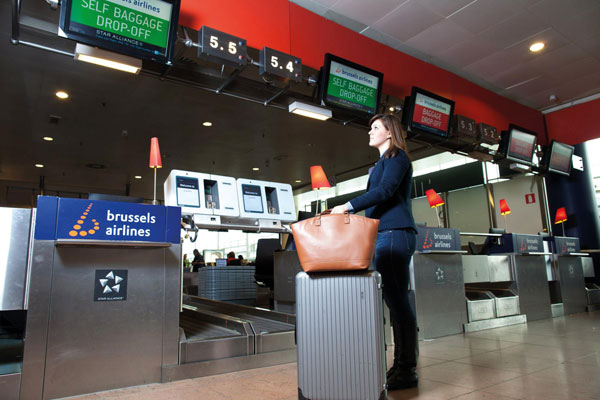
Brussels Airport and Brussels Airlines have announced their plan to test self-service bag drop over the next few months for passengers travelling within Europe.

Passengers who have checked-in online and have self-printed or mobile boarding passes will be able to use the self-service bag drop desks to weigh, measure and check-in their luggage, then print a baggage label from the self-service bag drop counter to attach themselves.

The airport will use the Dutch company, Type 22’s Scan & Fly, user-friendly technology, in two kiosks for the test, which is set to run until the summer.

“During the trial stage we will test the user-friendliness of the technology,” said Peter Cornillie, Brussels Airlines Vice President Ground Operations. “If the results are positive, the automated baggage check-in system will become a permanent option for all of our passengers travelling within Europe.”

Self-service bag drop is the way forward to streamline airport operations with common-use desks for multiple airlines, widely used in the U.S. using world-leading ARINC technology solutions.

ARINC Self Service Bag Drop

Passenger ProcessingStarting with Honolulu Airport, Hawaii say they are the first in the U.S. to move to completely automated self-baggage tagging with their new multi-airline check in kiosks.

Provided that Hawaiian passengers have self-printed boarding passes, they will be able to weigh, tag and check-in their baggage, leaving airport staff more time to assist passengers with oversized baggage or those with special needs.  This system will greatly reduce waiting time and streamline airport operations.

“Every minute saved in the check-in process improves our customers’ experience substantially, so this is a significant enhancement,” said Hawaiian’s Vice President for Customer Service Louis Saint-Cyr. “The kiosks reduced our customers’ check-in time to eight minutes. The ability to self-tag bags reduces the check-in time even further — by nearly half.”

There is a range of multi-airline check-in services out there, including the ARINC solution, vMUSE, and offering multi-airline check-in and bag drop facilities within an integrated suite of applications.  The vMUSE option maximises airport operations, eliminates the necessity for costly upgrades and gives smaller airports the flexibility of utilizing precious counter space.

ARINC offer interoperability with vMUSE solutions, using existing CUTE systems technology, allowing seamless operations for multi-airline check-in, self-printed boarding passes and bag drop facilities from an industry-leading, reliable provider.

This week the latest at ARINC was the news that it has won a major three year contract at 5 regional airports in Egypt to install its industry-leading passenger processing solution, vMUSE™. The Egyptian airports include Sharm El Sheikh, Luxor, Aswan, Borg El Arab and Abu Simbel. The ARINC CUPPS system fully compliant with the IATA CUPPS standard for common-use passenger systems.

Aviation Information Technology (AVIT) will be working in partnership with ARINC. In the contract, ARINC will install the core common use passenger processing systems (CUPPS) and provide remote third level support, AVIT will then handle first and second level support. There is a 14 week delivery and implementation schedule for all 5 airports which is due for completion by the end of May 2013, the team is currently on plan to achieve this.

Dr Ashraf Zaki, Vice President of EHCAAN said “Egyptian Airports Company (EAC) airports have been experiencing strong growth for several years, We believe that ARINC is an ideal partner to handle our continued expansion given their industry-leading technology and the tremendous airport experience they bring to the table, both globally and here in the Middle East.”

Tony Lynch, Regional Director for ARINC Middle East and Africa said “The ARINC vMUSE solution gives EAC the latest, state-of-the-art CUPPS platform, we have developed strong relationships in Egypt based on our excellent track record in delivering key projects such as Cairo Airport TB3 and Seasonal Terminal. We are pleased to be selected by EAC for these five airports and look forward to a long and mutually beneficial relationship.”

Giving smaller and mid-sized airports more flexibility to upgrade their operations is achieved by using ARINC’s vMUSE by eliminating software engineering and development costs.

EAC is a subsidiary of EHCAAN, and currently manages all 19 regional airports in Egypt. EAC airports serve all the different aspects of air travel.

ARINC will continue to provide and maintain the adaptable vMUSE™ platform for the Common Use Passenger Processing Systems (CUPPS). The long term relationship of ARINC and Munich began in 2003 and now to continue with ARINC’s CUPPS solution in MUC Terminal 2 until December 2014.

“We are impressed with the ARINC vMUSE platform and the support we have received over our long partnership. The ARINC team has regularly exceeded our agreed upon benchmarks and SLAs.” Said Marco Butz, Manager Technology and Infrastructure at Munich airport.

ARINC will continue to provide the premium on-site service and a centralized state-of-the-art firewall solution is due to follow during 2013. Tony Chapman ARINC Senior Director, Integrated Travel Solutions commented “We are delighted to continue working with one of our long-standing and valued customers, as we believe it reflects both the quality of our service and commitment to the highest standards of performance,” he continued “Munich Airport is focused on providing the best possible services for its customers, and ARINC’s technology helps make that achievable.”

At Helsinki Airport, as at many other airports the automatic border control system was introduced to help ease congestion of passenger processing during peak hours and travellers are swiping their passports themselves at border crossing checkpoints.

This year Helsinki Airport expects more than a million users to pass through its automated system, after it was reported that last year 600,000 passengers walked through at ease. Seppo Parkkinen the Kuopio-based musician travels internationally a dozen times a year spoke about the automatic passport control and said “It is much faster, you don’t have to wait and it works really well.”

Citizens holding biometric passports, of the European Economic Area, Switzerland and Japan can pass through the self-service passport control. Users scan their passport in a reader and later pose for a camera that uses facial recognition technology that compares their features with the digital photo embedded in the passport.

Business Aviation News - Border Management Solutions

Business Aviation News – Border Management Solutions

Departure control systems incorporating biometric passport information are becoming ever more affordable and within the reach of most airports. ARINC’s AviNet Airport system is specifically geared towards integration with existing systems and efficient passenger processing.

Currently 70% of Finns have a biometric passport according to Pentti Alapelto of the Finnish Border Guard. By the end of 2016 it is expected that that figure will be 100%. Alapelto explained “We also use the devices to help weed out passengers in cases where we believe someone is travelling with a false document,” as the high-tech readers also offer an additional layer of security to traditional passport control.

Chaos at Hazrat Shahjalal Airport in Dhaka was observed after a seven hour strike largely by ground handlers which led to approximately 3,000 passengers experiencing untold suffering. Civil Aviation Minister Faruk Khan warmed that if the ground handler failed in its responsibilities then the government would have no other option but to replace it.

Ground handling involves providing cabin services, catering, ramp services and passenger services. In Hazrat Shahjalal, Biman is the handling agent specifically for baggage handling and continually shows poor performance

At Dhaka baggage is brought to the delivery carousel from the arriving aircrafts in wheeled containers and unloaded by hand at the carousel point.  Most of the time baggage arrives and is ready to be picked up to an hour or more. If two or three wide-bodied aircrafts lands one after the other, it could be total pandemonium. In several other international airports procedures are such that a passenger could be eligible for compensation if their baggage takes more than 20 minutes to arrive at the baggage carousel.

The government is reported to be switching to an automated baggage handling system. It is trying to introduce a computerised Baggage Reconciliation system which will reduce mishandling of luggage. Sophisticated machines designed for baggage handling, including loading and unloading, will be introduced. This measure is expected to reduce loss or damage and will speed up dispatch and receipt of baggage..

Announced by ARINC Managed Services (AMS), Aeropuertos Dominicanos Siglo XXI (AERODOM) will continue offering ARINC’s vMUSE Common Use Check-in system at two of the Dominican Republic’s leading international airports, De Las Américas (SDQ) and Gregorio Luperón (POP). Mike Picco, Vice President of ARINC’s Airports Systems Division. Said “ARINC has successfully partnered with AERODOM since 2005,” he continued “We are excited to be given this renewal for our technology and services, and believe it demonstrates our strong commitment to the Latin America and Caribbean region”.

Common Use Passenger Processing Systems

Common Use Passenger Processing Systems

Aeropuertos Dominicanos Siglo XXI (AERODOM) a private concessioner commissioned by the Dominican Government to develop, operate and manage six international airports in the Dominican Republic for a period of 30 years: De Las Américas, José Francisco Peña Gómez in Santo Domingo; La Isabela, Dr. Joaquín Balaguer in Santo Domingo Norte; Gregorio Luperón in Puerto Plata; María Montez in Barahona, and Presidente Juan Bosch in the province of Samaná;

Monika Infante, CEO of AERODOM said “We are pleased to be working with ARINC, a company with a well recognized expertise in passenger processing technology that makes airports more efficient”. “ARINC’s products and the high level of support it provides have a significant positive effect on our customers’ travel experience.”

Amsterdam Airport Schiphol provides one of Europe’s best reference sites for self-service bag drop and 12 units are in place in Departure Hall 2.

ICM Airport Technics has supplied its self-service baggage drop system to Qantas as part of the airline’s Next Generation Check-In programme.

ICM Airport Technics has supplied its self-service baggage drop system to Qantas as part of the airline’s Next Generation Check-In programme.

Amsterdam Airport Schiphol provides one of Europe’s best reference sites for self-service bag drop and this year, 6 new self-service bag drop systems were introduced in Departure Hall 2, taking the total number to 12. Among the latest airports to announce an intention to implement such systems is Bologna Airport, which is expected to complete the installation of 14 units by mid-2013. Aéroports de Paris has also successfully installed a system at Paris-Orly and will soon be extended to Paris-Charles de Gaulle.

The benefits of allowing passengers to take charge of the check-in and bag drop process themselves are clear. For the airline it means fewer agents are needed, passenger processing is faster and congestion around check-in desks is reduced. For the airport, it enhances the check-in capacity, reduces operational costs and allows for the optimisation of existing space. Airports and airlines need to decide whether to implement a one- or two-step solution. The first option allows the process of printing and attaching bag tags and depositing the bag into the system, completed in a single transaction. The second requires the passenger to print their bag tags at a self-service kiosk, before depositing their bag at a separate location.

As Vaessen explained, the implementation at Amsterdam Airport Schiphol makes use of the one-step process. “There were two main reasons for using one-step. The first was our home check-in passengers. More than 50% of our passengers check-in at home, so we didn’t want all of these to still have to go to a kiosk when they arrive at the airport and we simply wouldn’t have enough room for all of the kiosks. The one-step or two-step process depends very much on the infrastructure of the airport.”

The implementation by Qantas, ICM Airport Technics’ two-step solution is now operated across 8 airport terminals in Australia and London Heathrow a total of 84 units. Duncan Watson, Qantas Head of Global Marketing Operations uses the two-step process, explained that the process “maximises the available real estate for the airport departures concourse”. He added: “The two-stage process results in significant savings in both expenditure and footprint. It is better for the passenger to spend two minutes in Area A and subsequently 30 seconds in Area B, compared to two-and-a-half minutes in a single stage process.”

One product available for self service check-in is ARINC’s ExpressDropTM, the world’s first common bag drop application for passengers who have already checked in on the Web, at a self-service kiosk or on their mobile phone. For more details please visit the ARINC ExpressDropTMsite.