Archive

Tag Archives: common use systems

ARINC have announced that Michael DiGeorge MD of ARINC’s Asia Pacific will speak at the Future Travel Experience Conference, hosted in Hong Kong’s Asia World Expo.

ARINC will be exhibiting their latest developments in Common Bag Drop solutions and innovations such as Roving Agent and VeriPax, the Passenger Reconciliation System.

Mr DiGeorge will moderate a working panel session to highlight the theme of the event, which is ways to facilitate rapid passenger growth, while enhancing the passenger experience by speeding up processing of those passengers and their baggage.

ARINC’s common bag drop solutions include the Self-Service Baggage Drop desks, which give the passenger greater control of their journey, enabling them to check-in online, and then process their own baggage at these dedicated points, used for multiple airlines.  Passengers can tag their own baggage, drop their baggage and save time queuing, also helping airport terminals to save valuable space and giving them greater flexibility with staffing, removing the need for airline dedicated desks.

Mr DiGeorge said, “I am pleased to be sharing strategies to help airlines and airports make the best possible decisions regarding passenger and baggage processing methods.”

Canada’s fourth largest airport, Calgary International (YYC) has announced it will extend its current contract with ARINC, providing via the successful vMUSE platform, Common-Use Passenger Processing System (CUPPS) for a further 10 years.  The Calgary Airport Authority agreed the extension of the system with the addition of BagLink, the passenger-friendly, Common Use Self Service system and Local Departure Control on the vMUSE platform.

ARINC has been working with the YYC and CAA for 10 years and are looking forward to providing their existing and future passengers with an enhanced travelling experience for the next decade, especially with the addition of the new terminal, currently under construction and expected to be in use by 2015.  The new terminal will incorporate ARINC’s pioneering common-use technology, seamlessly integrating into the existing operations of the airport.

ARINC’s industry-leading, innovative communications, passenger and baggage processing solutions herald the past, present and future of aviation travel, benefiting airlines, airports, passengers and crew in Calgary and across the globe.

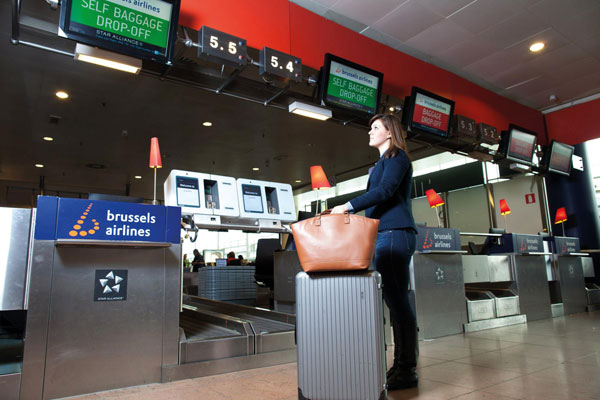
Brussels Airport and Brussels Airlines have announced their plan to test self-service bag drop over the next few months for passengers travelling within Europe.

Passengers who have checked-in online and have self-printed or mobile boarding passes will be able to use the self-service bag drop desks to weigh, measure and check-in their luggage, then print a baggage label from the self-service bag drop counter to attach themselves.

The airport will use the Dutch company, Type 22’s Scan & Fly, user-friendly technology, in two kiosks for the test, which is set to run until the summer.

“During the trial stage we will test the user-friendliness of the technology,” said Peter Cornillie, Brussels Airlines Vice President Ground Operations. “If the results are positive, the automated baggage check-in system will become a permanent option for all of our passengers travelling within Europe.”

Self-service bag drop is the way forward to streamline airport operations with common-use desks for multiple airlines, widely used in the U.S. using world-leading ARINC technology solutions.

ARINC Self Service Bag Drop

Passenger ProcessingStarting with Honolulu Airport, Hawaii say they are the first in the U.S. to move to completely automated self-baggage tagging with their new multi-airline check in kiosks.

Provided that Hawaiian passengers have self-printed boarding passes, they will be able to weigh, tag and check-in their baggage, leaving airport staff more time to assist passengers with oversized baggage or those with special needs.  This system will greatly reduce waiting time and streamline airport operations.

“Every minute saved in the check-in process improves our customers’ experience substantially, so this is a significant enhancement,” said Hawaiian’s Vice President for Customer Service Louis Saint-Cyr. “The kiosks reduced our customers’ check-in time to eight minutes. The ability to self-tag bags reduces the check-in time even further — by nearly half.”

There is a range of multi-airline check-in services out there, including the ARINC solution, vMUSE, and offering multi-airline check-in and bag drop facilities within an integrated suite of applications.  The vMUSE option maximises airport operations, eliminates the necessity for costly upgrades and gives smaller airports the flexibility of utilizing precious counter space.

ARINC offer interoperability with vMUSE solutions, using existing CUTE systems technology, allowing seamless operations for multi-airline check-in, self-printed boarding passes and bag drop facilities from an industry-leading, reliable provider.

This week the latest at ARINC was the news that it has won a major three year contract at 5 regional airports in Egypt to install its industry-leading passenger processing solution, vMUSE™. The Egyptian airports include Sharm El Sheikh, Luxor, Aswan, Borg El Arab and Abu Simbel. The ARINC CUPPS system fully compliant with the IATA CUPPS standard for common-use passenger systems.

Aviation Information Technology (AVIT) will be working in partnership with ARINC. In the contract, ARINC will install the core common use passenger processing systems (CUPPS) and provide remote third level support, AVIT will then handle first and second level support. There is a 14 week delivery and implementation schedule for all 5 airports which is due for completion by the end of May 2013, the team is currently on plan to achieve this.

Dr Ashraf Zaki, Vice President of EHCAAN said “Egyptian Airports Company (EAC) airports have been experiencing strong growth for several years, We believe that ARINC is an ideal partner to handle our continued expansion given their industry-leading technology and the tremendous airport experience they bring to the table, both globally and here in the Middle East.”

Tony Lynch, Regional Director for ARINC Middle East and Africa said “The ARINC vMUSE solution gives EAC the latest, state-of-the-art CUPPS platform, we have developed strong relationships in Egypt based on our excellent track record in delivering key projects such as Cairo Airport TB3 and Seasonal Terminal. We are pleased to be selected by EAC for these five airports and look forward to a long and mutually beneficial relationship.”

Giving smaller and mid-sized airports more flexibility to upgrade their operations is achieved by using ARINC’s vMUSE by eliminating software engineering and development costs.

EAC is a subsidiary of EHCAAN, and currently manages all 19 regional airports in Egypt. EAC airports serve all the different aspects of air travel.

Amsterdam Airport Schiphol provides one of Europe’s best reference sites for self-service bag drop and 12 units are in place in Departure Hall 2.

ICM Airport Technics has supplied its self-service baggage drop system to Qantas as part of the airline’s Next Generation Check-In programme.

ICM Airport Technics has supplied its self-service baggage drop system to Qantas as part of the airline’s Next Generation Check-In programme.

Amsterdam Airport Schiphol provides one of Europe’s best reference sites for self-service bag drop and this year, 6 new self-service bag drop systems were introduced in Departure Hall 2, taking the total number to 12. Among the latest airports to announce an intention to implement such systems is Bologna Airport, which is expected to complete the installation of 14 units by mid-2013. Aéroports de Paris has also successfully installed a system at Paris-Orly and will soon be extended to Paris-Charles de Gaulle.

The benefits of allowing passengers to take charge of the check-in and bag drop process themselves are clear. For the airline it means fewer agents are needed, passenger processing is faster and congestion around check-in desks is reduced. For the airport, it enhances the check-in capacity, reduces operational costs and allows for the optimisation of existing space. Airports and airlines need to decide whether to implement a one- or two-step solution. The first option allows the process of printing and attaching bag tags and depositing the bag into the system, completed in a single transaction. The second requires the passenger to print their bag tags at a self-service kiosk, before depositing their bag at a separate location.

As Vaessen explained, the implementation at Amsterdam Airport Schiphol makes use of the one-step process. “There were two main reasons for using one-step. The first was our home check-in passengers. More than 50% of our passengers check-in at home, so we didn’t want all of these to still have to go to a kiosk when they arrive at the airport and we simply wouldn’t have enough room for all of the kiosks. The one-step or two-step process depends very much on the infrastructure of the airport.”

The implementation by Qantas, ICM Airport Technics’ two-step solution is now operated across 8 airport terminals in Australia and London Heathrow a total of 84 units. Duncan Watson, Qantas Head of Global Marketing Operations uses the two-step process, explained that the process “maximises the available real estate for the airport departures concourse”. He added: “The two-stage process results in significant savings in both expenditure and footprint. It is better for the passenger to spend two minutes in Area A and subsequently 30 seconds in Area B, compared to two-and-a-half minutes in a single stage process.”

One product available for self service check-in is ARINC’s ExpressDropTM, the world’s first common bag drop application for passengers who have already checked in on the Web, at a self-service kiosk or on their mobile phone. For more details please visit the ARINC ExpressDropTMsite.
Virtual Airport Common Use Systems vMUSE Enterprise, the latest version of ARINC’s well-known MUSE® (Multi-User System Environment is a common use platform that offers an advanced virtual technology,  providing all in one multi-airline check-in without having to connect to on-site servers or platform software – using the private cloud of ARINC.

The benefits of vMUSE Enterprise, which has the capabilities as full-size server-based terminal, are that airlines and airports can enjoy power savings, space savings and reduced up-front capital costs. It also reduces operational and maintenance costs. Key components of vMUSE Enterprise are safely stored in the cloud so it can be quickly set up in any environment where power and the internet are available. Ideal for small and seasonal airports, airport parking terminals, rental car facilities, transit stations, and overflow use. This “pay-as-you-go” service reduces expenditure, minimises overheads with immediate access.

Existing PC’s can be converted to vMUSE Enterprise physical clients, and those who opt to replace traditional PCs with thin client workstations can realise further cost savings. With no moving parts, support costs are lower and the power consumption of thin client devices is considerably less than that of a PC.

To find out additional information view the website: http://www.vmuse-enterprise.com/

Evolving Self-Service Kiosks

Evolving Self-Service Kiosks

In June Airport Business Magazine featured the evolution of the kiosk. As passengers come to expect technologies to make their check in process simpler companies such as ARINC have reacted to the demand to offer ever increasingly advanced solutions.Common-use self-service (CUSS) kiosks are now extensively used across Europe, but now we are seeing the next generation – kiosks that allow passengers to check-in, select their seat, print boarding passes, and print out their own baggage tags.

ARINC provides cost effective solutions for private and commercial airlines to improve efficiency and security.

In recent years common-use technology that enables multiple airlines to share computer systems at airport check-in desks and boarding gates has become well established. The next decade will see many airports and airlines moving away from PC-based applications to those hosted in cloud computing environments. The advantages of hosted services include not only lower capital outlay and greater efficiency, but also a reduction in power consumption, space requirements and IT airport costs.

ARINC will continue to exploit the benefits of common-use technology by designing new systems to meet the ever-changing demands of the industry. At the same time, the company provides a comprehensive service to enhance customers’ legacy solutions, ensuring they are CUPPS (Common-use Passenger Processing System) compliant and certified.

It is all part of the service at ARINC, which has significant experience in delivering reliable, versatile and innovative solutions to improve all airport operations, from baggage management and passenger reconciliation to terminal optimisation and automated turnaround activity.

This month we heard that Tan Son Nhat International Airport has asked ARINC to continue their contract to provide maintenance and support services for its passenger processing systems. Multiple products are in place there including the common use system, which processes passengers faster and more efficiently by sharing airport infrastructure and resources

“We are very pleased to renew our maintenance contract with ARINC,” said Mr. Tran Van Thang, Deputy General Director of the former SAC. “They have provided us with an exceptional level of support, and our customers, including the airlines and ground handling companies have given us very positive feedback on system performance.”

ARINC offers a multitude of multi user system environment solutions for passenger processing at airports.  vMUSE Enterprise, the latest version of ARINC’s well-known MUSE® (Multi-User System Environment) common use platform, combines the security and reliability of vMUSE with advanced virtualisation technology to provide seamless, multi-airline check-in without having to install and manage on-site servers and platform software.

For more information please visit: www.vmuse-enterprise.com

Virtual airport common use systems

Virtual airport common use systems

Tens of thousands of football fans will be arriving this arriving in Poland this summer to attend the EURO 2012TM tournament matches. The Gdansk Lech Walesa Airport has recently more than doubled its passenger capacity by increasing airside infrastructure and adding a second passenger terminal

The sharp increase in passenger numbers expected has led the airport to chose vMUSE Enterprise hosted technology from ARINC Incorporated as its common-use passenger check-in and departure solution.

ARINC say “Unlike common-use systems that require costly IT hardware on site, ARINC’s vMUSE Enterprise solution delivers passenger processing as an Internet service. The check-in and departure functions use inexpensive “thin client” terminals in conjunction with an Internet connection.”

Because the data processing for vMUSE Enterprise occurs at an off-site data centre managed by ARINC, there is no need for the costly servers, core rooms, and computer workstations typical with other common-use systems. The need for on-site server maintenance, back-ups, and health checks is also eliminated. Airports can lower their IT capital and support costs while enjoying advanced common-use passenger services with improved overall system reliability and security.

As an added benefit, vMUSE Enterprise greatly reduces power consumption compared with conventional server-based core systems, enabling airports to lower their carbon footprint.

Along with Warsaw, Poznan, and Wroclaw, Gdansk is one of Poland’s four Host Cities with venues for the UEFA (Union of European Football Associations) EURO 2012 matches. With the opening of Terminal 2, Gdansk Lech Walesa Airport will serve 5.0 million passengers a year. In addition to facility improvements for EURO 2012, the airport will enact a special management plan to ensure efficient and friendly service for the volume of fan traffic expected from all over Europe.