Archive

Tag Archives: business aviation services

The Fort Wayne-Allen County Airport Authority has given the go-ahead for plans to be designed for a new aviation fuel station.  The fuel station is expected to be in the region of $4 and $5 million for construction cost, with design budget set at a maximum of $500,000.

The fuel station will be a major improvement for Fort Wayne Airport and will help to put the airport on the map for refuelling, giving the airport direct control over fuel, which is currently served by a fuel farm owned and managed by Atlantic Aviation.

Although contracts and designs are expected later this year, it could be years before the construction is finished and the fuel station is operational.

According to Scott Hindermann, executive director of the airport, local money will be used as the new station will not be eligible for federal funding.

In the aviation industry, fuel management can be critical to the continuation of operations for many airlines, both commercial and private.  Often, a large part of flight planning, the costs for fuel need to be managed for optimum productivity and also for the growing concerns about environmental impact.


 

business aviation Bookajet

Bookajet, leading supplier of executive jets to celebrities has announced the first signs of growth in business aviation since the beginning of the recession.  This growth is a welcome move for the business aviation industry and is likened to the property sector by the MD of Bookajet, Mr Jonathan Clements, who adds, “We are pleased to say we are starting to come out of what has been a very flat and challenging time in Europe.”

It appears that charter demand in business aviation is on the increase and the arrival of new additional aircraft to the fleet has meant the creation of new jobs in the UK.

Bookajet was established in business aviation in 2003 and has bases throughout Europe, in Italy, France, the Netherlands and in Russia that deal with the charter of private jets; overseeing more than 40 aircraft, management and sales.

The newest addition to the fleet is the Gulfstream 4, a luxury executive private jet capable of long-range flight.

Private and business aviation is a steadily growing sector and is competitive, with more and more emphasis placed upon comfort and connectivity.  It is critical that business aviation stays ahead of the game in terms of affordability, maintaining high standards and allowing passengers the same levels of business availability in the air that they have on the ground.

Communications providers must remain cost-effective while offering a range of services that are combined to keep the cabin as efficiently connected as the flight deck to maintain serviceability in this competitive sector of business aviation.

TAG Aviation Use iPad Flight Planning AppUK operator, TAG Aviation has said that it plans to replace the traditional flight bag with the use of iPads and an iPad flight planning app, making them the first UK business aviation operator to move toward the paperless cockpit.

A surprising difference is made to the weight of the aircraft and subsequent fuel consumption with the heavy flight bags on board, as minute calculations are made during the flight planning process.  The innovation of the iPad flight planning app reduces not only the paper consumption, but also the fuel costs making it an all-round winner for business aviation if you add the benefit of streamlined efficiency on the flight deck.

“The introduction of paperless technology will ensure that pilots have up-to-date, essential information at their fingertips.  Flights manuals, manufacturer’s documents and aeronautical flight charts can be updated at the touch of a button instead of the time-consuming and wasteful process of manually updating hard copies,” said Russ Allchorne, Vice President of Flight Operations Europe at TAG Aviation (UK). “At TAG Aviation, we are committed to identifying ways to pioneer standards in flight operations and wider business aviation practices to improve efficiency, safety and our environmental footprint.”

Many communications providers now offer the iPad flight planning app with the aim of reducing costs while maintaining effective and efficient flight management.  ARINC Direct, industry-leading business aviation solutions provider are able to incorporate the iPad flight planning app into their tailored communications and flight support services for business jets.

in-flight wifiIt looks like the days of turning off our mobile devices on aircraft could one day be behind us as the demand grows for passenger in-flight wifi connectivity.  Many passengers now want to tweet their journey or update Facebook statuses as they fly, posting photos of the clouds, their meals or cities from the air.  Social networking, as we all know, is huge and in-flight wifi is a necessary fuel for that fire.

Recent surveys show that a quarter of British holidaying passengers out of 5,000 believe that free in-flight wifi is not only necessary, but a human right, according to HolidayExtras, although it is also recorded that 84% of these passengers are unwilling to pay the current high rates charged for in-flight wifi.

Now that the US FAA declared the use of the new models of mobile phones and device safe to use in ‘airplane mode,’ the floodgates are open in terms of demand for cheaper, faster in-flight wifi connectivity and this leaves many airlines thinking about the possibilities for revenue versus the inevitable costs involved with upgrades to their existing equipment.

Within the next few years, Inmarsat, the British satellite communications network, will be launching three new satellites, which will give global connectivity possibilities and could spell faster and cheaper in-flight wifi, but, until then, with only four commercial airlines currently offering free in-flight wifi, competition is slim and the cost implications for the passenger still high.

While business passengers enjoy the versatility of in-flight wifi, it looks to be a while before the demand is met for the average holidaymaker.

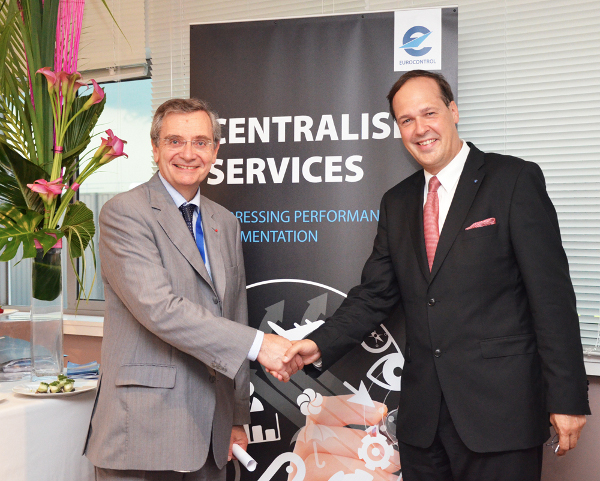
The European Aviation Safety Agency and EuroControl have established a co-operative plan for the improvement of aviation, focussing upon the implementation of the Single European Sky, with environmental protection, training and the development of the EU External Aviation Policy as priorities.

The co-operative plans will establish a common foundation, general framework and a programme on a formal basis, expected later this year.  There will be an evaluation of national civil aviation authorities’ mandates and the requirements of military airspace users in addition to overseeing the SESAR deployment.

EASA executive director Patrick Goudou said “the new framework is instrumental in the development of a more competitive air transport industry in Europe. EUROCONTROL believes this agreement will provide the optimal framework to combine the expertise and resources of the two European organisations, following the extension of EASA competences to ATM/ANS and aerodromes”

It is believed that EUROCONTROL will support EASA’s regulatory work with its air traffic and route management.

The new Single European Sky is a direct initiative borne from the heavy congestion over Europe.  Part of the directive spells the need for CPDLC capability in the cockpits to free up the airwaves.

EASA EuroControl Single Sky CPDLC

in-flight wifi

In-Flight WiFi

According to many airlines, in-flight WiFi provision gives them a ‘competitive advantage’ in the commercial aviation industry.

As the competition grows fiercer, it seems that in-flight wi-fi will become less of an advantage and more of a normality according to a report by ‘routehappy.com,’ a site that ranks airlines.  Their report says that currently 38% of US flights offer internet connectivity and long haul or the most popular routes, such as non-connecting California-New York are offering in-flight WiFi.

Although it is still a small percentage of flights overall, it shows that, as passenger demands for in-flight WiFi grows, the more likely that it will become standard practice and airlines will be looking to offer faster, better and cheaper in-flight WiFi to remain competitive.

The debate grows after the FAA’s announcement last week that it will be lightening up about the use of electronic devices on-board, allowing passengers on certain flights to carry on using their Smartphones instead of the insistence of powering down before take off.

Most airlines provide ‘GoGo’ for in-flight WiFi, but with dramatic price fluctuations and intermittent signal, the marketplace is broadening and the opening into business aviation for passengers wishing to work in the sky and on the move means that a push into the Ku-band for international connectivity is the way forward.

Aircraft in-flight Wifi provider, ARINC, already offer truly global connectivity with their Inmarsat/iridium satellite network connectivity and are leaders in the business of aviation communications.

Gogo expects that in-flight wifi for business travellers will become a required expense and not an optional one and are experimenting on new pricing models as it is still early days for in-flight wifi connectivity.

Only time will tell…

This week it has been announced that a pilot has written an iPad app that will handle the commuter and on-demand flight ops calculations, such as departure gradients, approach planning, flight time tracking and climb performance, to name a few.

The new app for the iPad, called the ‘Aviation Pilot Duty and Performance Calculator’ is the latest in a line of innovations introduced since the iPad impact on the cockpit began saving the Pilot hours of complicated, intricate work involving reams of paper that would have to be carried.

The iPad has been a major contribution to the paperless flight deck and with the many apps on the market, such as the ARINC Direct iPad Flight Planning App, especially designed and developed for business aviation users, the Pilot and flight ops crew can look forward to a truly streamlined, optimized cockpit.

iPad flight planning app

ARINC Direct Flight Planning iPad App

ARINC Direct Flight Planning iPad App

ARINC Direct, industry leading business aviation communications providers, demonstrated their new Flight Planning iPad app at EBACE last month, showing the incredible capabilities and connectivity for the use of the iPad as a valuable flight planning tool.

James Hardie, Director for ARINC Direct EMEA and Asia Pacific, said, “Once we realized that more than 50 percent of our subscriber base was already using the [Apple] iPad as an electronic flight bag in the cockpit, we knew that we could provide more up-to-date information, automatically, through our own app, whenever it is connected via the Internet to our servers.”

The combination of the WiFi connectivity of the iPad and ARINC Direct’s Inmarsat SwiftBroadband link, allow for the flight planning iPad app to achieve maximum capability, enhancing the flight deck operations, cutting down the paperwork and offering live weather graphics, graphical flight following and much more.

ARINC Direct’s unique features, such as the ability to connect two iPads via Bluetooth on the flight deck, enabling data sharing, and amending, saving and uploading amended flight plans as PDF’s make the ARINC Direct flight planning iPad app a much needed and long awaited solution to utmost efficiency and another huge step towards a paperless cockpit.

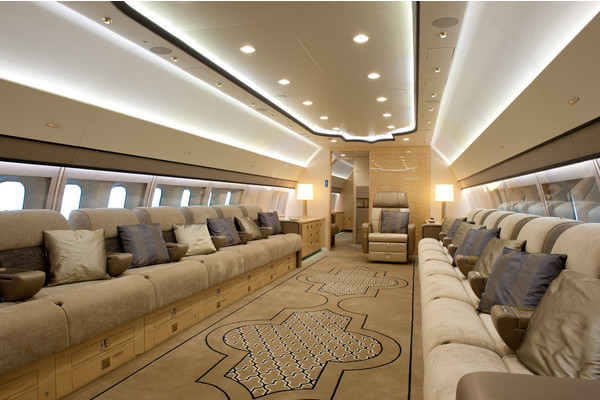
Visitors to EBACE 2013 will be able to view for the first time on static display, the luxuriously fitted BBJ3 from Boeing and Jet Aviation Basel.

The BBJ3 is the latest and the largest business jet aircraft from Boeing and is based upon the 737-900 Extended Range airliner.

The aircraft is currently on sale by the owner, who had the, Jet Aviation Design Studio VIP custom refit done last year.

The BBJ3 has a lounge, dining room, private bedroom with en-suite bathroom and staff area all comfortably furnished with the finest materials and fittings, including real stone, highly-polished sycamore wood, silk carpeting and hand-finished marquetry.

As the first privately owned BBJ 3 to be completed at Jet Aviation Basel, the highly customized cabin interior is finished in a flawless, bright, high-gloss quarter-figured Sycamore wood, with hand-crafted marquetry artwork integrated in the entrance panel,” said Neil Boyle, Vice President of the Completions Center at Jet Aviation Basel.  The centre employs over 1200 staff in their design, engineering, upholstery, fibreglass and paint shops and is capable of outfitting jets to VIP standards as large as an Airbus A380.

During their long-time partnership with Boeing, Jet Aviation Basel has delivered 24 completed aircraft, this being the first privately owned BBJ3 to be completed and shown in this way.

The BBJ3 will accommodate 38 passengers and 8 crew members comfortably and is beautifully equipped for a VIP journey.  With a spacious cabin of 32.7 m long and 3.57 m wide and with a range of 4,900 nautical miles, it is outselling all other business jets in its class by 7-1.

President of BBJ, Captain Steve Taylor said, “Our customers demand airplanes with great performance, enabling them to conduct business around the world.

The business jet aviation industry is experiencing a surge in growth and with more business and corporate use comes a high demand for comfort and connectivity in the air as effectively as in their ground-based offices.

business aviation refit

business aviation

Changing trends in commercial aviation have shown that over the past six years, there has been a drop in scheduled domestic flights to the tune of almost 9% per year in the largest hub airports in the U.S. with smaller airports losing 21% of domestic activity, according to a report by MIT’s International Center for Air Transportation.

The blame for this significant decrease in activity is largely attributed to the troubled economy and vastly fluctuating fuel prices, forcing operators to adjust capacity for a higher yield per flight and even removing direct flights to smaller airports, thus creating an impact upon small and medium-sized communities, in rural America, for example, in turn greatly affecting the service levels to these areas.

With public transport at a minimum in rural areas, and the demands upon business travellers increases with the economic crisis, there has never been a more critical time for business aviation to provide business travellers with the means to act fast in opportunistic situations.

The U.S. has invested billions in ensuring a safe, reliable and efficient air transport infrastructure and this is essential for the facilitation of the continued operation of airline travel for commercial airlines, business and recreational aircraft to maintain a robust infrastructure and to keep the skies busy and keep the economy growing.

Indeed, rural America encourages companies to bring jobs to the communities and the creation of effective transportation is welcomed with open arms.  The need for strong connections grows and, currently, airlines serve only 10% of the nation’s airports between less than 50 locations country-wide.

The authors of the report do not expect the situation to improve in the near future with commercial airlines and, with the businesses that fly their executives to where the opportunities lie, it is clear that business aviation is an area of the industry that will experience the growth and productivity that will ultimately benefit the nation’s economy.

business aviation

Business Aviation to aid economic growth