
Archive

Tag Archives: AviNet

APIS & PNR Transmission Solutions ProvidersIndian airports will soon step up its efforts to control smuggling and track ‘persons of interest’ through its launch of Advance Passenger Information System (APIS) this month.

The APIS system has been developed by the National Informatics Centre with assistance from the Directorate General of Systems under the Finance Ministry and is set for launch at Indira Ghandi International Airport.

The system will operate in much the same way as the US and European APIS systems with the provision of an electronic database of all passengers and flight crew, with the addition of a manifest of all personnel entering and exiting the airport terminals.

APIS is designed to enable government and border agencies access to Advance Passenger Information which can then be screened to identify potential threats to national and international security. The system is mandatory in the US and is proving to be a great asset to agencies in the tracking of terrorist movements. APIS requirements are spreading around the globe as more and more countries take a stand in the threat of terrorism.

APIS providers have a responsibility to ensure that Advance Passenger Information is collected, stored and distributed securely, swiftly and reliably to be of the greatest use to agencies all over the world.
Flight Deck Aviation Weather Data Solutions Today, Rockwell Collins unveiled their latest program that will give pilots, flight line maintenance and service repair technicians access to training solutions on mobile devices.

Amongst the training applications, and one that will be demonstrated this week in Orlando at the Interservice/Industry Training, Simulation and Education Conference, is the Rockwell Collins MultiScan ThreatTrackTM weather radar on a mobile tablet.

Also at the conference, Rockwell Collins will be introducing new capabilities that will allow subscription customers to view and download task-specific training and publications online.

LeAnn Ridgeway, vice-president and general manager of the Simulation and Training solutions for Rockwell Collins acknowledged that people use mobile devices for almost everything they do and said, “This new offering demonstrates our commitment to providing our customers with the right content in the right format, when and where they need it. Our new mobile training and publication offerings allow our customers to access, manage, and interact with information as they need it.”

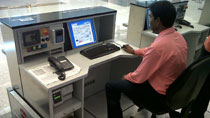
Rockwell Collins' ARINC Check-In-Counter & Baggage SystemsThis week it has been announced that Indira Ghandi Airport (IGI), India’s busiest hub, has renewed its contracts and signed for another six years with Rockwell Collins’ ARINC passenger processing systems and technology, following ICI’s recent award to the company as “Best IT Service Provider” for the second consecutive year.

IGI has used the ARINC vMUSE common-use passenger processing system for more than five years, in addition to ARINC SelfServ kiosks and ARINC VeriPax Passenger Reconciliation system, ARINC BagLink for baggage messaging and Rockwell Collins’ integration of a Local Departure Control System in Terminals 1D and 3.

“IGI has prided itself on being a purveyor of new technology, recognizing it as key to becoming a world-class airport,” said Chief Information Officer and Vice President Davesh Shukla, Delhi International Airport Ltd., on why it has worked closely with Rockwell Collins on implementing the newest and latest technology to aid in ‘Fast Travel.’

“We created a customized solution for IGI that accommodates its rapid growth, while continuing to improve the passenger experience, enhance their competitive advantage and maximize return on investment,” explained Heament John Kurian, managing director, Information Management Services division, Asia Pacific for Rockwell Collins.

As a part of the new contract, the airport will work with Rockwell Collins integrators to deploy mobile and portable check-in devices throughout in a bit to further streamline and enhance the passenger processing experience for both the passenger and the airport.

The space-saving attributes of the modern passenger check-in systems, which now incorporate greater flexibility with multiple airline check in facilities and bag drop points, give airports the opportunity to create enhanced retail spaces and better utilisation of airport personnel within the terminals. This allows increased operational productivity and a better experience for the passenger with the reduced likelihood of queueing and ground delays.

Scottish Airports Select AviNet Airport SolutionRockwell Collins have announced new five-year agreements signed with Aberdeen International Airport, Edinburgh Airport and Glasgow Airport for the installation of their ARINC vMUSE Common Use Passenger Processing System (CUPPS) with workstations throughout the airports.

The process was competitive, but Rockwell Collins was delighted to announce the news this week and is the third contract to be won in recent times. Earlier this year, they were awarded a contract in Scotland for their ARINC AviNet Airport service, with installation of common-use self-service kiosks at Aberdeen International. Glasgow Airport also signed up for the AviNet Airport service.

“This new system means that different airlines can use the same desks,” explained Andrew Mutch, Airport Head of IT. “It increases our flexibility and means that in a growing airport we can be much more reactive to demand than the previous system allowed for. As a result this will provide real benefits for our customer service provision, it will help to manage queues and deliver a more integrated product.”

“We’ve been providing airport solutions in Scotland for almost ten years,” said Michael DiGeorge, vice president of international and global airports for Rockwell Collins. “This win is another example of our commitment to invest and grow our business in Europe, the Middle East and Africa.” ”Rockwell Collins’ ARINC solutions are now being used at three of Scotland’s major airports. This contract marks yet another key milestone in our commitment to invest and grow our business in Scotland, and we look forward to a long and productive relationship with Glasgow and other airports throughout the country.”

“The Rockwell Collins solution provides Glasgow Airport with a customized and cost-effective program that meets our current requirements while being flexible enough to easily adapt to our projected growth in passenger traffic,” said Graeme Frater, CUTE Club Chairman at Glasgow Airport.

Other Airport Operations Management ProvidersIt has been announced that the world’s busiest airport, Atlanta International (ATL) has upgraded its airport management platform, bringing a range of new and advanced tools to airport operations.

An extended range display, the first of its kind, will provide a National Airspace System view of all flights which will enhance the airport’s capabilities for proactive air traffic management. Real-time flight cancellation notifications and reporting is set to improve management with greater visibility, allowing historical views.

Real-time vehicle tracking with portable Wi-Fi hotspots will enable vehicle operators to access a view of airport activity and the facility will additionally enable expanded vehicle data collection, improving efficiency through dispatch and communications support network.

The airport management system at ATL will assist the operators and ground personnel to streamline operations, increasing an already efficient system even further.

“Atlanta has continually seen a decrease in delays and improved overall operational performance since deploying Aerobahn in 2010,” said Paul Meyer, Airport Assistant General Manager for Operations. “These achievements are possible due to the airport-wide collaboration fostered by the airport community through the use of a common surface management system.”

In an ever-growing industry, airport management solutions can help airports of all sizes to achieve cost-cutting targets and improve operational productivity.

Flight Deck Weather Solutions ProvidersAccording to major airlines, improved use of satellite and datalink communications technology has resulted in fewer incidences of turbulence and will continue to do so as more and more airlines utilise the high-performance tools at their fingertips.

Using the latest solutions for communications and navigation, airlines and traffic control have gained a greater understanding of flying conditions resulting in better flight planning and route optimisation to circumnavigate storms and minimise ground delays.

According to the Bureau of Transportation, 36% of all delays in 2013 were weather-related. This sounds like a pretty high occurrence, but when compared with the figures of 2003, they are down by a whopping 50%.

The threat of turbulence has been a challenge to airline operators, due to its invisibility on radar or satellite charts. Meteorologists at Kansas’s Aviation Weather Centre produce global weather forecasts every six hours and are now able to predict areas of turbulence using complex weather models and informative reports from pilots and sensors on some aircraft. This enables dispatchers to re-route aircraft if necessary to avoid these areas in advance and thus preventing the chaos that could ensue in busy airspace.

Using modern aviation technology it is hoped that the numbers of injuries as a result of turbulence, which has been estimated at an average of 36 people per year since 2002, according to the FAA, will be cut dramatically as reliable solutions are maintained.

Today, communications and navigation systems are streamlining not just efficient operation in the aircraft and on the ground, but are improving the entire flight experience for the passenger.

Airport Security Management SolutionsBaltimore/Washington International Airport (BWI) recently achieved an award with Intergraph Security Solutions for recognition of their PSIM system for Physical Security Information Management procedures. The airport also won Most Notable Airport Security Program, Large Airports.

The Consolidated Dispatch Centre (CDC) at BWI provides emergency calls delivery across the airport, using a fully integrated platform with software, hardware and multi-system and agency coordination services. The CDC responds to security system-wide calls and additionally, provides a Public Safety Answering Point (PSAP) to the Anne Arundel County.

“This highly successful project provided our security and public safety personnel with cutting-edge emergency response technology,” said Paul J. Wiedefeld, chief executive officer of BWI Marshall.  “The improvements to the consolidated dispatch centre help ensure increased responsiveness and situational awareness.  We are honoured by the recognition from Government Security News.”

Sophisticated PSIM solutions are necessary within a secure aviation environment. Many security systems incorporate physical security systems, from perimeter fencing and monitoring to personnel access systems and information management systems for all mission critical facilities.

AviNet Mail Airport Messaging Service InformationIt has been announced today by Rockwell Collins that Tunisian Airline, STARS, has selected their ARINC AviNet Mail Enterprise messaging service to provide a cost-effective solution for their messaging requirements for passenger processing and cargo systems messages.

“AviNet Mail Enterprise Hub represents the next generation messaging hub for the air transport industry,” said general manager for STARS Airlines, Chemam Hichem. “With eHub serving as our messaging platform, we have migrated all of our legacy accounts to Rockwell Collins because of its cost effective solution and superior customer service.”

The ARINC AviNet eHub solution is a cloud-based service, requiring no costly internal server installation or software licensing fees and offers free local traffic routing. There are also reduced costs to the customer for infrastructure, training and individual messaging transactions. The solution brings reliable airline operational messaging with tailored plans and IATA compliance.

“eHub has been designed to meet all the IATA standards and customer interface needs, including Type B, XML SMTP, X400, Fax, SMS or even Type X,” said Alexis Hickox, senior director, Aviation Solutions for Rockwell Collins. “With eHub, we’re continuing the drive to reduce operational costs, and at the same time equipping our customers with the ability to embrace future developments in messaging.”

Aviation Information Sharing ProvidersAviation information needs to be shared across a growing number of partners to ensure efficient day-to-day operational productivity.

The meteorology department of Qatar’s CAA has selected Polycom to build a communications infrastructure to allow the sharing of information across IP/ISDN networks with external government and private agencies, in addition to ports, shipping offices and fuel providers across the country.

Signed by the CAA, the deal will provide two complete Polycom RPX systems with four screens at two locations and conferencing systems that will encourage inter-departmental collaboration.

A web-based messaging environment, such as ARINC’s AviNet, allows cost-effective information sharing across all partners, including the delivery of ACARS messages, aviation weather data and updates to flight plans.

AviNet Airport Solutions

Rockwell Collins will be demonstrating the best features of their ARINC airport solutions at this year’s Dubai Airport Show on stand 8310.

“The Dubai Airport Show is an important platform for us to engage with new and potential customers – especially as we continue to invest and grow in the region,” said Tony Lynch, Middle East Director, Information Management Services for Rockwell Collins. “We’re looking forward to many productive meetings at the show, and demonstrating how our innovative airport technologies can help manage airport costs and improve processes.”

Rockwell Collins will be exhibiting highlights of the Airport Solutions package, with cost-effective shared check-in features, such as:

Multiple airline support
• Cloud-based common check-in
• Touchscreen Wayfinding
• Airport Operational Suite – as part of the CDM initiative
• Security & surveillance solutions
• Legacy & CUPPS application support
• Common-use biometric passenger processing

All these features and more will provide advanced solutions for the airport of tomorrow, offering flexibility and enhanced operational activity with cost-sharing initiatives for all sized operations.