Archive

Tag Archives: AviNet

Find Out More About Passenger Processing Systems and Airport Technology IntegrationIt has been announced that Orlando Sanford International Airport (SFB) are to replace their current airport technology with an upgrade to improve their operational efficiency using a common use platform.

The airport will use AirIT’s EASE (Extended Airline System Environment) to increase flexibility for their major operations, including passenger processing, flight information displays, airport database operation and airline resources with a shared option to allow leverage of airport network infrastructure.

These and other providers of common use airport management systems, such as Rockwell Collins’ ARINC, deliver the opportunity for airports across the world to integrate systems and give airlines greater flexibility in terms of cost-management and efficiency.

Find out more about IATAIt has been announced that a collaboration between IATA and Tel Aviv University has resulted in a signed deal this week to develop technology that is aimed at improving aviation safety in the areas of big data, cyber security and authentication and general security.

IATA represent much of the passenger and cargo transportation across the world – 83% – and deal with a wide range of issues, including streamlining and simplifying both ground-based and airborne operational procedures.

The simplification of processes, including airline messaging, which is historically complex and expensive, can improve airport operations on a global scale.

Korea Airports Corporation (Providers of Leading Airline Messaging SolutionsKAC) and Korea’s T’Way Air have signed two separate contracts for Rockwell Collins’ ARINC GLOBALinkSM for their air-to-ground data link communications networks.

KAC is a service provider for civil aviation and airline communications and T’Way Air is South Korea’s fastest growing airline. KAC will use ACARS for pre-departure clearance and D-ATIS messaging, utilising VDLM2 for faster, more accurate and reliable transmissions.

T’Way Air hope to enhance accuracy with their new system, using the real-time benefits of Rockwell Collins’ ARINC solution to increase operational safety.

These latest contracts now mean that all of Korea’s largest low-cost carriers are benefitting from Rockwell Collins’ ARINC GLOBALink for the transmission of communications between aircraft, ground crews and airline DCS.

Heament John Kurion, managing director of IMS for Rockwell Collins’ Asia Pacific said, “Our expertise in communications messaging combined with our understanding of the Korean market ideally positions Rockwell Collins to provide these two leading organisations with robust solutions for their aviation communications needs [and] marks another key milestone in our successful strategy to invest and grow our business in the country and throughout the region.”

Other Airline Messaging Solutions ProvidersIn a bid to improve passenger services, Virgin Atlantic has announced that, with Delta Airlines, it will be replacing current ticketing, passenger reservations and departure control system functions with AIR4.

In order to focus upon customer services, Virgin Atlantic and Delta Airlines will also use Air4 to enhance web-based check-in with self-service capabilities, optimised for mobile use.

Using passenger service systems with integrated access to airline DCS can help to streamline airport operations and minimise delays for both airlines and passengers, particularly during peak flow times. Other integrated systems in use in the airport environment include solutions for weather data management, aircraft datalink and flight planning using business-to-business communications.

Using Technology to Provide Increased Airport SecurityAtkins Identity Management toolkit will be integrated with the ARINC vMUSE and VeriPax technologies from Rockwell Collins to produce a new suite of fully integrated and configurable airport identity management solutions, which will help to take automated passenger processing to another level, while maintaining critical airport security.

The combined technologies will capture passenger identities using biometrics, comparing the information with boarding passes and passport details, including finger print and facial recognition capabilities.

Nick Whitehead, head of strategic services in identity assurance at Atkins said, “Combining Rockwell Collins’ experience deploying CUPPS technology at airports worldwide with our proven capabilities in developing and implementing biometric applications has allowed us to create a fully integrated identity management solution for airports. Airports can use this service to validate a passenger’s identity, ensuring that the individual given the authority to fly is actually the one who boards the plane.”

The initial implementation of the technology will include highly configurable elements and standardised plug-ins to allow seamless identity management without making changes to an airline’s DCS.

Atkins is a leading global design, engineering and project management company with employees in the UK, Middle East, Europe, Asia Pacific and North America.

Find Out More About Rockwell Collins' HFDL ServicesNew packages have been introduced by both Rockwell Collins and SITA, following high demand for cost-effective and reliable aircraft tracking and in readiness for the new global industry standards and rules – as much as the subject is still in debate to the extent of flight tracking capability.

Initial moves call for aircraft positioning data every 15 minutes, with a view to reviewing this figure and other requirements during potentially problematic situations or when flying over remote areas or vast oceanic expanses.

Tim Ryan, Director of Programs and Service Management for IMS at Rockwell Collins said, “What we have seen since the disappearance of Air France Flight 447 in 2009 is that there is always a desire to find a single ‘silver bullet’ solution. If we’ve learned anything over those years, we’ve learned that a single solution, while it can be fashioned, doesn’t meet the equally important facet of cost-effectiveness.”

Both companies can provide high-frequency surveillance data from equipped aircraft using Automatic Dependent Surveillance Contract (ADS-C), a part of FANS or ACARS using the Rockwell Collins’ ground-based high-frequency data link (HFDL) network, Inmarsat and Iridium satellite communications networks.

Rockwell Collins are currently working with five non-U.S. airlines on a new tracking services to be a part of their GLOBALink suite – to be officially launched next month.

Providers of Inflight Messaging with GLOBALink ACARSHong Kong Airlines this week became the launch airline for the latest Rockwell Collins service that offers live credit card authorisation using WiFi over the ARINC ACARS infrastructure.

The first service of its kind in the industry is offered via an agreement with the DFASS Group, retail options providers for Duty Free luxury brands.

The introduction of the service will eliminate losses for HKA due to credit card fraudulent activity and will offer them greater scope for the provision of high value items in addition to immediate seat upgrades with the safe removal of credit card spending limits.

“In-flight credit card sales represent an important revenue stream for our airline,” said Mr. Stanley Kan at HKA.  “However, without the ability to conduct live credit card authorization, we faced the risk of loss due to fraudulent transactions.  Now, by validating transactions in real time, we can significantly decrease our risk.”

“Our Wi-Fi over ACARS solution allows airlines to capitalize on their existing equipment to conduct live credit card authorizations without the need to invest heavily in expensive connectivity equipment,” said Heament John Kurian, managing director, IMS Asia Pacific for Rockwell Collins. “With this cost-effective new service, we can help airline customers around the world increase security by identifying individuals involved with fraudulent credit card activity.”

More Information about CPDLC NextGen BenefitsThe FAA’s Bruce DeCleene will be a keynote speaker at the Avionics for NextGen 2015 conference later this year, opening the discussions about the modernisation of the National Airspace System.

The two-day conference, set for October 14 and 15 will open with Mr DeCleene’s discussion about the FAA’s progress with the implementation of major flight technology projects for the benefit of the aviation community as a whole.

Four initiatives are to be targeted over the next two to three years:

  • Datacomm
  • Performance Based Navigation (PBN)
  • Multiple runway operations
  • Surface & data sharing

Also open for discussion at the conference will be the ability of a range of different aircraft types to use existing infrastructure to implement next generation communications initiatives, such as CPDLC, and the ADS-B network in addition to discussions regarding Optimised Profile Descents (OPDs) and the wide area augmentation system.

The challenges associated with the provision of new procedural initiatives and the creation of increased peak throughput at the U.S.’ busiest airports, including re-categorisation of aircraft wake turbulence characteristics will be highlighted at the conference and attendees will hear from pilots and air traffic controllers about the advantages of Controller-Pilot Data Link Comms (CPDLC) and Required Navigation Performance (RNP) in terms of the improvisation of the use of national airspace, fuel cost savings and operational efficiencies.

It is hoped that many questions will be answered at the conference and operators will be assisted with their decision-making regarding the right investments to make for onboard technology to meet the objectives of the NextGen air transportation system.

Passenger Reservations and Aviation Messaging Solutions ProvidersItalian-based carrier, Alitalia has selected an SaaS platform as a part of its modernisation program to handle critical airline operations, including its passenger reservations system.

CEO of Alitalia, Silvano Cassano said, “We are reinventing Alitalia. In the coming years, we expect that you will see a healthy carrier with a fresh and exciting new brand. This is a significant, multi-year initiative and technology will be the cornerstone of our success.”

Alitalia, one of Europe’s largest carriers, have selected Sabre Corporation, U.S. based travel and tourism technology providers, to implement their new passenger reservations system.

Across the globe, the numbers of international travellers is increasing and airlines are seeking new ways to streamline the passenger reservations and processing system. With API requirements also increasing worldwide, it is becoming critical to ensure that reliable aviation messaging solutions are in place, not only for compliance, but also to ensure security.

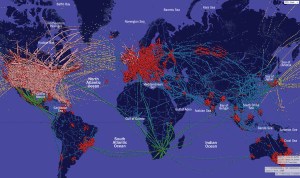
Other leading solutions providers, such as Rockwell Collins’ ARINC AviNet, provide a robust system architecture to ensure that all mission critical messaging is delivered swiftly and reliably while maintaining seamless security on a global scale.

Many carriers also realise that a reliance upon the latest technology is clearly the way forward.

Find Out More About the Technical Advantages of Seamless Aviation MessagingEurocontrol have deployed the second phase of Variable Division Flight Level (vDFL) following the successful implementation in eastern airspace managed by Maastricht Upper Area Control Centre (MUAC). The concept will now cover further into western airspace covering Holland and Northwest Germany.

The deployment of vDFL is the first phase of the introduction of the Single European Sky initiative (SESAR) and is set to improve efficiency of Air Traffic Management through reliable messaging and streamlining of operations across the aviation industry.

As the airways grow busier, messaging providers are supporting a need for greater flexibility for the ATM system. Choosing seamlessly reliable aviation messaging over a robust network, such as Rockwell Collins’ ARINC AviNet is the way forward into the future of commercial and business aviation sectors, improving safety and helping operators to manage spiralling costs.