Archive

Tag Archives: aviation news

Rockwell Collins' Bag Drop technology in action | Business Aviation NewsA two-phase project at Dublin Airport has seen a dramatic reduction in passenger check-in times with the introduction of Rockwell Collins’ ARINC vMUSE, self-service kiosks and the latest bag drop solutions.

Frances O’Brien, VP PMO at DAA (Dublin Airport Authority), spearheaded a campaign to streamline airport operations to address the challenges she recognised within the airport. Speaking about the implementation of CUPPS by Rockwell Collins in 2015/16, she said, ‘We worked with Rockwell Collins to implement systems that enable our airlines to share workstations, helping us make the best use of our current resources. As we embarked on this new initiative, our existing relationship plus Rockwell Collins’ extensive industry expertise made them the right partner for us.’

The first phase of the project began in December 2015, with the introduction of 19 Common-Use workstations. This quickly expanded to 64 units through spring 2016 with no issues, described by O’Brien as ‘a painless process.’

The self-service bag drop stations now number 20 in Ryanair’s hub, Terminal 1, and 16 in the Aer Lingus check-in area in Terminal 2. Jim Rogers, the Aer Lingus bag tag and drop off project manager said, ‘Some of our guests have told us that this technology is a key differentiator on whether they would fly with Aer Lingus again. Our fleet size is increasing by about 10 percent this year, and this type of technology allows us to increase throughput without capital expenditure on building and facilities.’
Munich Airport Aims for Carbon Neutral Status by 2030 | Business Aviation BlogGermany’s Munich Airport has detailed a €150 million plan to reduce its carbon emissions directly by 60% over the next 17 years.

The Bavarian State Minister for Finance, Regional Development and Home Affairs, Dr Markus Soder said, ‘With this target we are underscoring the enormous importance attached to climate protection by the airport and the Bavarian state government.’

Dr Soder, who is also chairman of the supervisory board for Munich Airport, is keen for the airport to become a ‘trailblazer for all of Germany.’

The plan contains many fine details, including increased reliance of renewable energy sources, electromobility within the vehicle fleet, LED runway lighting and intelligent control technology.

Dr Michael Kerkloh, CEO of Munich Airport, spoke during the launch of the CO2 strategy of the continuation of the current efforts the airport already makes towards climate protection, ‘As Europe’s first five-star airport, we also set very high standards for climate protection. With our far-reaching climate targets, we want to help ensure that the airport’s operations and ongoing development are pursued in ways that preserve the opportunities and possibilities of future generations.’

The remaining 40% CO2 emissions will be offset at regional level against certified projects.

Alaska Air Group Acquires Virgin America | Aviation NewsIt has been announced, just one week after the deal was given approval by regulators, that Alaska Air Group has closed the acquisition of Virgin America for the sum of $4 billion.

It has not been decided whether Alaska Air will retain the Virgin America brand, but this is expected to be revealed within the first quarter of this year.

Alaska Air Group notes that the consolidation of one of its biggest competitors will enable them to compete more effectively with the other major carriers that between them handle 84% of air traffic in the U.S. – Delta Air Lines, United Airlines and American Airlines.

According to a statement from Alaska Air Group a few days ago, ‘Alaska Airlines and Virgin America will spend the next year working to secure Federal Aviation Administration certification to allow the two airlines to operate as a single carrier.’ The group hopes to achieve certification by 2018.

The merger will give Alaska Air and Virgin a fleet of 286 aircraft, operating almost 1200 daily flights to 118 destinations across the U.S., Canada, Costa Rica, Cuba and Mexico.

Automated Check-in Agreement | Rockwell Collins and Falcon AviationFalcon Aviation, based in the UAE at Al Bateen Executive Airport, delivers a range of services to clients throughout the Middle East, including charter of helicopters and private jets, aircraft maintenance and management services and flight support. It also provides an authorised service centre for Embraer and Airbus Helicopters, a warranty service centre for Gulfstream and is a founding board member of the Middle East Business Aviation Association (MEBAA).

The implementation of Rockwell Collins’ ARINC LocalCheckSM Local Departure Control System (L-DCS), improves the efficiency of check-in and boarding processes through automation of key processes, such as passenger processing, baggage tags and passenger reconciliation.

Captain Raman Oberoi, Falcon Aviation, said, ‘Over the years, Falcon Aviation has become synonymous with safety, quality and excellent customer service. We have built a reputation for delivering high-quality products and innovative services to our loyal customers, and Rockwell Collins’ airport solutions are helping us deliver on that promise.’

Paul Hickox, head of Airport Systems Sales at Rockwell Collins, said, ‘Rockwell Collins airport solutions are used throughout the world to help airports improve efficiency and enhance operations. This win is an excellent example of how we can tailor our solutions to meet the requirements of both large international airports as well as smaller regional airports and private business terminals.’

Australia Ramps Up Border Control | Automated Border ProtectionIt has been announced that a major project to install automated border control e-gates in 8 airports across Australia has been completed.

A total of 83 e-gates have been installed since the project began last year, and already more than 10 million travellers have successfully passed through.

The Australian government committed to the project to ensure border control processes were not only efficient, streamlining Advance Passenger Information processing and reducing the time taken to process passengers, but also enhanced border protection at the country’s international checkpoints.

Peter Dutton, the Australian Minister for Immigration and Border Protection said, ‘This milestone delivers on the Australian Government’s commitment towards streamlined border control processes and enhanced border protection capability at our international airports. [This technology is] critical to improving our ability to accurately confirm the identity of travellers.’

Smart device apps making airports efficient | Aviation Industry NewsAs airline passenger numbers continue to increase around the world, airports are making sound investments in apps to assist passengers with self-service and automated solutions to make the processes of check-in, security and baggage handling easier. Airports are realising that these investments are already paying off in increased passenger experience and in the increased efficiency for the airport operator.

Common-use check-in and bag drop desks have been operating in global airports successfully, and with an estimated 80% of passengers now checking-in online using smart devices and their desktops, the introduction of apps has further streamlined the entire process of checking-in. Airports are also able to provide additional travel information to passengers via these innovative applications, which is another way travellers are gaining even greater control of their journey, increasing passenger satisfaction significantly.

Large airport services providers, such as Rockwell Collins, deliver technological advancements that enable airport operators to achieve greater efficiency across the airport environment, with solutions such as automated check-in kiosks, bag drop facilities and more common-use applications that can be accessed directly from smart devices. The addition of ARINC ExpressDrop has given airports the opportunity to address off-site baggage handling, further adding to efficiency, and helping to reduce waiting and queueing times.

As air travel continues to increase by an average of 5% every year, self-service passenger processing innovations seem an obvious path for airport operators to take.

Vladivostok International Airport Acquired | Aviation NewsIt has been announced that Russian Vladivostok International Airport has been acquired by a consortium, including Basic Element, the Russian Direct Investment Fund (RDIF) and Changi Airports International (the investment arm of Changi Airport).

The consortium aims to ‘create a high-tech aviation facility’ to raise standards in the region and to create a key hub. Already, the consortium has begun to expand the airport’s route network, and believes that the location of the airport is ideal to become the ‘gateway between Russia and the Asia-Pacific’.

Changi Airports International CEO, Lim Liang said, ‘Together with our partners, RDIF and Basic Element, we will develop Vladivostok International Airport as one of the best air hubs in the region with strong air connectivity and top-class service – two of our priority areas. We will showcase the uniqueness and vibrancy of Vladivostok and Russian Far East to the rest of the world through the airport, and open up this region to the vast opportunities in international trade and tourism.’

POD Point and Airparks EV Charging Points | Airports NewsElectric vehicle (EV) charging stations are soon to be operational at Birmingham and Luton airports, and will be free to use for drivers of electric vehicles using the car parks. These will become the first off-airport parking facilities to offer free vehicle charging.

The airport car parking facilities, run and managed by Airparks, will see the EV stations installed by POD Point, the leading provider of electric car charging units in the UK. Erik Fairbairn, CEO of POD Point noted that ‘this is a move that simply makes sense for all parties.’ Continuing, he said, ‘It not only gives EV drivers a clear destination of choice for knowing their car will be secure and well managed while away, but also peace of mind of knowing that whatever time of day they land back, their car is charged and ready to go.’

Airparks, the latest partner for POD Point, is proud to be the first off-airport car park to offer the free facility. Andrew Bird, GM at Airparks said, ‘We’re committed to constantly evolving our products to benefit our customer’s needs; and this new service means that people driving electric vehicles can use Airparks’ car parks and return from their trip to a fully charged vehicle. The EV market is growing year on year and we hope that Airparks will be the car park of choice for EV owners flying from Birmingham and Luton.’

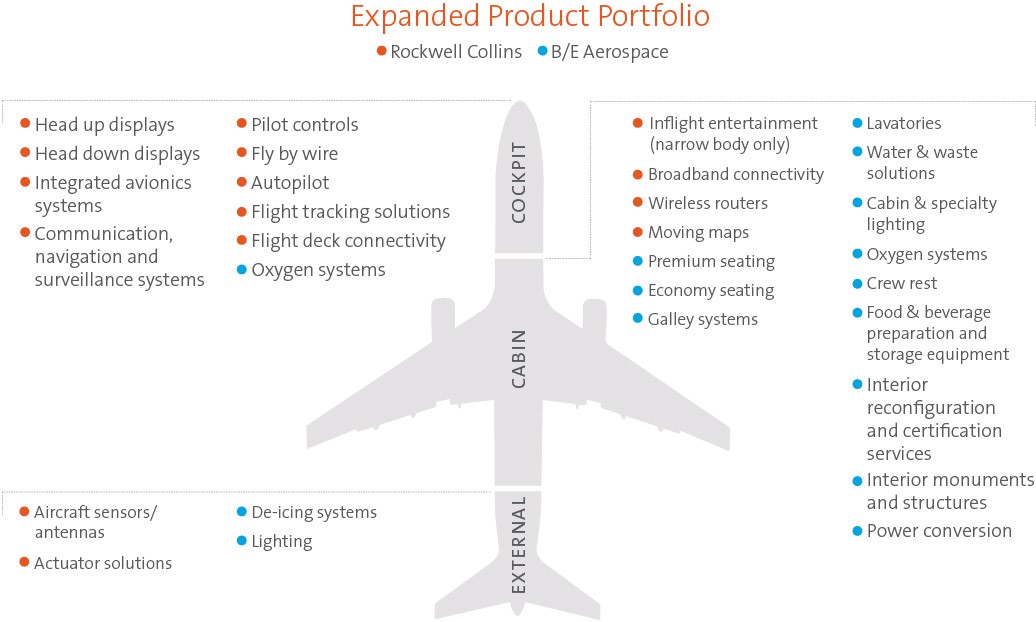
Announced on October 23, Rockwell Collins is set to further expand its cockpit and cabin solutions product portfolio with the acquisition of B/E Aerospace for the sum of $8.4 billion.

B/E Aerospace began life in 1987 as Bach Engineering, and has enjoyed success since then, expanding with acquisitions such as EECO Inc, PTC Aerospace Inc and Aircraft Products Gallery, changing its name to B/E Aerospace Inc in 1992.

Its strong position in the cabin interiors sector has spread to aerospace consumables and logistics, distribution and energy services.

Growth since its inception in 1987 has been significant, and B/E Aerospace now employs more than 10,000 personnel over 35 facilities around the world.

Acquisition of B/E Aerospace will add value to Rockwell Collins’ considerable portfolio, as the image below demonstrates.

Rockwell Collins Expanded Product Portfolio | B/E Aerospace

Gatwick airport runway expansion | Business Aviation BlogAccording to a UK government poll, around 63% of London councillors are prepared to support Gatwick airport’s plans for expansion, compared to just 44% for Heathrow.

The announcement from Gatwick, who has also pointed out that it will require no public funding, unlike Heathrow, comes as both airports reiterate that a new runway is necessary for the UK since the Brexit result has continued to damage the country’s economic position.

Gatwick and Bechtel can deliver second runway by 2025

Gatwick airport has also announced that it is ready to deliver its second runway by 2025, following a strategic partnership with Bechtel, one of the world’s longest-standing, respected engineering companies, who work with clients to increase economic growth.

If the UK government give the go-ahead to Gatwick, the expansion project can begin almost immediately, with significantly lower environmental impact, and lower financial risk.

Bechtel’s Amjad Bangash, general manager for infrastructure said, ‘We are delighted to be confirmed as Gatwick Airport’s partner for the second runway programme. We have provided Gatwick with robust plans for a second runway and are confident that this low risk project can be built to the highest quality, safely and sustainably – and that it can be operational by 2025.’