Archive

Tag Archives: aviation industry

Following alarming claims made by German IT Consultant, Hugo Teso, regarding his ability to ‘hack’ into navigational systems of aircraft, using only an Android app, the FAA and the EASA have issued statements to the contrary; neither feeling that his claims pose any real threat to flight safety.

According to Information Week, the FAA state that it “is aware that a German information technology consultant has alleged he has detected a security issue with the Honeywell NZ-2000 Flight Management System (FMS) using only a desktop computer,” and adds that the app does not, “pose a flight safety concern because it does not work on certified flight hardware.  The described technique cannot engage or control the aircraft’s autopilot system using the FMS or prevent a pilot from overriding the autopilot,” and says that, “a hacker cannot obtain ‘full control of an aircraft’ as the technology consultant has claimed.”

Teso claims to have carried out research, using the Android app in a closed, PC-based system with simulation software.  He alleges that flaws in the Honeywell NZ-2000 Flight Management System, particularly in the navigational security systems, would render it simple to use on a live aircraft to perform ‘tricks’, such as letting the oxygen masks fall from overhead.  On a more serious note, Teso goes on to allege that he could just as easily use the app to crash the plane into another aircraft during flight, which has, understandably, caused much panic in the aviation industry and public alike.

The European Aviation Safety Association (EASA) issued the following statement, “There are major differences between PC-based training FMS software and embedded FMS software.  In particular, the FMS simulation software does not have the same overwriting protection and redundancies that is included in the certified flight software.”

Airline passengers across the world will be relieved to learn that Hugo Tero won’t be releasing details of his exploitation methods and will be working with aviation governing bodies to make sure that the systems are updated if it is proved necessary.  The FAA and EASA cannot fully reassure concerns, however, as it remains to be seen whether the hack is a software issue or due to redundancies built into the systems, which, if proved, could lead to resourceful hackers finding other exploits or loopholes in the systems.

ARINC Cabin ConnectA new Ka-Band delivered high-speed broadband service was on display for the first time for visitors to the Hamburg Aircraft Interiors Expo last week.  GX Aviation, launched by Inmarsat, will be supported by new avionics developed by Honeywell and will be commercially available in early 2015.

Jack Jacobs, Vice President of Marketing Product and Management, Honeywell Aerospace said: “The consumer demand for fast, global in-flight connectivity continues to grow at a monumental rate. People want to be connected no matter where they are and have the same Internet experience that they have at home.”

The world-leading satellite communications company, Inmarsat, plans to change the face of in-flight connectivity with GX Aviation, designed to provide throughputs of up to 50Mbps with uninterrupted global broadband coverage, offering like-for-like, ground-based comparative connectivity.

“The world is changing and airlines are seeking to keep up with passengers’ expectations. Our new GX service, which can be combined with our existing L-band solution, enables airlines to capitalise on already installed hardware to provide high speed broadband service with complete geographical coverage for all aircraft requirements, both in the cockpit and the cabin,” says Inmarsat’s Miranda Mills, Vice President of Aerospace.

The in-flight wifi debate continued last week as service providers all have a different approach to bandwidth.

Bill Sullivan, Director for Strategy and Business Development at ViaSat, commented, “People value speed, whether at home or in mobile environment. We have built a system around a very high speed experience. So we are taking that and bringing it into the airline sector.”

However, not everyone agrees that speed is the answer, especially when in-flight wifi provision is so expensive.  Row 44’s John Guidon argues,

“Just talking about speed is not satisfactory. It doesn’t explain the totality of the experience,” adding, “Really people are most interested in, in my opinion, page load time.”

There is no doubt that connectivity for in-flight wifi is in demand.  It is not a question of whether aircraft need it; it is now an account of which service to choose.  Ka-band wifi will provide speeds of at least 12Mbps per passenger, with even faster speeds being achieved with Ku-band or satellite in-flight wifi operations.

Most airlines recognise passengers’ growing demands for in-flight wifi and with the buzz created by the different broadband connectivity providers, the market is exploding.

Flights Resumed After Jet2 Agree to Use Alternative RunwaysThe airline Jet2 suspended flight operations from Belfast International Airport for two days, following concerns over the delay of maintenance issues on the main runway, due to the recent bad weather.  Jet2 had reported engine-related problems on three occasions, but there was no evidence to suggest it was related to the runway.

Despite assurances from the Civil Aviation Authority (CAA), Jet2 switched flights to George Best Belfast City Airport and City of Derry Airport instead.

Belfast International Airport agreed to investigate their concerns, but Jet2 was the only airline to suspend flights or report any issues.

The company apologised, saying, “We would like to apologise for the inconvenience this has caused, however the safety of our customers is of paramount importance and we will not operate from Belfast International Airport’s main runway until the resurfacing has finished.”

Jet2 agreed to resume flights, using the airports’ alternative runway two days later.

They issued a statement that said, “This decision follows close consultation with the airport and a detailed safety assessment conducted today (Tuesday).  All our customers due to travel from Belfast International this week should go to the airport as normal.

Following the success of ARINC’s development and introduction of their ground-breaking flight planning app for the iPad, yet another contender enter into the marketplace.  WSI are the latest company to launch a weather and flight planning app.

Named WSI Pilotbrief, the General Aviation and Flight Planning app is iPad specific and is set for launch at the Sun N Fun annual event in Florida this year.

ARINC developed their industry-leading iPad application for ARINC Direct after figures showed that more than half of their business jet aviators were accessing their accounts using the tablet device.

A valuable tool, the app integrates into the flight planning process, assisting pilots and increasing efficiency for effective, real-time operations.  Using the flight planning app, pilots are able to access up-to-the-minute weather data and geographical information, in addition to fuel burn data, ETA and flight tracking with sharing capabilities via iCloud networks and Bluetooth connections.

Pilots Asleep in the Cockpit Over LondonShould the public be concerned about the occurrence of Pilots falling asleep ‘at the wheel’?

Not according the the CAA, who say, “The evidence the CAA has is that the fatigue of crew is not a significant safety concern.”

This follows the release of data after a request to the CAA for ‘Freedom of Information’ revealed that pilots had dozed off during flights over London in June 2010 and June 2011, one having to be shaken awake after a colleague was locked out of the cockpit.

Pilots blame long hours and fatigue caused by unrealistic rostering, which is set to grow worse if the proposed change in European law is passed, expecting them to work extra hours and extend overnight flying.

Dr Hunter, head of flight safety at Balpa said, “A pilot falls asleep on the flight deck on a UK-registered airplane at least once in every 24 hours – and probably a lot more than that.”

This alarming statement is not backed up by figures, but with a two year prison sentence attached to falling asleep in the cockpit, Dr Hunter estimated that pilots would rarely report themselves, as they would be “writing the evidence for their own prosecution”.

The International Atomic Energy Agency (IAEA) recognise the important roles that non-nuclear weapon states, such as those in Africa are playing in shaping and enhancing nuclear security, in spite of development challenges that they face and rising economic issues.

At the forthcoming, and probably penultimate, Nuclear Security Conference in July this year, with the last of three summits planned in the Netherlands in 2014, the IAEA hosts will have a chance to strengthen its corroborative role with states to enhance their capacity for nuclear security and will provide an opportunity for stakeholders to have their say, proving input into the agency’s Nuclear Security Plan for 2014-17.

This is good news for African states in particular, as they have had little chance to participate in global nuclear security debates as the international community continually search for a channel in which to encourage the nuclear security agenda forum in a more fundamentally inclusive way.

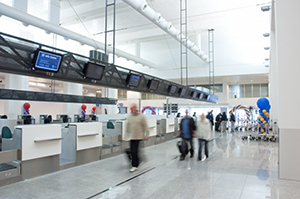
Passenger ProcessingStarting with Honolulu Airport, Hawaii say they are the first in the U.S. to move to completely automated self-baggage tagging with their new multi-airline check in kiosks.

Provided that Hawaiian passengers have self-printed boarding passes, they will be able to weigh, tag and check-in their baggage, leaving airport staff more time to assist passengers with oversized baggage or those with special needs.  This system will greatly reduce waiting time and streamline airport operations.

“Every minute saved in the check-in process improves our customers’ experience substantially, so this is a significant enhancement,” said Hawaiian’s Vice President for Customer Service Louis Saint-Cyr. “The kiosks reduced our customers’ check-in time to eight minutes. The ability to self-tag bags reduces the check-in time even further — by nearly half.”

There is a range of multi-airline check-in services out there, including the ARINC solution, vMUSE, and offering multi-airline check-in and bag drop facilities within an integrated suite of applications.  The vMUSE option maximises airport operations, eliminates the necessity for costly upgrades and gives smaller airports the flexibility of utilizing precious counter space.

ARINC offer interoperability with vMUSE solutions, using existing CUTE systems technology, allowing seamless operations for multi-airline check-in, self-printed boarding passes and bag drop facilities from an industry-leading, reliable provider.

Seal Dynamics, a division of Heico Aerospace will use ARINC’s AviNet mail from now on for all their critical Type B messages.

Seal Dynamics stock, manufacture and sell millions of components for the aviation industry, processing hundreds of orders each day.

It is important for them to ensure highly reliable and fast communication of these orders, often consisting of urgent replacement parts from their diverse range of products, to minimize delays or ground-time for their aviation partners – a costly exercise.

ARINC are world-leaders in communications solutions, serving hundreds of aviation businesses and handling millions of critical Type B messages every day.  AviNet mail is capable of delivering mission-critical Type B messages within one second and is the most reliable in the industry.

Type B messaging is used by aviation companies to deliver global mission-critical communications for a number of reasons, such as replacement aircraft components, weather data, flight planning and passenger reservations.

“We chose ARINC’s AviNet Mail because it provides us with high message reliability, ease-of-use, accessible support, alternative methods for accessing Spec2000 messages and on-demand traffic analysis,” said Vice President of Technology at Seal Dynamics, Marc Alter.

Yun Chong, ARINC Vice President of Global Network and IT Solutions, said “ARINC values the opportunity to serve a recognized market leader and we look forward to a long and mutually beneficial relationship.”

It was recently reported in the latest release of the Wingx Business Aviation Monitor that business aircraft flight departures fell by 10% in Europe over the past year.  The figures reflect a major decrease over the year, mostly due to March 2012’s strong figures, as March 2013 showed 20% more activity than February 2013.

The Euro Zone financial crisis has been blamed for the major decrease, as there were increases in flights from the Middle East, BRIC countries and East and West Africa.

Christoph Kohler, Managing Director of WINGX Advance, said, “March analysis indicates a slump which was certainly precipitated by further Euro Zone tensions, especially affecting demand in Germany. The overall picture is gloomy, but there is growth, in selective aircraft types and on specific routes.”

Growth was recorded, however, in the Russian Federation, Norway, Turkey and the Ukraine with a couple of activity spikes in Malta and Cyprus.  The relatively small business aviation market associated with Ireland also saw an increase.

Piston activity was badly hit, being 27% down over the year, business aviation charter activity coming down by 6% compared to March 2012.

This comes as business aviation services become more affordable to the sector and surprisingly the largest drops were felt by smaller aircraft, such as Cessna, Beechcraft and Piper aircraft, while the industry experienced a rise in usage of Ultra-long range, Bizliner and Heavy Jets.