Archive

Tag Archives: aviation industry

Pioneering Providers of ACARS Messaging It has been announced that the aviation regulator for India has issued a mandate for airline crew to be given training on the ACARS system, following the disappearance and issues surrounding flight MH370.

ACARS delivers and receives mission critical messaging throughout the flight, unless manually deactivated. These messages may include NOTAMs, OOOI, engine information and aircraft performance figures, including air speed, issues, position and weather reporting.

Currently, the only area where ACARS coverage is mandatory is within the North-Atlantic route.

Although some Indian airlines have incorporated ACARS into their aircraft, with the largest operator, IndiGo having used ACARS from their earliest flights, several airlines do not have ACARS capability. Murmurs around the aviation industry suggest that every flight should carry the latest that technology has to offer for mission critical messaging.

Aviation Security Messaging ConcernsThe recent disappearance of Malaysia Airlines flight MH370 has raised global questions about the effective use of aviation security messaging for both aircraft communications systems and passenger data transfer.

The International Air Transport Association (IATA) suggest that a more refined, tailored approach to security messaging is needed, as current measures appear to be unsuitable in a general sense. With the technology available today, such as biometric security and electronic passports, information can be shared in real-time, allowing passengers to be screened more effectively.

Although the mysterious disappearance of the Boeing 777-200ER has encouraged tighter security in airports across the world, questions are being asked why passengers were allowed on board with stolen passports, whether the incident is linked to the disappearance or not, as has been speculated.

The aircraft’s communications systems were allegedly switched off intentionally and continued to ‘handshake’ with the satellite network, Inmarsat until 8.11 am, when over the Indian Ocean and low on fuel.

Finding a balance when conducting security measures means treading a fine line. Security within airport operations should work in conjunction with border control agencies and government bodies to ensure that security should be tight, but effective, without causing major ground delays.

Airport operations software can help to streamline passenger processing, while maintaining high biometric screening levels and allowing passenger data to be checked, such as with the provision of advance passenger information, now mandatory in the U.S. since the events of 9/11.

Airport Processing Technology - In-Cloud SolutionsAmadeus, European technology firm, has revealed their latest airport platform, designed to focus upon next-gen passenger processing and integration for airport operations.

The common-use system will bring cost effective solution for airport management with an opportunity to lower operational expenses, improving flexibility with simplified messaging and passenger processing capabilities.

With the cloud-based software-as-a-solution (SaaS) system, airlines and ground based operations are able to share both space and resources without costly hosting, development or infrastructure expenses.

John Jarrell, head of airport IT for Amadeus said, “The airport industry has advanced tremendously from the days of dedicated airline check-in desks towards a much more flexible and shared environment.”

ARINC Solutions for Information Management & Passenger Processing Rockwell Collins have been awarded a five-year contract to place ARINC’s vMUSE in four common-use terminals at London Heathrow Airport (LHR). The contract was awarded through Heathrow AOC Ltd on the strength of Rockwell Collins’ recent acquisition of ARINC Inc. LHR will upgrade their current ARINC MUSE platform in terminals 1,2 and 3 to the latest vMUSE implementation and will install a new system in Terminal 4, supporting more than 1,500 common-use workstations.

The upgrades will bring the latest CUPPS standards, offering airlines and LHR greater efficiency and cost management opportunities. The vMUSE platform allows the extension of CUPPS support to off-site locations and is a scalable solution for baggage drop and information management systems.

“As one of the world’s busiest airports, Heathrow must utilize the most effective passenger processing technologies available,” said David P. Wilding, chairman of the AOC Shared Systems Board. “The ARINC system enables us to meet the needs of our member airlines by improving the efficiency and flexibility of passenger processing, which ultimately enables us to provide the best customer service possible.”

“We’ve been working with LHR for many years, and are delighted that the AOC has decided to renew and expand its relationship with us,” said Tony Chapman, executive director, Heathrow for Rockwell Collins’ Information Management Services business. “As passenger traffic continues to grow, we remain committed to providing airlines and airports of all sizes with the most efficient solutions available to meet passenger demands.”

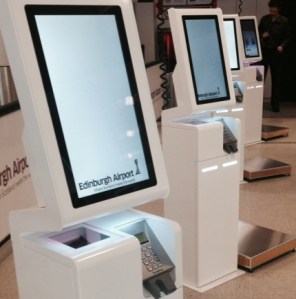
Single Bag Drop Solutions for Multi-Airline UtilisationEdinburgh airport has become the first to bring multi-airline bag drop system operation to the UK in a move that has seen them install ten, new self-service kiosks and web-based software that operates a fully common, shared bag drop facility for its passengers.

Operated by EasyJet and FlyBe, passengers will retain control of their entire check-in experience, from online check-in and self-printed boarding pass to baggage weigh in and luggage tag attachment, when they will be directed to a drop off point to dispatch their luggage.
Although new to Edinburgh and the UK, this system is in operation in CUTE platforms across the world and is designed to streamline airport operations. Using common-use functions for bag drop system operation speeds up the check-in process and allows cost-sharing within the terminal, also freeing up premium space.

This is just the beginning for Edinburgh airport, as they plan to continue a programme of investment for the installation of the latest technological solutions. Later this year, they plan to carry out a trial for a baggage storage facility, where passengers will be able to check-in luggage in advance of the flight.

David Wilson, chief operating officer at Edinburgh Airport, says: “New ownership has allowed us to be creative in the way we look at the check-in process. A huge amount of research, engagement and investment has gone into this new process and we’re delighted to officially launch the first multi-airline common bag drop facility in the UK with our partners at easyJet and Flybe.

ARINC Direct Business Flight Support ServicesAs Rockwell Collins see the business aviation industry growing, it makes sense that after its acquisition of ARINC Inc was finalised late last year, that the business aviation division, ARINC Direct brands and Rockwell Collins applications would gel perfectly in the business flight support services sector.

Rockwell Collins formed the Information Management Services division in January, placing Jeff Sanderski in the senior vice president role. It is a worldwide operation with offices in London and Singapore in addition to the HQ in Annapolis and a further US office in Houston with a total of 2,200 employees.

Around 22% of the business for this division lies in business aviation – a figure that Mr Sanderski sees growing as more private jet aircraft continue to be fitted with Rockwell Collins/ARINC Direct applications, including air-ground voice and data, ground-ground networks and business flight support services.

capitol-place-1-964706-mThe U.S. Senate met this week to discuss a warning from the aerospace and aviation industry that the upcoming expected wave of retiring aviation professionals could damage the industry within the next five years if the Government does not help more young people to train and qualify for these jobs.

Although there are sponsored training courses springing up across the industry, fears that global competitors could steal the show are growing within the U.S. industry. Regulatory issues, the need for an updated infrastructure and workforce development were some of the topics that were raised at the meeting.

Edward Wytkind, president of the Transportation Trades Dept at AFL-CIO warned that the FAA will face similar staffing issues, “One third of the (FAA) workforce, including controllers, inspectors and systems specialists are eligible to retire. This is unsustainable and must be addressed because we believe it’s going to not only impact operations for the airline industry, but also the safety of the system as you see this brain drain of high-quality people retiring and we’re not hiring and replacing them fast enough,” he said.

Boeing’s Dennis Muilenburg told the Senate Subcommittee on Aviation operations, safety and security, “If we look at demographics of our workforce across Boeing and much of the aerospace industry, about 50 percent of our top engineers and mechanics will be eligible to retire over roughly the next five years.” Officials have added that encouraging schools to push science, math and technology-based subjects could help to create a new generation of engineers for the future, albeit even then, still putting pressure on the aviation industry jobs sector.

Muilenburg said, “We have about 4 million children entering kindergarten this year. At current rates, that would produce about 60,000 to 70,000 engineers at the end of college. That’s not even enough to satisfy the aerospace industry, let alone all sectors that need engineers.”

With the predicted rises in air traffic and passenger demand hitting new highs, the need is becoming more urgent for a skilled and experienced workforce in the coming years if the aviation industry is to cope.

New Eclipse 550 Business AircraftDescribed by its CEO, Mason Holland, as a ‘game-changer’, the Eclipse Aerospace delivered the first of its new Eclipse 550 to Albuquerque, New Mexico this week to the delight of the company’s European dealer, non-executive chairman of Aeris Aviation, Bruce Dickinson of Iron Maiden fame.

Mr Dickinson, who believes strongly in the Eclipse 550 as the ‘only VLJ’ on the market, said, “In essence it is a two-hour aeroplane. You can stick pretty much anything you want in it and go for two hours. The same is not true for other alleged VLJ’s that weigh a lot more and cost a lot more to operate.” A accomplished private jet pilot and joint-CEO of Cardiff Aviation, Mr Dickinson joined Aeris Aviation to promote sales of the Eclipse in October last year and underwent his type-training while piloting himself to Iron Maiden concert venues in an Eclipse.

Certification has just been achieved from the FAA for the Eclipse 550, a beautiful aircraft that began its production journey in June 2012, and has been described as ideal for those wishing to upgrade from turboprop or pistol aircraft.

Mr Holland said it was an exciting day for Eclipse Aerospace and for general aviation, “With the Eclipse 550, we’ve built a high-performance light jet that includes advanced technology and safety features that have traditionally been found only on much larger cabin-class business jets and commercial aircraft.”

More About Advance Passenger InformationIt has been revealed that as many as 20 million passports per year may not be receiving proper consideration in the UK alone. These shocking figures come as the Home Office estimated that only 90% of Advanced Passenger Information (API) is being received. API is passenger data that is electronically gathered and transmitted to government and border agencies for checking and comparison to international ‘at risk’ registers. API can detect high risk passengers on ‘no-fly’ lists across the world and can ensure that terrorist activity is kept at bay.

If these estimates tell us that 10% of UK API is not being received, this could spell an average of 20 million passports that are not being checked properly. Interpol say that countries are not doing enough checks against its list of stolen passports. Globally, this figure could reach up to one billion passengers; a disturbing figure.

API is mandatory for all passengers travelling to and from the US and has been so in the wake of the official investigation into the tragic events of 9/11. Last year, the EU questioned the use of API with regard to the privacy aspect and raised issues about the use of the information, once gathered and checked.

Once reported stolen, UK passports are cancelled and deemed unusable for travel. International stolen passports are entered into the Interpol Lost and Stolen Database, accessible by border security agencies for comparison.

The Home Office are looking into the figures to clarify the situation and are working towards improving coverage.


Other Baggage Handling Systems ProvidersAs demand increases at Stockholm-Arlanda Airport, with a record that reached almost 21 million passengers last year, the decision has been taken to upgrade the baggage handling system in terminal 5. The upgrade plan will include the integration of Septembers’ mandatory standard two screening and it is hoped that the current baggage handling system will continue to operate to keep disruption to a minimum while work is being carried out.

Stockholm-Arlanda is managed and operated by Swedavia, who have awarded the upgrade contract to Crisplant, a part of the Beumer Group who provide baggage handling systems and logistics solutions. The company have been selected to extend the tilt-tray sorter in terminal 5 in addition to the upgrade of the control systems within the terminal building.

Baggage handling systems can help to streamline the passenger processing system and therefore, with careful integration, can help to maximise productivity, particularly during peak times and busy periods. With demand expected to continue rising, it makes sense that expediting the check-in and baggage handling process is necessary to avoid costly ground delays for both passenger experience and airport management.