InFlight Broadband by Cabin Connect

Last month we heard that ARINC was teaming up with Panasonic Avionics on offering its new Inmarsat SwiftBroadband-supported in-flight wi-fi solution, Cabin Connect, with some of the IFEC giant’s products.

“We’ve been talking to Panasonic for a long while about different ways that we can work with them. We are really looking at [having] options where we integrate with them. Or there is another option that [sees a] configuration where we connect directly to the satcom so that we can sit alongside the in-flight entertainment,” David Harrold, an executive with Arinc, told ATI at the Airline Passenger Experience Association (APEX) conference and exhibition in Seattle.

Unveiled at APEX, Cabin Connect is being billed as a simple connectivity system that allows airlines to easily and inexpensively bring in-flight wi-fi to passengers, since many aircraft already carry the lion’s share of necessary kit or will do so in the future.

At present, SwiftBroadband offers a data transfer rate of up to 432kbps per channel. However, Inmarsat has an upgrade path for the service, which will be implemented at the end of next year and bring the speed to 700kbps.

Arinc, meanwhile, is also “doing a number of things to improve the service”, including compressing the data going through the SwiftBroadband pipe, said Harrold

He added that, on the ground at Arinc’s data centre, the company is putting a “large amount of computing power” at the issue of speed “so in real time, we are making the images a bit smaller [and] blocking some of the adverts”, a service that is customisable to the airline’s needs and requirements.


This week we heard that digital data messaging between pilots and air traffic controllers is scheduled to begin replacing voice-based communications in U.S. airspace in the next three years.

A multifunction control display unit in aircraft cockpit shows a controller-pilot datalink communications (CPDLC) message. (Photo: FAA)

The data communications program is considered one of six “transformational” programs leading to the Next Generation Air Transportation System (NextGen).

Data messaging for air traffic services is expected to improve controller productivity and reduce workload by automating delivery of routine clearances, freeing controllers to handle increased traffic. Safety will be enhanced by reducing misunderstandings and radio congestion arising from voice communications. Data communications are integral to the networked, data-centric vision of NextGen.

The chosen contractor will provide ground-to-ground and air-to-ground segments of a data network between FAA air traffic service points and data comm-equipped aircraft. In the DCIS solicitation, the FAA said it expects the contractor to use one or both of the current commercial providers of air/ground communications–a reference to Arinc and SITA–to provide a VHF Digital Link Mode 2 (VDL-2) datalink for air traffic services that also accommodates aircraft communications addressing and reporting system (Acars) messages.

Acars is used mainly for data communications between an airliner and its operations centre.

ARINC has been providing flight deck communications to the commercial industry for over 20 years – tailoring it to individual needs and operational preferences.

Over half of the world’s business jets rely on ARINC for their air-to-ground communication needs. From the value and reliability of ARINC’s SATCOM and Iridium-based solutions, to the proven industry-standard ACARS and expanded capabilities of VDLM2, to ARINC’s expert Air Traffic Services (ATS) and world-class weather graphics technology – ARINC Direct goes above and beyond to ensure airlines have communications they can always trust.

More information about ARINC’s business aviation communications services can be found at www.flight-planning.aero.

Aircraft Safety Improved 50% in 2011

Aircraft Safety Improved 50% in 2011

This week we heard in the news that global airline safety rates, covering total crashes and passenger deaths, have improved by nearly 50 per cent this year over the first 11 months of 2010..

Total fatal accidents up to November 30 were 22, causing the deaths of 486 passengers and crew. Last year’s totals were 23 and 786. In 2006, 855 people died in 20 crashes.

All world regions including Africa, long one of the most dangerous for air travel, have this year seen a proportional drop in fatalities and plane losses — with the lone exception of Russia and countries linked to it in the Commonwealth of Independent States (CIS), IATA said.

“As of the end of November, the global safety performance (of the industry) is at the best level recorded, and is 49 percent better than the same time last year,” IATA senior vice-president for safety Gunther Matschnigg told reporters.

One of 2011’s most high-profile Russian air disasters was September’s crash at Yaroslavl, on the Volga north-east of Moscow, which killed 45 passengers, including the 37 members of the local Lokomotiv ice hockey squad.

Matschnigg, speaking at IATA’s annual briefing for journalists covering the industry, said a key problem in Russia was that pilots and ground technicians were having to adapt to a growing number of highly sophisticated aircraft.

The IATA safety chief credited the seven-year-old programme, which provides for thorough and regular checks on all aspects of flight security and aircraft maintenance as well as training of personnel, for the major improvement in Africa.

Last week the European parliament approved a new deal offering the passenger name records (PNR) to be transferred to Australia within data protection laws, helping with airport security and anti-terrorism names. The agreement, set to last for 7 years, will allow the Australian government to keep passenger data for five and half years.

Advance Passenger Information (API), is obligatory in the USA and all EU member states. Increasingly it is being required by governments around the world. Combined with Passenger Name Records (PNR), this information must be sent to the destination country’s border security department for passenger screening, crucial for effective border management.

PNR data is collected by airlines and includes passengers’ personal information, passport numbers and credit card details. After 3 years personal identifying data will be marked out.

PNR data will be kept in the system for the purpose of preventing, detecting, investigating and prosecuting terrorist offences or serious transnational crime. 

Passenger Data transfer services are usually provided by a third party to the airline. Services such as AviSec Data Transfer by ARINC Direct ensure that data is transferred flawlessly and cost effectively for the airline. Failure on the part of the airline can result in fines of up to $5000, and so in these tough economic times quality services are essential.

ARINC processes 25 million messages each day – over 50% of the world’s operational Type B traffic, to a 3000 strong customer base.

ARINC said “airlines choosing AviSec can be confident that they are getting the highest possible performance at a wholly affordable price.”

We know that the dire financial condition of the present have had an effect on almost every industry imaginable, business aviation being no exception.

Business Jet Production Slowed By World Economic Crisis

Business Jet Production Slowed By World Economic Crisis

One tell-tale sign was reported by Flight Global this week. Hawker Beechcraft (HBC) is planning to slow the development of its light business jet, Hawker 200, a six seat aircraft.

With the crisis having lasted now for 4 years this is the second occasion that HBC has been forced to stop development of this low end jet, launched in 2008.

Another of HBC’s light jet stable – the Hawker 400XP – became a casualty of the financial crisis in 2010. Hit by poor sales and low demand, production of the six-seat aircraft was suspended.

HBC have also suspended production of another of their light jets, and whilst they have affirmed that both will be brought back into production once the economy is in a better state, most industry experts expect no improvement in the light jet market for the next 18 months.

But the impact is not only on the order books of manufacturers, used business jet sales are at an all-time low.

All we can do now is wait it out, and hope that new opportunities enter the market soon.

This December Evergreen Airlines will start to fit out 6 Boeing 747 freighter with a new system that features enhanced GPS accuracy, flight global reported this week.

Evergreen will trial the new system for 2 years, collecting data on how effectively the aircraft maintain their routes and approached, using existing systems on the same routes as a control.

Positional accuracy will be increased from 1m to 1m in the new wide-area augmentation system (WAAS) by boosting correction signals that combined with basic GPS signals in on board receivers. A key benefit to having WAAS is the ability to fly vertical guidance precision (LPV) approaches, the GPS equivalent of a Category 1 instrument approach.

Globally, there are now three SBAS in operation – WAAS in the US, EGNOS in Europe and MSAS in Japan. A fourth system, GAGAN, is slated to come on line in India in 2013.

The FAA are keen to test the interoperability of all the systems for airborne navigation and instrument approach applications, hence the Evergreen programme.

UK & Ireland airlines have asked UK ministers to halt the rise in APD. The rates, which apply to all flights originating from the UK and was introduced in 1994, were originally between £5 and £40, but now equate to an extra £17 – £120 per ticket.

Determined by destination, searing class and other factors the hike in prices could adversely affect the market in the UK – further making it an unattractive location for airlines.

An official from the Treasury told reporters that the APD had been frozen in 2011 and added that the UK did not charge VAT on air tickets, unlike many other countries.

However environmental groups continue to defend the APD, citing that its revenues go toward fighting climate change. Richard Dyer from Friends of the Earth said that ministers must now stand firm in the face of ‘unfair lobbying’ from the airline industry

ARINC Incorporated today announced it has received a contract from major South Korean low-cost carrier Jeju Air, for a suite of ARINC voice and data communications and network services.

ARINC will provide Jeju Air with its GLOBALink/VHFSM and GLOBALink/HFSM data link communications, and its AviNet® Type B network service, with value-added messaging applications for enhanced operational efficiency and performance.

Mr. Park Keuk Ro, Director, Operation Support Division, Jeju Air, stated “ARINC’s solutions have a good track record for quality and reliability. Consistent and long-standing performance as well as flexibility in adhering to our requirements were key factors that helped us in making our decision.”

The GLOBALink voice and data services will allow Jeju Air to benefit from seamless data transfer and communications between air and ground crews. ARINC’s AviNet Type B messaging supports pre-flight applications such as aircraft movement monitoring, passenger handling operations, and load control.

The AviNet Type B Messaging Service architecture is one of the most reliable in the world, delivering 100% availability. Based on store-and-forward capabilities and a robust set of IATA standard message routing features built into ARINC’s high-availability message platform, it supports legacy, proprietary, and custom messaging applications, as well as industry-standard IP-based MQ and MATIP formats.

For more information on the service visit typebmessaging-avinet.com/.

ARINC Incorporated, a portfolio company of The Carlyle Group, provides communications, engineering and integration solutions for commercial, defense and government customers worldwide. Headquartered in Annapolis, Maryland with regional headquarters in London and Singapore, ARINC is ISO 9001:2008 certified.

Gamining Industry To Influence Aviation Technology

© Honeywell

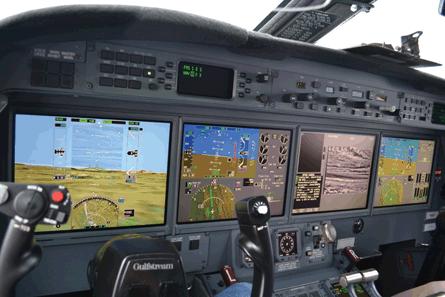
Man-machine interfaces look ever more likely today as avionics attitudes change. Inclusion of gesture based touch screen primary flight displays, voice control and 3D displays are becoming more of a possibility as safety regulators take an open mind to the incorporation of gaming technology, Flight International reported.

Synthetic vision approvals were first made in 2002. The following year, Texas-based Chelton Flight Systems earned a supplemental type certificate for its wireframe SV on the primary flight display. Universal made news again in 2005, with an egocentric SV system for the PFD in Part 25 aircraft.

A number of airframers are working on creating  advanced EFVS that will allow for a zero ceiling, zero decision height. Research and development continues on fused SV and infrared displays.

With so many technological developments being made the FAA asked why with such good safety present it was necessary to incorporate gaming type technology in aircraft, and expressed concerns over this technology being distracting for pilots. Ultimately if proved safe and improving the pilots ability to control and monitor the aircraft these are likely to be become increasingly widespread.

ARINC is introducing AviSec as a new flat-rate pricing concept to help airlines manage their costs for transferring Advanced Passenger Information (API) to destination governments.

It was launched by ARINC EMEA at its annual customer event, Converge and ENGAGE on 19-20 October.

“AviSec, a simple charging method based on a monthly rate for an agreed number of flights, has been designed to enable airlines to budget more easily. Currently many airlines are charged for each message on a per character basis, resulting in unpredictable costs,”

AviSec can handle and convert multiple formats from different airline systems and safely transmit data over ARINC’s highly resilient AviNet network, which has served the air transport industry’s need for secure, reliable messaging for over 50 years. Secure delivery is paramount for airlines which must transmit API in the form of batch flight manifests to border control agencies in the destination country.

Any failure by an airline to comply incurs a significant fine.

More information can be found at avisec-messaging.com