Archive

Tag Archives: aviation operational messaging

Inmarsat Satellite Communications Systems for Business AviationInmarsat, British satellite communications network is considering the possibility of becoming a direct provider of its integrated air-to-ground (ATG)-S band inflight connectivity service, soon to be launched in Europe. Currently, Inmarsat partners with resellers for its services.

Leo Mondale, Inmarsat president of aviation said, “Going direct is not a strategy or goal of ours per say, but we’re looking at a pretty dramatically changing environment when giant name brands in telecommunications are entering the business, and so there is much higher interest in adjacent markets like mobile communications to cause us to want to study the right way to go to the market.”

Although no fixed plans have been settled, Inmarsat are considering an industry sector that is consistently selling bundles, and following ViaSat’s decision to sell directly to airlines, partnering with Thales/LiveTV, the satellite giant is looking at the sector with a different set of eyes.

“We are actually just a connectivity provider,” says Mondale. We don’t build equipment, and we don’t want to sell content. Our bundle is multiple connectivity platforms, given to the right geography, irrespective of what type of aircraft or how big a fleet. That makes us different because we’re not saying ‘buy IFE and we’ll give you connectivity for free’. We say ‘you decide, and we want to give you the best connectivity.”

Inmarsat are in no hurry to make a decision, and are considering all their options. Current reseller partnerships will not be affected.

For Border Security Enhancements Use Reliable Providers of APISGerman government officials are standing firm in a decision to support passenger data transfer and retention despite objections to another personal information database.

Privacy concerns have been raised by Andrei Hunko, a member of the Bunderstag, who suggests that such a database would violate fundamental privacy rights. He believes that the tracking of potential terrorists or ‘persons of interest’ can be done with the information that already exists and there is no need for ‘yet another’ database, to which ‘police and intelligence agencies would have unlimited access’.

The German government insist that ‘urgent action is needed in the Federal Government’s view’ and suggest that a way to counter the threat that Jihadists returning from Middle Eastern war zones could potentially have across the EU.

Plans for the EU Passenger Name Records (PNR) database were suggested back in 2011 and although the German government are in support of these plans, they do concede that five years is too long a time for the retention of such information as a fundamental violation of privacy rights.

In May this year, the European Court of Justice ruled for the invalidation of EU laws governing the retention of personal passenger data, so the battle is far from won.

Leading Providers of Baggage Handling SystemsPalm Beach Airport baggage handling system is 25 years old and needs to be upgraded. According to airport officials, it is growing increasingly difficult to keep up with maintenance issues with the 10-year old explosive detection system.

To ensure enhanced safety is in place for the monitoring and handling of airport baggage, the system must undergo a complete modernisation program and Jerry Allen, deputy director of Palm Beach Country’s airports department, know what he wants, following research that has been ongoing for almost 10 years. “We have had this baggage system for 25 years, and things change in our industry,” said Allen, “What this is going to do is allow us to drop a bag off at any gate and still get it to the appropriate airline.”

Airports across the world are embracing the latest technological advancements in baggage handling systems. With biometric scanning and electronic tagging and tracking, sophisticated, modern systems involve almost no human intervention to operate to maximum efficiency, which gives airport personnel a greater flexibility. Mr Allen said “It operates more efficiently, so those employees can be doing other things.”

To pay for the new automated system, the airport plans to use $32.4 million in federal and state grants, leaving $9.6 million to be realised from passenger facility charges at $4.50 per passenger.

Officials from the airport sought permission from the county to spend the $42 million earlier this week and are awaiting an outcome.

Rockwell Collins' FANS 1/A & CPDLC CapabilitiesIt has been announced that Rockwell Collins is to offer FANS 1/A with CPDLC capability to the Bombardier Challenger 604 aircraft currently equipped with their Pro Line 4 avionics systems. The upgrade will be made available in mid to late 2015 and will build upon the aircraft’s current Flight Management System (FMS) and Control Display Units (CDUs).

The incorporation of a new communications unit will give operators of the Challenger 604 access to the transatlantic route that offer greater wind-efficiency, which results in significant savings of both time and fuel for the carriers.

The FANS 1/A package is made up of Controller-Pilot Data Link Communications (CPDLC) capabilities and Automatic Dependant Surveillance-Contract (ADS-C) which offer both enhanced clarity for pilot communications and a reduction in flight crew workload.

Rockwell Collins' ARINCDirect Bundles to Further Enhance Connectivity

Rockwell Collins acquired ARINC Inc last year in its largest purchase in its history at $1.4 billion. In the last 10 months, Rockwell Collins have folded ARINC into an information management services organisation with the former Air Routing International – now Ascend Flight Information Solutions and Computing Technologies for Aviation (CTA) businesses. Combined and branded as ARINCDirect, the marketplace is presented with a robust suite of flight planning and international-trip software with communications technology for enhanced aircraft and ground communications solutions.

Combining Ascend and ARINCDirect online, with an integration of mobile applications and consolidated customer billing was the first job for the aligned sales teams and progress was measured in subscriptions to the newly-bundled offerings.

“When we started out here, our objective was to look at where are the Ascend customers that might have different connectivity than Arinc, where are the Arinc customers that might use different international trip planning—and synch those customers up so that we can provide a combined value proposition,” Jeff Standerski, senior vice president of information management services, said. “We’ve been able to do that on 60-plus tails already within a nine-month period.”

As one of the biggest names and forefront players in the business aviation sector, Rockwell Collins’ ARINCDirect promises further advancement in the industry with ‘bundled’ features and integration with leading avionics systems, such as Pro Line Fusion suites and the improved iPad planning application.

Providers of Inflight Connectivity Systems for Business AviationWith the onboard Wi-Fi revolution firmly underway and becoming increasingly standard on today’s business aircraft, maintenance personnel and connectivity providers are finding that their workloads are becoming more complex. According to NBAA Maintenance Committee Chairman, Jim Sparks, nowhere is this more of an issue than in the business aviation community, with technicians having a different ‘need to know’ than their counterparts in general aviation.

“In business aviation, technicians have a somewhat different ‘need to know,'” said Sparks. “In our case when you talk about an [Airframe and/or Powerplant] A&P you speak of an all-purpose technician — meaning you have to service tires or diagnose slow Internet access. … You get into the world of the airlines [and] yes, in many cases they have the technology and they have the specialists who deal with it. They’re not necessarily A&Ps, they’re more network specialists because they don’t have to have the return to service authority that an A&P technician does.”

Inflight connectivity in the modern business jet has evolved at an astonishing pace. Business passengers are able to operate at 45,000 feet as effectively as they can in their ground-based offices. It is becoming clear, according to Mr Sparks, that training standards have not been as fast to evolve and demand is growing for skilled technicians in the industry.

“The current requirement for the need to know of A&P technicians was established by the FAA and is pretty much based on technology from the 1960s or earlier; it just has not evolved over the years,” said Sparks. “There are some A&P schools, some affiliated with colleges or universities that have stepped it up where they provide more knowledge than is required. But the basic requirements for an A&P, they have not changed. If you go to an A&P school to get an A&P license that’s all you’re going to get, and you’ll have a basic understanding of ‘60s and ‘70s technology equipment.”

The NBAA and the FAA are beginning to work towards to evolution of training standards for A&P technicians. Nextech for NextGen is a program that includes formal development called ‘Project Bootstrap’, providing guidance to the FAA in the revision of basic requirements.

The phases of the program will address the need for filling the gaps in these areas and also for the physical installation and maintenance of advanced IFE systems.

Parts Manufacturing Aprroval Granted by FAASupplemental Type Certificate (STC) has been received from the FAA for ICG and Chicago Jet Group to develop and install ICG’s latest eRouter aircraft data management system on the Dassault Falcon 900 business jet. Hailed as the ‘best in class’, the eRouter promises to deliver enhanced cabin connectivity and high-speed data transfer.

ICG has also been granted Parts Manufacturing Authority (PMA) for the ERT-120.

The router is the lightest and smallest certified product in its class and is capable of multiple connections to networks such as Inmarsat SwiftBroadband and Iridium.

“We designed the eRouter with a modular architecture that makes it easy to expand its capabilities and adapt to varied systems and advancing technologies,” said ICG’s Executive Vice President, Brad Smith.

With provision of airborne connectivity to Electronic Flight Bags (EFBs) the eRouter can deliver efficiencies on the flight deck with the addition of cabin connectivity for passengers and cabin crew for use of tablet PCs and Smartphone technology at speeds comparable with those on the ground.

“The eRouter’s modular architecture also reduces costs by offering operators only those services they might currently require, yet providing a forward upgrade path for future and emerging requirements,” Smith continued. “It has a Graphical User Interface (GUI) that allows operators to install updates in the field and permits many configuration options and flexibility to tailor the functionality to an operator’s specific needs.”

Worldwide Passenger Data Transfer ProvidersThe U.N. Security Council have called for new measures to help curb the movement of potential terrorists. Drafted by the U.S. the measures received unanimous approval from the Security Council, who intend to clamp down on funding and recruitment opportunities amongst the militant groups.

U.S. President, Mr Barack Obama said that it is believed that around 15,000 fighters have travelled to Iraq and Syria to join the Islamic State or Jabhat al-Nusra, the al-Qaeda affiliated group, from more than 80 nations. Speaking about the crisis at an unusual Security Council session, Mr Obama said, “The tactic of terrorism is not new. What brings us together today, what is new, is the unprecedented flow of fighters in recent years to and from conflict zones, including Afghanistan and the Horn of Africa, Yemen, Libya, and most recently, Syria and Iraq.”

Strengthened steps will be taken to prevent suspected foreign terrorist fighters from entering their territories or passing through borders. Part of the plan is the widespread provision of Advance Passenger Information (API), currently mandatory in the U.S. and spreading throughout the world.

Mandatory provision of API, which includes passenger details, destination countries and methods of payment in some cases, can help governments and border agencies to track the movements of travellers, thus indicating potential high-risk passengers for further investigation. The resolution also includes a strengthening of the legal framework for international action by the suggestion of a passage of legislation that can give countries greater flexibility for the prosecution of suspected foreign fighters.

The U.N. have also encouraged member states to be more co-operative with information-sharing.

“Foreign terrorist fighters increase the intensity, duration and intractability of conflicts, and also may pose a serious threat to their states of origin, the states they transit and the states to which they travel,” the resolution said. More efficient methods of sharing information is what is called for to discourage recruitment, organisation and financing of terrorist movements and the aim of the resolution is to make this as difficult as possible.

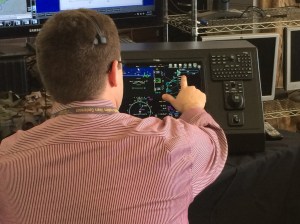
Rockwell Collins' ARINC HFDL CapabilitiesRockwell Collins demonstrated the capability of their Pro Line Fusion flight deck to be utilised as a ground control station last month as a part of a flight demonstration with the University of Iowa College of Engineering Operator Performance Laboratory (OPL).

Alex Postnikov, principle engineering manager at the Rockwell Collins Advanced Technology Center said that the aim of the flight was to ‘test the operational capability of a distributed Flight Management System using a certified digital communications link.’

The flight was conducted with a surrogate unmanned aircraft with a safety pilot onboard in order to test some of the repurposed Rockwell Collins technology for manned aircraft, with a view to applying that to unmanned aircraft.

“One of the big parts of the certification with the FAA is being able to handle lost link procedures. Today in the military world, when you lose a link, the [unmanned] aircraft essentially starts spiralling up with the hope of getting a line of sight to the radio. When it is unable to do that for some time it just flies in a straight line to the point of origin or where it is launched from,” said Postnikov. “Imagine doing something like this in the NAS. You cannot do that. The aircraft cannot just spiral up and just fly it in a straight line somewhere. So you have to follow the Standard RNP procedures, you have to use the standard navaids that are understood by everybody who flies in the NAS. That’s the piece that we believe has very strongly positioned us because the Pro Line Fusion has that capability. While this test focused on demonstrating the datalink capability, the emphasis of the September flight test was to “ensure that we can exercise our distributed Flight Management System (FMS).”

The only part of the flight test that was not automated was the take-off and landing procedures. The test team artificially broke the data link between the aircraft during the test and the modified Pro Line Fusion ground station, which was connected to the radio that was in communication with the aircraft.

Cost is a major issue with HFDL communications and Rockwell Collins are, through their acquisition of ARINC last year, offering cost effective solutions for aircraft messaging across the world, whether in manned or unmanned aircraft.

Global SwiftBroadband Providers for Flight Deck CommunicationsL2 Consulting Services, avionics engineering, integration and installation services providers, have announced a contract from Cobham SATCOM to develop the STC for AVIATOR SwiftBroadband installations for Hawaiian Airlines 767-300 series aircraft. The certification will apply for the use of ACARS Ground Gateways (AGGWs) for FANS and ACARS safety messages.

With the design phase already in action, prototype installations and certification is on track for the projected completion deadline during the first quarter of next year.

President of L2, Mark Lebovitz said, “This FANS 1 Controller Pilot Data Link Communication and Automatic Dependent Surveillance Contract to implement over SwiftBroadband Safety Services certification project is intended to support the FAA’s initiative to evaluate communication technologies that are expected to be viable in meeting the needs of the aviation community. We are delighted that Cobham SATCOM has entrusted our company with such a significant program to support FANS Evaluation flight trials towards meeting ICAO GOLD RCP240 requirements for support of 30/30 NM operations.”

AVIATOR SwiftBroadband is capable of delivering voice and data communications in addition to the provision of other critical services, such as aircraft tracking data, support for Electronic Flight Bag (EFB) and Ethernet connectivity for devices such as the Aircraft Interface Devices (AIDs).