Archive

Tag Archives: aviation industry

Seal Dynamics, one of the world’s largest and diverse suppliers of aviation parts and components becomes one of the latest customers for ARINC’s industry-leading AviNet Mail.

Based in the U.S. and with field locations across the globe, Seal Dynamics are committed to meeting customer demand, fulfilling hundreds of daily orders of FAA PMA approved, self-manufactured parts and components from OEM-approved manufacturers for the International market.

With a focus upon reliability and timely delivery of critical parts for airlines, Seal Dynamics needed a solution that provided essential back-up for their electronic ordering system.  Their reputation depends upon excellent service and efficient processing of parts orders to ensure the continuity of airline operations.

ARINC Incorporated, with their global reputation for the provision of innovative communications solutions proved that AviNet Mail is more than capable of the job in hand. Using Type B messaging services to handle critical communications is a daily occurrence for ARINC, serving many hundreds of aviation customers with decades of industry assurance of delivery and utmost reliability.

‘We chose ARINC’s AviNet Mail because it provides us with high message reliability, ease of use, accessible support, alternative methods for accessing Spec2000 messages and on-demand traffic analysis’ said Seal Dynamics Vice President of Technology, Marc Alter.

Yun Chong, ARINC Vice President of Global Network and IT Solutions said ‘ARINC values the opportunity to serve a recognized market leader and we look forward to a long and mutually beneficial relationship.’

Bag Drop Desks

Bag Drop Desks

Since the announcement from EasyJet of the imminent closure of their check-in desks, replacing them, instead with bag drop desks, the face of airline travel is set to change.

More than 80% of airline passengers now choose to check-in online and can do so from 30 days before departure to 2 hours before the flight, printing their boarding passes at home.

This innovation spells the end of the ritual of the queue at check-in desks at airports around the world, ultimately reducing airport congestion and speeding up the entire process of check-in, with the potential of increasing operational efficiency and productivity for airlines.

Bag drop desks do not have to be airline-specific.  ARINC have developed ExpressDrop desks, for use by passengers who have checked in online, travelling with various airlines, providing a single drop-off point to simplify, expedite and offer passengers an enhanced experience with greater control.

The idea is not a new one, by any means.  Ryanair closed their airport check-in desks in 2009, but does charge passengers inordinate fees if they forget to check-in online.

Another advantage to the introduction of ExpressDrop or other bag drop desks, is that waiting times are reduced.  This will produce great sighs of relief for travellers, who may arrive at the gate as late as 30 minutes before departure.

Although US budget cutbacks effects air traffic control the airport security sector is still expected to grow, and terrorism is still a threat, analysts have said.

In the wake of the September 11 attacks screening passengers and surveillance at airports has boomed. Because airport security is one of the areas that has been hit in the US by budget cuts, the expected growth on air travel will mean an increase in spending on airport security.

Didier Brechemier, an expert at the Roland Berger consultancy said “Airport security is a market niche which is outperforming that of the aviation. It grows along with the volume of passengers which is growing itself by five to six percent per year.”

3 billion passengers will travel by air this year according to the International Air Transport Association (IATA), this is nearly double the amount of people that flew in 2001. IATA also expects this number to double by 2030.

According to Philippe Nguyen, president of the IPE Investment Fund “The airport security screening market is worth some $10 billion (8 billion euros) annually” The Visiongain business information service said “If physical security at and around airports is included the market is worth over $22 billion”

Visiongain has noted that national governments are increasing spending on developing new airport facilities and expanding existing ones to meet increasing air travel, with spending on enhancing security also rising. Visiongain said “Contract sizes and financial data released by companies involved in the industry indicate this and would suggest that the market will continue to expand”

Europe and the US have the largest airport security markets while the Asia Pacific region is on course for the largest growth in the aviation sector.

In the next 10 years China is expected to construct 70 new airports.

Other boosts for security companies include changing the restrictions on carrying on board planes certain items, and the change of the rules of liquids should also boost this sector.

At a recent security conference IATA chief Tony Tyler said “that a right balance needs to be struck between risk and regulation. If we don’t find the right balance soon we will lose the goodwill of our passengers and shippers, clog our airports, slow world trade, and bring down the level of security that we have worked so hard to build-up”

Plenty of commercial opportunities are expected as growth will rest on new technologies. Better target screening is expected by use of information on travellers available to border control agencies will rely heavily on technology and data gathering. Many companies are now offering a full suite of airport security and passenger processing solutions.


Connect - providing airborne communications addressing and reporting system

Connect – providing airborne communications addressing and reporting system

ARINS Direct hope to launch its Connect low-cost business aviation communication service before the National Business Aviation Association (NBAA) convention this October in Las Vegas. They have just a few regulatory hurdles and technical issues to resolve.

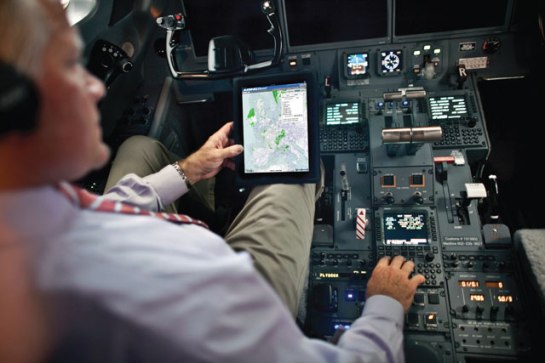
Designed to provide airborne communications addressing and reporting system (ACARS) messaging via an Apple iPad application, the service is the future of ACARS’s communications traditionally provided by the like of the ARINC AviNet service.

James Hardie ARINC Direct director said “We were looking at having the box ready for the second quarter of this year, but we’re a little bit behind with some of the things we’ve had to do to refine things, We’re very confident that by NBAA we’ll be in full production offering it up to customers, and in between we’ll be looking to do some trials as well”

“Connect” currently is only a working title for the product and fresh branding will be announced at the EBASE show in May.

At the 2012 NBAA convention the product was announced and a pre-production version will be available for demonstration at the EBASE show.

James Hardie added  “It is designed to provide airborne communications addressing and reporting system (ACARS) messaging via an Apple iPad application, high quality voice communications using an iPhone or Android device, and email. We’re looking to enable connectivity into new markets and also into existing markets with this box. If they’ve got an Iridium phone system then this box can take the place of some of that, using the antenna infrastructure. We’ve had an awful lot of interest from all sorts of operators, from medevac to charter. They might buy this equipment and put it on board a charter aircraft that they are managing for another individual.”

Connect is also being offered as a low-cost enabler for on-board services. “We think there’s an opportunity there to enable across a much wider range of aircraft because of technological developments in terms of miniaturisation of equipment and better understanding of interference issues, a lot of those issues that were around at the top of people’s agendas a few years ago are very much resolved. The next iteration will be looking at developing a user interface for the data link in the cockpit, which would be done through the iPad and connecting to the Arinc Direct box.”

James Hardie added the Connect iPad app is “essentially an electronic flight bag providing a paperless cockpit capability”.

At the request of their customer various new features have been added including “Cloud” connectivity for continuous synchronisation.

Carrying on James hardie said “If you write something down on your iPad it’s appearing on the co-pilot’s iPad, and as long as the aircraft has got a connection to the ground then we can provide data back to our cloud servers. They’ll store that information so if there are any problems with it, it can be regenerated and the content of your flight plan is accessible in flight and after the flight by everybody.”

Other  features to be included shortly include ad hoc flight planning within the app, as well as “just before flight” activities such as weight and balance sign-off.

A agreement has been signed by Inmasat and Kymeta to develop a new satellite antenna that will enable business jets to use high speed broadband connectivity worldwide using Inmasat’s Global Xpress (GX) service

Only GX users will be able to use the propriety Kymeta Aero Antenna enabling the two company’s opportunities in the fast expanding business aviation market.

Managing Director of Inmarsat Global Xpress, Leo Mondale said, “Over the coming 10 years, some 10,000 new business jets are forecast to enter service. In this changing world, where enhancing the productivity and effectiveness of the business executive is paramount, the need to offer constant connectivity is non-negotiable. It is this absolute requirement to keep executives connected, wherever they are, that is driving demand for solutions which support smaller aircraft. Our partnership with satellite technology specialist, Kymeta, will make business jet travel an even smarter and more efficient option for executives”

CEO of Kymet, Vern Fotheringham added, “Our technology for flat-panel, beam-forming antennas will enable a number of new markets and a new generation of customers to benefit from lower cost, high-speed satellite internet connectivity anywhere in the world. We are excited to reach this milestone and engage with Inmarsat to bring next-generation broadband services into the global business aviation market.”

Inmarsat is a long standing player in the industry providing passenger communications solutions for both commercial airlines and business jets.

Korean Air set up a dedicated charter team in 2007, now, having 3 VIP aircraft in its fleet, it is planning to boost demand for its business jet service by focusing on the Hong Kong and Chinese markets.

The VIP aircraft consists of a Boeing Business Jet, a Bombardier Global Express XRS that it flies internationally, and a Sikorsky S-76C+ helicopter that it operates within South Korea. It is planned that passengers on Korean Air‘s private jet charter service will earn First Class mileage points and will have access to the airline’s VIP lounges.

The airline also has a Flexjet Connect Service, which allows passengers to connect from a regular Korean Air flight to a private jet service for non-stop travel throughout the USA. A spokeswoman from the airline said “With many opportunities from Hong Kong and China, Korean Air is keen to capture a share of the business jet market with a focus in Hong Kong,” “We look forward to flying people to different cities from Hong Kong to China as well as various destinations around the world. With state-of-the-art aircraft, unparalleled services and competitive offerings, Korean Air is confident of capturing a share of the market in Hong Kong and in other countries in the region.”

Please see this link for a full range of business jet support and communications services.

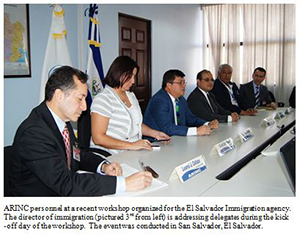
In Annapolis ARINC said it has started a series of workshops specialising on effective border security. These workshops are focusing on protecting borders from illicit activities, and have become a major concern for all nations. These situations have a significant impact on national security and immigration control. These workshops are starting in El Salvador and will roll out to ARINC’s entire customer base.

ARINC Conducting Border Security WorkshopsIn the course of these workshops, ARINC and its customers will discuss the positive results of implementing ARINC’s border security system, security trends, and share best practises and identify areas that can be improved. The courses are made up of senior officials and technical people from the various government agencies as well as airport operators, airlines and ground handlers.

Jorge Ramirez, Marketing Director of Global networks and IT Solutions for ARINC said ‘The ultimate goal of the workshops is to improve a country’s border security; these workshops are essential for our existing customers and ideal for countries in the process of evaluating effective border security solutions.’

34 of the 35 countries that have implemented border security systems ARINC is working with. ARINC’s complete portfolio in electronic borders uses its expertise gained in ARINC’s  aviation, governments, information technology, surface and maritime transportation and systems integration to deliver the most cost effective and efficient solution available.

Biofuels showcased at Avalon Air Show

Biofuels showcased at Avalon Air Show

The Avalon Air Show saw a lively exchange of ideas about aviation biofuels in general and Australia’s opportunities in particular.

The Australian aviation biofuel objective is ambitious, established in 2011, the aim is for 5 per cent of aviation fuels to come from sustainable fuels by 2020, representing two commercial-scale plants. By 2050 the target is 50% sustainable fuels. Forestry residues, stubble, bagasse, seed oils, tallow pongamia, algae, coppice and eucalyptus trees are the biofuel ideas. It is thought that ultimately 4.5 gigalitres can be obtained from lignocellulose, sustainably, over 1 billion US gallons per year.

Another contender that has intrigued by Airbus is mallee, an oilseed crop. It is thought 14,700 hectares of existing capacity would be available in the near term, just in one region they studied in Victoria. Producing 150,000 bone-dry tons of biomass would result in 85,000 tons of bio-oil which could be upgraded to 12-18 mega litres of jet fuel.
 

Out in the news this week was a rather novel idea from the University of Arizona. Immigration interviews may never e the same again if the idea of automated lie detector tests takes off. The machine could ask the passenger a series of questions, and analyse different aspects of your behaviour: how your eyes are moving, how your voice changes, how you pause between answers, how you fidget.

Border Security Future

An image from a demonstration of the Embodied Avatar, from a video by BORDERS, the National Center for Border Security and Immigration at the University of Arizona.

The machine, an “Embodied Avatar kiosk” uses this data to assess how truthful your answers were. Whilst this is the latest technology in the field, it is unlikely to be at Gatwick in the near future. You are much more likely to start to see more of the automated border control systems in place!

This month we have heard another story of airline struggling to deal with costs. Chanchangi airline has said that high cost of aviation fuel in Nigeria is a huge setback for domestic airline operations.

Airlines now have to look at every aspect of their business in order to balance the books. There are lots of areas that you can make cut backs but using route optimisation as a part of flight planning is one, and getting a good deal on aviation messaging is another.

But even with these basics in place fuel remains crippling. Using a contract fuel supplier will help – but this year at the Avalon air show Australia showcased aviation biofuels as the roadmap for the future. More on that story later…

Australian aviation biofuels showcased at Avalon

Australian aviation biofuels showcased at Avalon – picture courtesy of ABC