Last week, at the Hamburg Aircraft Interiors Expo, much excitement was generated by some of the innovative technological advancements set to change the in-flight cabin experience.

From a partnership with Bose, to improve in-flight entertainment with a range of noise-cancelling headphones to Twinings, for a great cup of tea, brand partnerships are a growing trend for airlines in an aim to enhance passenger comfort and experience.

The second in a stream of improvements is the issue of tablet computers to flight attendants, who are now able to be better connected and will be able, for example, to warn passengers of baggage delays or problems to save stress at the carousel.  The tablets will be connected to passenger headrest consoles, enabling them to request help or order directly from the console to the tablet.

In addition to improving passenger experience, the issue of the tablet will streamline communications to the flight deck and to ground-based personnel and will increase efficient operations, maximising the resources of staff for airlines and airports.

In Holland, KLM announced the release of their latest mobile app, following the realisation of the growth of passenger connectivity via Smartphone use.  The airline hopes to begin a free in-flight wifi trial later this year.  They will introduce real-time customer service operations for passengers to provide feedback and have problems dealt with immediately via an intranet connected to teams of iPad-bearing staff.

Virgin America is also developing a similar interactive service, with both airlines paving the way for passenger satisfaction and confidence.

Another interesting reveal at the expo was a growing market for airline and airport specific ‘souvenirs’.   Designers are using the latest trends in fashion to create mementos that passengers will want to use long after their flight experience and creating a realistic income stream for the airlines.

Take the stylish Finnair teaset, for example:

cabin trends Hamburg Expo

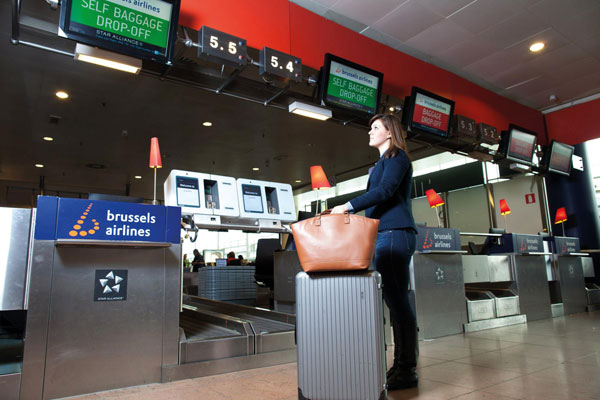
Brussels Airport and Brussels Airlines have announced their plan to test self-service bag drop over the next few months for passengers travelling within Europe.

Passengers who have checked-in online and have self-printed or mobile boarding passes will be able to use the self-service bag drop desks to weigh, measure and check-in their luggage, then print a baggage label from the self-service bag drop counter to attach themselves.

The airport will use the Dutch company, Type 22’s Scan & Fly, user-friendly technology, in two kiosks for the test, which is set to run until the summer.

“During the trial stage we will test the user-friendliness of the technology,” said Peter Cornillie, Brussels Airlines Vice President Ground Operations. “If the results are positive, the automated baggage check-in system will become a permanent option for all of our passengers travelling within Europe.”

Self-service bag drop is the way forward to streamline airport operations with common-use desks for multiple airlines, widely used in the U.S. using world-leading ARINC technology solutions.

ARINC Self Service Bag Drop

Business Aviation News - Border Management Solutions

Business Aviation News – Border Management Solutions

This week saw the introduction of tighter security measures in Fiji as the Immigration Department implemented the new Integrated Border Management System (IBMS) at Nadi International Airport and every other entry point countrywide.

The Fijian Government awarded the contract for installation to Public Sector Solution of Informatics International Limit, a Sri Lankan company who implemented the IBMS, state-of-the-art technology with features designed to enhance passenger profiling and visual verifications that can assist in the identification of high-risk passengers.

IBMS will change the face of security and enhance border management system control, maximising efficiency and productivity with features including access to data, passport and citizenship information, visa and permit modules.

“It will allow for a quick flow of all of our immigration processes and ensure there is quick turnaround time for each passenger that enter or leave our country,” said Major Nemani Vuniwaqa, Director of Immigration for Fiji.  “It strengthens our security system at all of our borders and ensures that we find people that may, in the past, slipped through.”

The alarming issue of aircraft hacking with the Smartphone app designed by Hugo Teso continues this week as he claims he could create false ACARS messages that could distract pilots with false weather or air traffic information.

Since the current ACARS system uses no authentication, Teso, an engineer and pilot, who works for a German security company, declared it was possible to cause these disruptions from a Smartphone, while seated on the plane.  He uses technology called ‘software defined radio’ to mimic the ACARS VHF frequency.

Teso, speaking at the ‘Hack in the Box’ conference in Amsterdam last week, says he bought second-hand Honeywell and Rockwell Collins Flight Management System equipment from eBay and extensively tested his app.  His findings have led him to believe that he could produce malformed ACARS messages to trigger vulnerabilities in the flight management systems on certain aircraft, potentially giving a hacker a degree of control over the aircraft.

acars

ACARS


The U.S. FAA and the European Aviation Safety Agency (EASA) have dismissed his claims, highlighting the fact that he has only tested his app on flight training simulation software and not on the protected technology that exists on a real flight deck.

A spokesman for EASA said that no, “Potential vulnerabilities on actual flying systems,” have been shown, and that, “The simulation does not have the same overwriting protection and redundancies included in certified flight software.”

Although both agencies strongly deny the possibilities of interference through ACARS messages, Teso states that he is “working with EASA to improve the situation.”


Following alarming claims made by German IT Consultant, Hugo Teso, regarding his ability to ‘hack’ into navigational systems of aircraft, using only an Android app, the FAA and the EASA have issued statements to the contrary; neither feeling that his claims pose any real threat to flight safety.

According to Information Week, the FAA state that it “is aware that a German information technology consultant has alleged he has detected a security issue with the Honeywell NZ-2000 Flight Management System (FMS) using only a desktop computer,” and adds that the app does not, “pose a flight safety concern because it does not work on certified flight hardware.  The described technique cannot engage or control the aircraft’s autopilot system using the FMS or prevent a pilot from overriding the autopilot,” and says that, “a hacker cannot obtain ‘full control of an aircraft’ as the technology consultant has claimed.”

Teso claims to have carried out research, using the Android app in a closed, PC-based system with simulation software.  He alleges that flaws in the Honeywell NZ-2000 Flight Management System, particularly in the navigational security systems, would render it simple to use on a live aircraft to perform ‘tricks’, such as letting the oxygen masks fall from overhead.  On a more serious note, Teso goes on to allege that he could just as easily use the app to crash the plane into another aircraft during flight, which has, understandably, caused much panic in the aviation industry and public alike.

The European Aviation Safety Association (EASA) issued the following statement, “There are major differences between PC-based training FMS software and embedded FMS software.  In particular, the FMS simulation software does not have the same overwriting protection and redundancies that is included in the certified flight software.”

Airline passengers across the world will be relieved to learn that Hugo Tero won’t be releasing details of his exploitation methods and will be working with aviation governing bodies to make sure that the systems are updated if it is proved necessary.  The FAA and EASA cannot fully reassure concerns, however, as it remains to be seen whether the hack is a software issue or due to redundancies built into the systems, which, if proved, could lead to resourceful hackers finding other exploits or loopholes in the systems.

ARINC Cabin ConnectA new Ka-Band delivered high-speed broadband service was on display for the first time for visitors to the Hamburg Aircraft Interiors Expo last week.  GX Aviation, launched by Inmarsat, will be supported by new avionics developed by Honeywell and will be commercially available in early 2015.

Jack Jacobs, Vice President of Marketing Product and Management, Honeywell Aerospace said: “The consumer demand for fast, global in-flight connectivity continues to grow at a monumental rate. People want to be connected no matter where they are and have the same Internet experience that they have at home.”

The world-leading satellite communications company, Inmarsat, plans to change the face of in-flight connectivity with GX Aviation, designed to provide throughputs of up to 50Mbps with uninterrupted global broadband coverage, offering like-for-like, ground-based comparative connectivity.

“The world is changing and airlines are seeking to keep up with passengers’ expectations. Our new GX service, which can be combined with our existing L-band solution, enables airlines to capitalise on already installed hardware to provide high speed broadband service with complete geographical coverage for all aircraft requirements, both in the cockpit and the cabin,” says Inmarsat’s Miranda Mills, Vice President of Aerospace.

The in-flight wifi debate continued last week as service providers all have a different approach to bandwidth.

Bill Sullivan, Director for Strategy and Business Development at ViaSat, commented, “People value speed, whether at home or in mobile environment. We have built a system around a very high speed experience. So we are taking that and bringing it into the airline sector.”

However, not everyone agrees that speed is the answer, especially when in-flight wifi provision is so expensive.  Row 44’s John Guidon argues,

“Just talking about speed is not satisfactory. It doesn’t explain the totality of the experience,” adding, “Really people are most interested in, in my opinion, page load time.”

There is no doubt that connectivity for in-flight wifi is in demand.  It is not a question of whether aircraft need it; it is now an account of which service to choose.  Ka-band wifi will provide speeds of at least 12Mbps per passenger, with even faster speeds being achieved with Ku-band or satellite in-flight wifi operations.

Most airlines recognise passengers’ growing demands for in-flight wifi and with the buzz created by the different broadband connectivity providers, the market is exploding.

Flights Resumed After Jet2 Agree to Use Alternative RunwaysThe airline Jet2 suspended flight operations from Belfast International Airport for two days, following concerns over the delay of maintenance issues on the main runway, due to the recent bad weather.  Jet2 had reported engine-related problems on three occasions, but there was no evidence to suggest it was related to the runway.

Despite assurances from the Civil Aviation Authority (CAA), Jet2 switched flights to George Best Belfast City Airport and City of Derry Airport instead.

Belfast International Airport agreed to investigate their concerns, but Jet2 was the only airline to suspend flights or report any issues.

The company apologised, saying, “We would like to apologise for the inconvenience this has caused, however the safety of our customers is of paramount importance and we will not operate from Belfast International Airport’s main runway until the resurfacing has finished.”

Jet2 agreed to resume flights, using the airports’ alternative runway two days later.

They issued a statement that said, “This decision follows close consultation with the airport and a detailed safety assessment conducted today (Tuesday).  All our customers due to travel from Belfast International this week should go to the airport as normal.

Following the success of ARINC’s development and introduction of their ground-breaking flight planning app for the iPad, yet another contender enter into the marketplace.  WSI are the latest company to launch a weather and flight planning app.

Named WSI Pilotbrief, the General Aviation and Flight Planning app is iPad specific and is set for launch at the Sun N Fun annual event in Florida this year.

ARINC developed their industry-leading iPad application for ARINC Direct after figures showed that more than half of their business jet aviators were accessing their accounts using the tablet device.

A valuable tool, the app integrates into the flight planning process, assisting pilots and increasing efficiency for effective, real-time operations.  Using the flight planning app, pilots are able to access up-to-the-minute weather data and geographical information, in addition to fuel burn data, ETA and flight tracking with sharing capabilities via iCloud networks and Bluetooth connections.

Pilots Asleep in the Cockpit Over LondonShould the public be concerned about the occurrence of Pilots falling asleep ‘at the wheel’?

Not according the the CAA, who say, “The evidence the CAA has is that the fatigue of crew is not a significant safety concern.”

This follows the release of data after a request to the CAA for ‘Freedom of Information’ revealed that pilots had dozed off during flights over London in June 2010 and June 2011, one having to be shaken awake after a colleague was locked out of the cockpit.

Pilots blame long hours and fatigue caused by unrealistic rostering, which is set to grow worse if the proposed change in European law is passed, expecting them to work extra hours and extend overnight flying.

Dr Hunter, head of flight safety at Balpa said, “A pilot falls asleep on the flight deck on a UK-registered airplane at least once in every 24 hours – and probably a lot more than that.”

This alarming statement is not backed up by figures, but with a two year prison sentence attached to falling asleep in the cockpit, Dr Hunter estimated that pilots would rarely report themselves, as they would be “writing the evidence for their own prosecution”.