Archive

Business Aviation News

Superbowl ToursAs the New York Super Bowl fast approaches, the area’s Fixed Base Operators are offering a variety of incentives to potential customers, with many of the best deals being publicised at the NBAA’s Schedulers and Dispatchers Conference in New Orleans.

Sheltair, which has FBOs at five of the airports in the local area had representatives on hand to provide operational information, together with details of events planned for the big day from its bases at John F. Kennedy International, La Guardia, MacArthur, Republic and Francis S. Gabreski Airports. Waiving the usual special-event fees and doubling its AVTRIP rewards points, Sheltair warned potential customers that, due to the increased pressure on the already limited hangar space at MacArthur and Republic airports, allocations could only be made on a first-come, first-served basis.

An FBO at Long Island MacArthur Airport (ISP) in Islip, Hawthorne Global Aviation, was also at the show; taking advantage of its location slightly away from what will be the busiest airspace to offer what promises to be an exciting customer experience. A twin-engine helicopter can be hired for a 20 minute flight to either New York City prior to the Super Bowl games or Teterboro Airport for the games themselves, at a round-trip cost of $5,000.
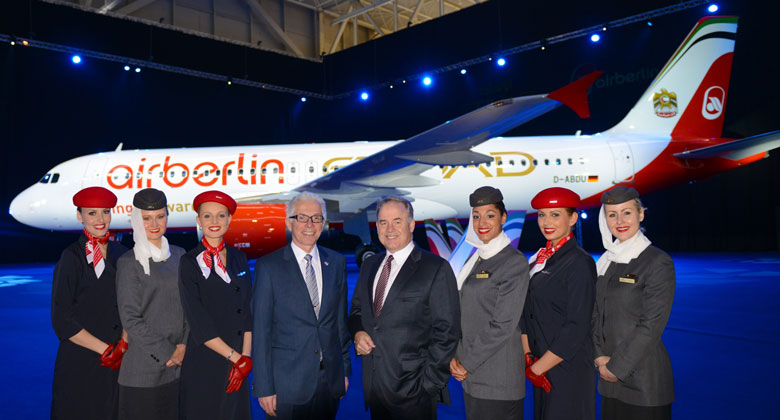
Air-Berlin-Etihad-livery-780The Gulf carrier Etihad has continued its foray into the European aviation market with the unveiling of an Airbus A320 in joint livery with Air Berlin at an event hosted by both Wolfgang Prock-Schauer, CEO of Air Berlin and it’s Vice Chairman, James Hogan, also President of Etihad.

Last year Etihad notably purchased a 49% stake in Air Serbia, formerly known as Jat airlines, and has announced plans to further strengthen its European presence with the purchase of a one third stake in Darwin, which will become Etihad Regional. However, Hogan was circumspect regarding recent reports that Etihad would also soon be announcing an investment in the ailing Alitalia, stating the importance of due diligence and the formation of,  “a clear plan to move to profitability.”

Clearing recent speculation regarding European carriers LOT Polish Airlines and the Latvian Air Baltic, Hogan stated there were no plans to invest in either.

APIS Solutions for Mandatory Passenger Data TransferNew rules from Mexico’s National Institute of Immigration (INM) have prompted FltPlan to expand the capabilities of its current eAPIS system. FltPlan president Ken Wilson said the rules now require Advanced Passenger Information System (APIS) manifests be submitted within 30 minutes of any aircraft closing its doors, and warned that breaching them could result in fines of up to $5,000.

Wilson reflected that FltPlan’s five-year plus experience in eAPIS systems and their early adoption of U.S. Customs and Border Protection certification for submission of passenger information made for a relatively easy transition when working with the Mexican government.

FltPlan, which recently exhibited at NBAA’s Schedulers & Dispatchers conference in New Orleans, said its aim was to provide a low-cost, specialist solution. Current annual subscription rates to its eAPIS system are $249, and the Mexico service an additional £200, with $20 per manifest ($40 for a round trip from the U.S. to Mexico).

In-Flight Connectivity Solutions ProvidersOnly weeks after the U.S. lifted the ban on in-flight connectivity, Global Eagle Entertainment showcased their new satellite Internet system at the Consumer Electronics Show.

The company claims that their satellite connection provides a more reliable system than air-to-ground providers.

“The satellite is already there and it’s possible to have more bandwidth when needed,” said Simon McLellan, chief engineer for Row44, the technology division of California-based Global Eagle, continuing his explanation that a satellite connection, “allows you to expand the capacity when the demand grows.”

With the demand for passenger in-flight connectivity with mobiles and tablets, and with the limitations lifted, the sky is no longer the limit for aviation communications providers.

Global Eagle have already signed a deal with Southwest Airlines and are set to rival Gogo, who have announced modifications to their ground-based connections in order to provide a hybrid system that will utilise both land and satellite transmissions.

Installation and set up of the system will cost carriers in the region of $300,000 to $500,000 – a cost that will be recouped via passenger fees for the use of the in-flight connectivity services. Some carriers may offer a free connection to premium or first class passengers, but demand is so great for in-flight connectivity, that it will become a matter of competitive interest over the coming year.

Business aviation passengers travelling on private aircraft have enjoyed in-flight connectivity for some time, as expectations are high for these premium services when high-end executive travellers need to operated effectively in their airborne offices.

It is expected that many providers will follow the trend for in-flight connectivity, in spite of the mixed bag of opinions from some big airlines – we shall see!


Other Leading Datalink Communications ProvidersAvionics engineering company, L2 Consulting Services, Inc. (L2) recently announced it has received a Federal Aviation Administration Supplemental Type Certificate (STC) for the installation of the International Communications Group, Inc. (ICG) Iridium Communications System on 767 series aircraft.

A dedicated datalink channel will be able to support Aircraft Communications Addressing and Reporting System (ACARS), Future Air Navigation System (FANs) messaging, Automatic Dependent Surveillance Contract (ADS-C) and Controller Pilot Data Link Communication (CPDLC).

Having developed the integration engineering, produced the installation kits and project managed throughout, including the STC process, L2 will now be allowed to install comprehensive communications systems via ICG NxtLink Series ICS-120A and ICS-220A line replaceable units.

Michael Eiras, Senior Director of L2 Technical Services welcomed the Iridium Communications System STC on the 767 aircraft saying it would ‘complement the companies current portfolio of SATCOM installations on the 737, 747, 757 and 777 aircraft.’

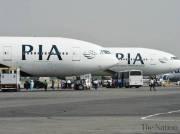
Cut Operational Costs with Consultancy ServicesThe board of directors for Pakistan International Airlines have rejected proposed budget plans for 2014, highlighting the airlines’ need to cut operational costs in order to continue to survive.

The reality is that this is happening across the globe and, especially in the global financial climate, the consensus is that many airlines, regardless of size, must look at ways to cut operational costs.

Although many countries announce a promising recovery from financial despair, it is clear that the changes may not come quickly enough for some.

Aviation consultancy agencies offer a service that has become invaluable in order to recognise the areas that can cut operational costs.

Big companies, such as ARINC, who bring more than 80 years of aviation messaging experience to the table, are able to offer insightful evidence that operational messaging budgets can be cut considerably. Saving money in this area can help enormously when operations management is considered.

Web-based solutions and cost-sharing programs for multiple airlines are made possible with CUTE systems and vMUSE technology.

Like PIA, airlines across the world can benefit from consultancy services when business survival is on the line.

Commercial Air Travel Centenary YearAir passengers taking advantage of the recent holidays to travel to far-flung climes, or those regularly nipping a few thousand miles to be united with friends and family have good cause to celebrate this centenary year of commercial air travel.

It’s hard to imagine that this globally vital industry, averaging over 8 million passengers and 140,000 tons of cargo per day began 100 years ago with a single passenger, Abram Pheil, Mayor of St. Petersburg; travelling with a ticket won at auction for $400.  It was an inauspicious start for an industry that today carries around 50 million tons of cargo worth in the region of $6.4 trillion per year, a figure representing some 35% of the value of all traded goods.

With funding organised by Percival Fansler, Pheil as passenger, and Tony Jannus as pilot, the 23 minute flight of Thomas Benoist’s airboat across Florida’s Tampa Bay on New Year’s Day 1914 went down in history not just as the inaugural journey of the St. Petersburg-Tampa Airboat Line, but that of commercial flight.

As the International Air Transport Association (IATA) announced a year-long celebration of the centenary it’s certainly worth considering how far commercial flight has come in that time. Last year annual passenger numbers reached 3.1 billion, exceeding all previous records, and this year it’s anticipated records will be broken again with 3.3 billion journeys. The figures are staggering enough but even more so when one considers they are equivalent to 44% of the global population.

The contribution of commercial flight to all aspects of modern life is well-recognised by IATA director-general and CEO Tony Tyler who said, “The first flight provided a short-cut across Tampa Bay. Today, the aviation industry re-unites loved ones, connects cultures, expands minds, opens markets, and fosters development.”  But the centenary year is not just about looking to aviation’s past, nor even to its present success. As Tyler says, “A hundred years is something worth celebrating. And we look forward to creating an equally remarkable legacy for commercial aviation’s second century.”

Solutions from ARINC AIM

Mohammed Ahli – Director General – Dubai CAA

With the Gulf airports aiming to increase passenger numbers to 450 million per year by 2020, and the development of new terminals at both Doha and Abu Dhabi, the Arabian Gulf States are investing heavily in airport security, an industry currently estimated to have a global value of $22 billion.

Much of this investment is focussed on innovative technologies designed not only to improve security and efficiencies for the airport but also to improve the passenger experience, as

Mohammed Ahli, director general of the, Dubai Civil Aviation Authority (DCAA) explained,  “It’s crucial to adopt innovative technology, improve security and streamline efficiencies to offer a seamless passenger travel experience.”

Airport Show, the Middle East’s largest airport industry event, provides a welcome opportunity for companies to showcase the technologies vital in achieving this aim. Both Intertech Vision Group, which already has 140 installations in the region, and ARINC, a security and systems integration company offering an Advanced Information Management system (AIM) will be attending,

Stephen Horner, International Business Development Director, Integrated Security Solutions, ARINC, said: “There are many security and systems integration opportunities throughout the GCC region. ARINC has provided integration and security solutions for more than 30 years to a security industry of equal age. We are able to provide ‘best fit’ technology and solution to airports. We wish to showcase our wider capability in delivering integrated security solutions, command and control facility as well as airport solutions.”

Although complaints arose over the Christmas period as delays grounded passengers around the globe, the move to long haul flight communications for low-cost airlines is set to light the fires of competitive costs within the industry.

Long-Haul Flight Communications Solutions ProvidersRecently, Norwegian Air Shuttle announced a new strategy that promises discount flying to long-haul routes such as Bangkok, Florida and New York and has ordered a fleet of Boeing and Airbus aircraft.

Ryanair are also making noises about plans to introduce long-haul flights once prices for wide-body aircraft come down.

Long haul flight communications ensure that global coverage is achieved. High Frequency Data Link is the answer. Communications can be transmitted and received via a network of ground-based stations and satellite networks that can provide truly global, seamless coverage, critical for long-haul flights across oceanic expanses and Polar Regions, where ground-based stations are intermittent.


Airport Perimeter Security Solutions ProvidersTwo separate incidents of an airport perimeter security breach on Christmas Day have highlighted the importance of effective surveillance – industry-wide.

Each incident happened at different airports – one at Newark International, where a man breached the airport perimeter security fence and remained undetected as he crossed two runways to reach a terminal before being spotted by an airline employee.

The second incident occurred at Phoenix Sky Harbor International later that day. The man scaled a nine-foot high fence and ran onto the tarmac waving his arms at a plane before being captured by airport security.

Although both airports had airport perimeter security surveillance, neither detected signs of the trespassers.

Questions have now been raised, especially as the Transport Security Administration has no mandate in place for the requirement of full-time surveillance of airport perimeter security fences.

This appears not to be an isolated problem. There is an industry-wide call for greater importance to be addressed for airport perimeter security.