Archive

Tag Archives: passenger processing

Aviation Information and Communications Management System ProvidersAs issues arise in the aircraft maintenance industry with gaps in knowledge of the fast-advancing technology on board, it has been suggested that training is necessary to ensure maintenance teams are fully aware of the latest solutions for airport information systems and aircraft communications.

According to experts, around 90% of problems that arise in the sector are down to people errors and issues. Even today’s graduates lack specific knowledge of the most advanced information management systems.

Older, legacy messaging systems are slowly being replaced all over the world with solutions such as Rockwell Collins’ ARINC eHub for example. Multi-use web-based services are increasing in popularity due to the increased efficiency of the messaging environment and comprehensive approach to information technology.

Business Aviation News | Aviation Security ImprovementsOn the 14th anniversary of the 9/11 terror attacks, we take a look at how those tragic events have led to improvements in aviation security and in counter-terrorism.

In the months following the attacks, physical security in airports around the world, and particularly in the US significantly tightened. The TSA immediately launched a comprehensive aviation security program and passenger and luggage screening became a major priority.

As the years have passed, technological advancements have led to the implementation of advanced passenger screening systems. The provision and requirement of Advance Passenger Information has become almost industry-standard across the world and security training has also been stepped up.

There are still threats to security on an international scale, but there is no doubt that the events of 14 years ago today have strengthened our resolve to never let it happen again.

Lufthansa Select vMUSE Mobile | Business Aviation NewsRockwell Collins’ new ARINC vMUSE mobile passenger processing platform will be launched by Lufthansa as they become the first airline to implement the technology.

This latest innovation in passenger processing promises to speed up the check-in process, which can be carried out by personnel on the ground using tablet devices, wherever they can get an internet signal and connection, even in the hotel foyer.

ARINC vMUSE mobile is based on an entirely mobile common-use passenger processing system (CUPPS) and is the first of its kind in the industry. Enabling cost-sharing and space-saving in the terminal, the solution paves the way for greater flexibility within the airport environment.

APIS Providers for Aviation Security | Business Aviation NewsAs countries around the world join the fight against terrorism and strive to improve their border security, South Korea make changes following a test period that saw them refuse 157 travellers from Thailand.

Previously, South Korea received passenger data via APIS after flights had left the originating airport. Then, if any passenger was ‘flagged’, airlines would have to return them to the point of departure, causing delays and incurring expense.

Now, the changes suggest that South Korea will require Advance Passenger Information before tickets are issued. The information will be screened by the ministry and only after approval, will tickets be sold to the passengers.

A statement from the South Korean Ministry said that the aim is to ‘strengthen the aviation safety and border security by analysing the passenger information in advance.’

Providing physical security for airports | Security systems from other suppliersThe Ministry of Transport in Oman has given to go-ahead for the installation of a new integrated security system for two of the country’s airports. Muscat International Airport and the new Salalah Airport will receive a new state-of-the-art, comprehensive system to include perimeter security intrusion detection, security check points and access control, overseen by a new data management centre.

The contact has been awarded to Thales, French technology firm, who will also be responsible for training and testing as part of the deal agreed this week.

Airports across the world are stepping up their security as the threat of terrorism and smuggling increases. Airport security providers are using the latest technology to develop powerful, high performance systems to strengthen border security.

Find Out More About London City AirportLondon City Airport (LCY) has embraced the holiday season, and the inevitable increase in passenger traffic, with the installation of 26 self-service check-in kiosks to help speed up passenger processing.

Designed by SITA, the kiosks are user-friendly and can also display flight information, including flight disruption and way finding.

Other providers of airport self-service kiosks, such as ARINC, utilise common use terminal equipment for the addition of single bag drop points for multiple airlines, further streamlining the check in process.

As passenger numbers rise at a global average of 5% every year, and noticeably more-so at certain peak times, it is clear that the increase of automated airport check-in systems is also inevitable.

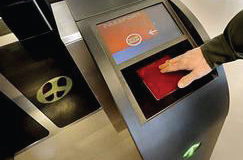
Find Out More About Biometric Airport Solutions In a bid to speed up and tighten passenger processing, as many airports around the world are, Barcelona El Prat Airport have implemented the latest technology with biometric passport control that includes fingerprint and facial recognition features.

Biometric and automated border control systems function with the use of ePassports and e-ID cards and are designed to increase passenger processing time while strengthening security and integrate with other airport systems. Many such improvements in Europe are co-financed by the European Commission as part of a ‘Smart Borders Programme’.

Barcelona’ El Prat airport will now join many other Spanish airports, including Palma de Mallorca, Malaga and Alicante with the implementation of their new system.

Find Out More About Passenger Processing Systems and Airport Technology IntegrationIt has been announced that Orlando Sanford International Airport (SFB) are to replace their current airport technology with an upgrade to improve their operational efficiency using a common use platform.

The airport will use AirIT’s EASE (Extended Airline System Environment) to increase flexibility for their major operations, including passenger processing, flight information displays, airport database operation and airline resources with a shared option to allow leverage of airport network infrastructure.

These and other providers of common use airport management systems, such as Rockwell Collins’ ARINC, deliver the opportunity for airports across the world to integrate systems and give airlines greater flexibility in terms of cost-management and efficiency.

Other Providers of Automated Border Control SolutionsFollowing the successful implementation of automated border control gates at Prague airport in 2011, the Czech border police have agreed to expand the project, known as EasyGO.

The project expansion will involve the installation of ten more eGates in both arrivals and departures and will also involve an upgrade of the entire airport IT infrastructure which will include a new Terminal Control Centre and maintenance contract.

Using a Secunet system, Prague airport uses electronic authentication of ePassports, identity cards and uses facial scanning and comparison with electronic data.

Automated border control solutions are becoming commonplace across the world as countries strive to improve security.

Providers of Systems for Sharing Data | Advance Passenger Information Systems (APIS)In a recent article, the U.S. Department of Homeland Security have reinforced their opinion that sharing data throughout the world is critically important to track and monitor the movements of potential threats, particularly in the environment of international air travel.

Since 9/11 the issue of aviation security has been high on the agenda for the U.S. and for many of its international partners. Recently, with the spread of threat against the west from militant groups such as the Islamic State organisation, security forces all over the world are stepping up security measures in a bid to control or at least monitor the movement of its members and those who are leaving their home countries to join these terrorist groups.

To mitigate such risks to national and international security, given that the number of air travellers consistently rises by an average of 5% every year, DHS maintain that sharing data is the strongest way to monitor passengers. The introduction of Advance Passenger Information (API), a system that is fast-spreading throughout the world, gives agencies and governments the opportunity to analyse passenger data before aircraft leave the ground for their destination country on a domestic and an international scale.

DHS believes that the coordination of sharing data is as important as the collection of API. Sharing must be seamless, between airports and authorities, governments and agencies and between countries. Only then can the process of sharing data be effective.