Archive

Tag Archives: aviation industry

Global Connectivity with ARINC eHub Solution for AirportsDC Aviation Al-Futtaim (DCAF) has become the first integrated business aviation company to start operations at Al Makhtoum International Airport.

In a joint venture, DCAF – Germany’s DC Aviation and Dubai-based Al Futtaim, have completed the integrated hangar facility, furnished with passenger lounge and offices and are now ready to ‘go’.

Their aim is to provide premium service to business aircraft, including a range of services for aircraft management and maintenance, passenger handling and business jet charters.  The company will also offer insurance services, fuel purchasing and many flight support services.

“DWC is expected to play a significant role in enhancing Dubai’s position as the regional aviation hub and we are very excited to be the first business aviation operation in what is undoubtedly going to be a world-class airport,” said Holger Ostheimer, general manager, DC Aviation Al-Futtaim.

It is becoming increasing important to manage airport operations on a scalable and flexible integration program to ensure maximum operational efficiency, utmost safety and accessibility.

Many companies offer airport hub solutions to include web-based solutions for fast and reliable global access from any computer or device.  This can be of huge benefit to multi-airline operations, where multiple DCS can be accessed from one platform, improving efficiency and cost effectivity as airlines can share these operational costs.

Airport operational messaging can be seamlessly managed with these web-based solutions and with the benefit of satellite operations networks integration.

Aviation industry messaging specialists ARINC EMEA received an accolade during the Aviation Business Awards in the category of Technology Implementation of the Year.

Tony Lynch, Regional Director and is team based in Dubai and Cairo received the endorsement for their work with the new airport processing systems at Ras Al Khaimah Airport (RAK International).

Specialist Solutions for Aviation Messaging & vMUSE Technology

The work involved the implementation of ARINC’s core suite of airport processing solutions for aviation industry messaging, including the latest vMUSE Common-use Passenger Processing solution (CUPPS), AirVue Flight Information Display and the Airport Operational Database, AirDB 7.

The award was presented to ARINC’s Tony Lynch and representing RAK International Airport, Imran Saeed, Senior IT and Engineering Manager by Ahmed Al Mamari, Chief Operations/Technical Officer from Royal Jet.

ARINC are proud of their award and hope to continue working with RAK International in further phases of their development.  ARINC are still making pioneering steps forward and are industry leaders in aviation industry messaging with products and solutions for end-to-end support from airport operations and passenger processing to business aviation services and flight support technology.

The Dubai air show has been busy this year with aerospace companies doing deals behind the scenes for rich and powerful Middle-Easterners with sales for private jets and helicopters.

Demands are high for security, good, robust construction and high performance.

Eric Trappier, Chief Executive of French Dassault Aviation, said that over the next 10 years, “We hope to double our orders in the Middle East where we have strong work and which attracts more and more competitors in the field of business aviation.”

Mr Trappier says that business aviation is rapidly growing in the Middle East, because of the demand for flexibility from customers.

Dassault were there to promote the new range of 5X business jets, originally unveiled in October in Las Vegas, which are expected to enter service in 2017.

American Beechcraft believe the region is a ‘key market’ for business aviation and has a market share of 69% for the turboprop products in the Middle East and 88% in North Africa.

“We do see this is a very strategic market for us and we expect growth over the next five years,” said Richard Emery, President of Sales for Asia Pacific, Europe, Middle East and Africa, Beechcraft.

Luxurious Flying ApartmentsHe described some of the luxury aircraft as ‘flying apartments.’

Embraer Executive Jets announced a purchase agreement for a Lineage 1000 to Arab Wings.

Style and comfort is a big factor for the purchase of executive jets here in the Middle East.  The analogy of the flying apartment is pretty accurate, but also pretty luxurious, with the incredible designs.

French interiors designer Jacques Pierrejean said “The market has evolved with aircrafts that have changed in size. We are more and more carrying flying apartments.”  His latest project was the design for the interior of an Airbus Corporate Jet for Emirates, who earlier this year launched their VIP charter flights service.

The design is luxurious, with large living room space and mini suites with shower.  The movement towards larger aircraft is a reflection upon the demand for ‘home comforts.’

Airbus, Panasonic Avionics and Lufthansa Technik have joined forces in a retrofit operation to improve cabin services for all in-service A380s.  The agreement will bring broadband connectivity and mobile phone services to the aircraft.

David Bruner, vice president for global communications services at Panasonic Avionics said, “With this agreement we have made great progress with Lufthansa Technik towards providing this very important service to our airline customers and their passengers. We can now provide our broadband services on every aircraft type, which has always been our goal.”

Cabin Services Solutions for Enhanced Passenger ServicesIn addition to the benefit for passengers with access to the Internet and the ability to send and receive calls and SMS messages, the retrofit will bring enhanced Cabin Services possibilities for cabin crew.

Cabin Services give cabin crew greater access to flight information, passenger information and can be forewarned of problems, i.e. lost baggage in advance to enable them to deal with issues on board, before touchdown.

Other cabin services providers, such as ARINC, offer global solutions to airlines to enable increased passenger services efficiency and experience.

It has been announced that the UK Civil Aviation Authority (CAA) plan to look at what are deemed as unnecessary bureaucracy regulations within the UK general aviation industry this week.

The GA Red Tape Challenge, launched in April, includes proposed changes by the CAA which have been suggested by GA industry stakeholders and operators, in the hope that a deregulation of certain aspects of the industry will be affected.

It has been said by the European Aviation Safety Agency (EASA) that the Department of Transport in the UK can start to apply the same safety requirements expected of commercial aviation to non-commercial under EU regulations for the fitness and performance program (REFIT).  The CAA will be looking for clarification of the regulatory conditions for GA aircraft.

Robert Goodwill, aviation minister for the Department of Transport said, “General aviation is an extremely important sector of UK civil aviation and it is right that we do everything possible to enable it to thrive. That includes making sure that, where appropriate, we ease the burden on what are often smaller operators and businesses who find navigating a complex regulatory framework particularly challenging.”

“We are absolutely committed to improving the way we regulate GA. We have made a start, for instance deregulating in some areas and delegating responsibilities in others. But there is much more we can do,” said Dame Deirdre Hutton, chairman of the CAA. “The new, dedicated GA Unit is a formal recognition that GA needs a different and less onerous regulatory regime to commercial air transport.”

In the US, similar reforms are being proposed by the General Aviation Manufacturers Association, who are awaiting decisions to be made by the Senate in relation to smaller aircraft and the FAA’s regulatory conditions for the category.

Bingo Airways Select ARINC Data Communications SolutionsBingo Airways, Polish charter airline has announced that it has selected ARINC’s AviNet Mail solution for mission-critical transmissions and GLOBALink ACARS solution for instant air-to-ground and ground-to-air data communications.

Bingo will use these industry-leading products for reliability, cost-effective messaging solutions and increased operational efficiency.

“Bingo chose ARINC because of our high quality European VHF and Global HF datalink services,” said Alexis Hickox, Senior Director, Aviation Solutions. “Our customers are telling us that the combination of superior products, low cost and outstanding service makes ARINC’s solution for airlines the best in the industry. We are excited to be working with Bingo Airways.”

The ARINC AviNet Mail brings operators efficient Type B, SMS and email messaging opportunities for business-to-business operations, such as maintenance, parts orders and ground-based supply staff.

ARINC’s combined solutions will give increased and enhanced flight safety insights to Bingo, which was their top priority.

For the first time in the organisation’s history, the National Business Aviation Association (NBAA) announced last week that its membership has now reached 10,000 registered members.

The 10,000th member is named as TCB Air LLC from Kalamazoo, Michigan.

The NBAA was founded in 1947 by a small group of the Wings Club who met in a New York hotel in 1946.  They realised the critical need for some organization within Business Aviation in the area of air space management and air traffic control.

Founding member, Mr Palmer J Lathrop or Bud to his flying associates, stressed the importance of the promotion and protection of the interest of business aircraft operators and led the way in an informal meeting of 13 aviators on May 17 1946.

Mr Lathrop wrote to the Presidents of a number of aviation companies and invited them to take representation at a further meeting to continue the important discussions.

A total of sixteen companies were eventually represented at the meeting on 21st November 1946 and led to the formation of the Corporation Aircraft Owners Association which was later to become the NBAA in 1953 following the Korean War, but the first A stood as Aircraft until 1997 upon its 50th anniversary, when the final decision was made to settle upon the National Business Aviation Association that it is today.

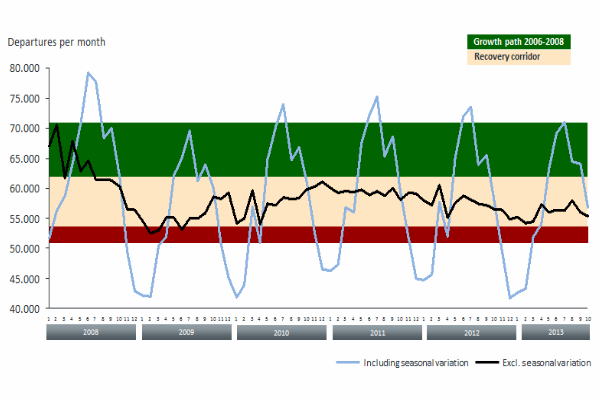
WINGX-October-2013 (1)October 2013 was the worst recorded month for European business aviation since October 2006, showing a 2.1% decrease in activity, according to WINGX Advance monthly report.

The number of Charter flights dropped by 3.5% year-on-year, which amounted to 800 fewer flights made on business jets than there were in October 2012.

There were a few regions that experienced growth; however, with Greece growing by 14% and Turkey growing by 3%, Italy reported a small increase, and Portugal the highest at 16%.

Richard Koe, managing director of WINGX Advance said, “The generally improving economic context in Europe is not yet feeding through to demand for business aviation.”

The Global Express from France’s Bombardier, was the most used aircraft, closely followed by the Citation CJ4, the King Air 350 and the Phenom 300.

More about GLOBALink Solutions from ARINCThe GLOBALink partnership between ARINC Asia-Pacific and Aeronautical Radio of Thailand (AEROTHAI) began back in 1998 when ARINC first sought to expand their data link presence in the region.

Now, the GLOBALink service stretches across 14 countries in Asia with AEROTHAI and both companies are now looking to the installation of their milestone 100th Remote Ground Station in the area at the end of this month.

GLOBALink data link coverage is a seamless, industry-leading service solution, used on a daily basis by 78 airlines and more than 3,000 aircraft in Asia.  The partnership have great plans to further expand into the new emerging markets such as Pakistan, Nepal, Vietnam, Bangladesh, Sri Lanka and the Maldives.

Very recently, the ARINC Company announced the installation of the 500th Remote Global Ground Station – a double celebration of sorts for ARINC Inc.

Solutions for Improved Data Security in AirportsIATA has announced a call to action for the aviation industry, regulators and governments across the world to reform aviation security through a partnership with a focus on a globally harmonised system.

Tony Tyler, Director General and CEO of IATA, while speaking at the 22nd AVISEC World Conference, held in Istanbul, said “Aviation security stands at a crossroads. Global passenger numbers will be approaching four billion per year by 2017, and the aging systems and outdated procedures of the current security system will not be able to cope. We need to change from prescriptive one-size-fits-all measures and embrace performance-based regulation if the economic benefits of aviation growth are not to be curtailed by security inefficiency.”

The move comes in direct support of the swift delivery of advance passenger information (API) to enable government departments and border security to screen passengers before they arrive on the ground at their destination.  High risk passengers can be identified and prevented from boarding the initial flight, or stopped from entering the destination country.

More than 45 states already operate API or PNR programs.  It is critical for the swift delivery of such information that the entire system is harmonised in line with ICAO regulation.  The issue of cost of collection of the vital information has yet to be finalised.

Mr Tyler went on to say, “Governments and industry can work together to make better use of the data collected. A good example is the checkpoint of the future initiative, which aims to improve the security and convenience of passenger screening by moving to a risk-based approach and adopting advanced technology. The flying public is eager to see the checkpoint of future deployed as quickly as possible. Stakeholders are aligned behind a staged implementation that will see the first versions in 2014. Subsequent stages will see us move from re-purposing equipment and using data more thoughtfully to the eventual deployment of new equipment in the final stage, around 2020.”