Archive

Tag Archives: airport operations

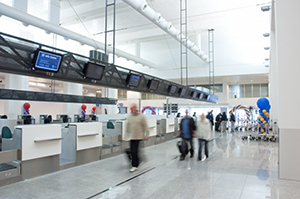
Passenger ProcessingStarting with Honolulu Airport, Hawaii say they are the first in the U.S. to move to completely automated self-baggage tagging with their new multi-airline check in kiosks.

Provided that Hawaiian passengers have self-printed boarding passes, they will be able to weigh, tag and check-in their baggage, leaving airport staff more time to assist passengers with oversized baggage or those with special needs.  This system will greatly reduce waiting time and streamline airport operations.

“Every minute saved in the check-in process improves our customers’ experience substantially, so this is a significant enhancement,” said Hawaiian’s Vice President for Customer Service Louis Saint-Cyr. “The kiosks reduced our customers’ check-in time to eight minutes. The ability to self-tag bags reduces the check-in time even further — by nearly half.”

There is a range of multi-airline check-in services out there, including the ARINC solution, vMUSE, and offering multi-airline check-in and bag drop facilities within an integrated suite of applications.  The vMUSE option maximises airport operations, eliminates the necessity for costly upgrades and gives smaller airports the flexibility of utilizing precious counter space.

ARINC offer interoperability with vMUSE solutions, using existing CUTE systems technology, allowing seamless operations for multi-airline check-in, self-printed boarding passes and bag drop facilities from an industry-leading, reliable provider.

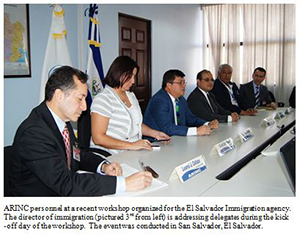
In Annapolis ARINC said it has started a series of workshops specialising on effective border security. These workshops are focusing on protecting borders from illicit activities, and have become a major concern for all nations. These situations have a significant impact on national security and immigration control. These workshops are starting in El Salvador and will roll out to ARINC’s entire customer base.

ARINC Conducting Border Security WorkshopsIn the course of these workshops, ARINC and its customers will discuss the positive results of implementing ARINC’s border security system, security trends, and share best practises and identify areas that can be improved. The courses are made up of senior officials and technical people from the various government agencies as well as airport operators, airlines and ground handlers.

Jorge Ramirez, Marketing Director of Global networks and IT Solutions for ARINC said ‘The ultimate goal of the workshops is to improve a country’s border security; these workshops are essential for our existing customers and ideal for countries in the process of evaluating effective border security solutions.’

34 of the 35 countries that have implemented border security systems ARINC is working with. ARINC’s complete portfolio in electronic borders uses its expertise gained in ARINC’s  aviation, governments, information technology, surface and maritime transportation and systems integration to deliver the most cost effective and efficient solution available.

ARINC will continue to provide and maintain the adaptable vMUSE™ platform for the Common Use Passenger Processing Systems (CUPPS). The long term relationship of ARINC and Munich began in 2003 and now to continue with ARINC’s CUPPS solution in MUC Terminal 2 until December 2014.

“We are impressed with the ARINC vMUSE platform and the support we have received over our long partnership. The ARINC team has regularly exceeded our agreed upon benchmarks and SLAs.” Said Marco Butz, Manager Technology and Infrastructure at Munich airport.

ARINC will continue to provide the premium on-site service and a centralized state-of-the-art firewall solution is due to follow during 2013. Tony Chapman ARINC Senior Director, Integrated Travel Solutions commented “We are delighted to continue working with one of our long-standing and valued customers, as we believe it reflects both the quality of our service and commitment to the highest standards of performance,” he continued “Munich Airport is focused on providing the best possible services for its customers, and ARINC’s technology helps make that achievable.”

Brussels Airport Passenger Processing

Brussels Airport Passenger Processing

ARINC announced that it has installed the new Passenger Processing System, with on-site maintenance and support at Brussels Airport in Belgium. ARINC installed its CUPPS-compliant vMUSE common use solution on nearly 500 workstations. ARINC’s AviNet global networking solution has also been fitted at the airport providing a secure WAN connectivity to the airlines’ host systems.

CUTE & Telecommunications Service Manager at Brussels Airport, Pierre Gehrenbeck Said “ARINC’s proven history of successfully migrating major airport sites to common-use passenger processing systems was a key factor in our selection decision. In addition, the efficient and cost-effective program is fully scalable to our airport and can be easily adapted to fit our projected growth”.

ARINC’s vMUSE platform maximizes the use of airport infrastructure through shared workstations, reducing the need for complex and expensive hardware systems, and a cost saving and rapid process. Supporting whichever application an airline has, the open design of vMUSE incorporates an easy integration with airline technology requirements.


Airport Systems for Border Security

Airport security technology has been in the news again this week with Lisbon Airport being the latest to install biometric eGates at Terminal 1.

The solution provides automated passenger checks for access to the departure lounge and has been chosen by Lisbon airport to enable faster and automated processing of passengers boarding passes in any format (paper, smartphone or PDA.

According to João Nunes, Director of Lisbon Airport: “This partnership allows ANA to offer the most advanced technologies in the implementation of self-service solutions for passengers in complete alignment with the IATA TRAVEL FAST program, which is also supported by the ACI.”

Automated passenger processing is being taken up by many airports around the world because of the increased demands being placed on resources to enforce ever tougher border security measures.

Electronic borders, airport systems and automated passenger processing systems are being offered by most suppliers but notable in the headlines have been ARINC with their electronic borders product achieving great praise.

Amsterdam Airport Schiphol provides one of Europe’s best reference sites for self-service bag drop and 12 units are in place in Departure Hall 2.

ICM Airport Technics has supplied its self-service baggage drop system to Qantas as part of the airline’s Next Generation Check-In programme.

ICM Airport Technics has supplied its self-service baggage drop system to Qantas as part of the airline’s Next Generation Check-In programme.

Amsterdam Airport Schiphol provides one of Europe’s best reference sites for self-service bag drop and this year, 6 new self-service bag drop systems were introduced in Departure Hall 2, taking the total number to 12. Among the latest airports to announce an intention to implement such systems is Bologna Airport, which is expected to complete the installation of 14 units by mid-2013. Aéroports de Paris has also successfully installed a system at Paris-Orly and will soon be extended to Paris-Charles de Gaulle.

The benefits of allowing passengers to take charge of the check-in and bag drop process themselves are clear. For the airline it means fewer agents are needed, passenger processing is faster and congestion around check-in desks is reduced. For the airport, it enhances the check-in capacity, reduces operational costs and allows for the optimisation of existing space. Airports and airlines need to decide whether to implement a one- or two-step solution. The first option allows the process of printing and attaching bag tags and depositing the bag into the system, completed in a single transaction. The second requires the passenger to print their bag tags at a self-service kiosk, before depositing their bag at a separate location.

As Vaessen explained, the implementation at Amsterdam Airport Schiphol makes use of the one-step process. “There were two main reasons for using one-step. The first was our home check-in passengers. More than 50% of our passengers check-in at home, so we didn’t want all of these to still have to go to a kiosk when they arrive at the airport and we simply wouldn’t have enough room for all of the kiosks. The one-step or two-step process depends very much on the infrastructure of the airport.”

The implementation by Qantas, ICM Airport Technics’ two-step solution is now operated across 8 airport terminals in Australia and London Heathrow a total of 84 units. Duncan Watson, Qantas Head of Global Marketing Operations uses the two-step process, explained that the process “maximises the available real estate for the airport departures concourse”. He added: “The two-stage process results in significant savings in both expenditure and footprint. It is better for the passenger to spend two minutes in Area A and subsequently 30 seconds in Area B, compared to two-and-a-half minutes in a single stage process.”

One product available for self service check-in is ARINC’s ExpressDropTM, the world’s first common bag drop application for passengers who have already checked in on the Web, at a self-service kiosk or on their mobile phone. For more details please visit the ARINC ExpressDropTMsite.