Archive

Monthly Archives: June 2014

spicejet 02-06India’s Directorate General of Civil Aviation (DCGA) has demanded all carriers to submit their financial statements by the deadline next week or face the cancellation of their aviation licences. The request is part of a program to ensure that loss-making carriers maintain standards in relation to safety and is not intended to be a financial audit.

The DGCA has raised concerns that airlines that have reported financial losses will compromise on safety due to a lack of funding, particularly following the recent escalation of competitive pricing within a so-called ‘airfare war’.

Notices have been issued to major Indian carriers, such as Air India (AI) and Jet Airways in addition to the low-cost carriers GoAir, SpiceJet and the only profit-making carrier, IndiGo.

An official representative from the DGCA said, “Many Indian carriers have ordered new planes, which we believe does not match with their financial performance. We also need to see how much is spent against different heads, on safety, engineering, infrastructure, salaries and other mandatory requirements. We just cannot take any chance now. We will be presenting our case to USFAA. We have to prove that we have put in some best practices.”

Civil Aviation Secretary, Ashok Lavasa said, “We keep giving directions to the DGCA. They have to ensure they do it in compliance with the law.”

Aircraft Tracking ProvidersFurther discussion are encouraged once again by Tony Tyler, Director General of the International Air Transport Association (IATA) to implement global flight tracking as three months pass since the disappearance of flight MH370. Many airlines simply do not want to wait for an industrywide solution to real-time tracking.

IATA plan to put aircraft tracking proposals to the UN’s International Civil Aviation Organisation (ICAO) in September and believe standards could be in place within two to three years. Some airlines, however, do not want to wait and are looking into making arrangements much sooner than that. Qatar Airlines, for example, hosted a recent meeting of IATA in Doha last week and said that the ‘technology to track planes is available today’, and cited the possibility of adapting the ACARS system as an example.

The adaptation of ACARS, which delivers information in short bursts, is a real possibility for airlines to ensure tracking information is consistent without incurring extensive retrofit costs; using equipment that is already installed in the aircraft.

Qatar Airlines are amongst many that are expressing a serious interest in exploring the possibilities for the provision of real time flight tracking.

CPDLC for SESAR InitiativeA demonstration project of Controller-Pilot Data Link Communications (CPDLC) launched under the Single European Sky ATM Research (SESAR) initiative has been completed this week across UK and Italian airspace with commercial flights operated by AirFrance, EasyJet and Scandinavian Airlines.

CPDLC will help to reduce pilot workload and improve safety by automating many routine cockpit tasks, in turn increasing air traffic management capacity in overcrowded airways. The system will supplement voice communications and will reduce communication errors, bridging language barriers and other challenges.

The project was completed over 95 flights and operated with a team of 30 air traffic controllers and resulted in initial findings that show involved parties are ‘increasingly confident about the use of data link communications (CPDLC) in most operational conditions where radio telephony messages can be replaced.’

In the US, under the FAA’s NextGen program, similar trials are taking place to evaluate the effectiveness and efficiency of air traffic controllers being given the ability to send flight procedural information and revised clearance messages via CPDLC directly to the aircraft avionics systems.

The SESAR Joint Undertaking initiative (SESAR JU) plan to deliver the final results of all trials in July, ahead of the mandatory changes early next year.

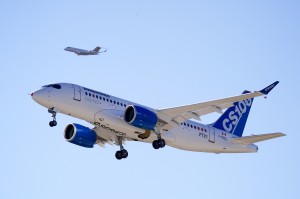
Bombardier 01-06-14According to the Wall St Journal, an incident during ground maintenance testing of the Bombardier C Series jet resulted in an uncontained engine failure and has grounded the jet until an investigation is completed. Although the engine and body of the aircraft were damaged, no personnel suffered any injury.

The geared Turbofan engine (PW1500G) from Pratt & Whitney features a new fuel-saving concept that sees different parts of the engine running at different speeds. The incident is likely to cause further delays to the program that is already behind schedule.

Pratt & Whitney now face a major setback commercially, with the engine currently holding more than 5,500 orders from Bombardier, Embraer and for the Airbus A320neo series.

The company were not available for comment.